DbcultAccessing Vault...
Cult Review
Senior Film Conservator
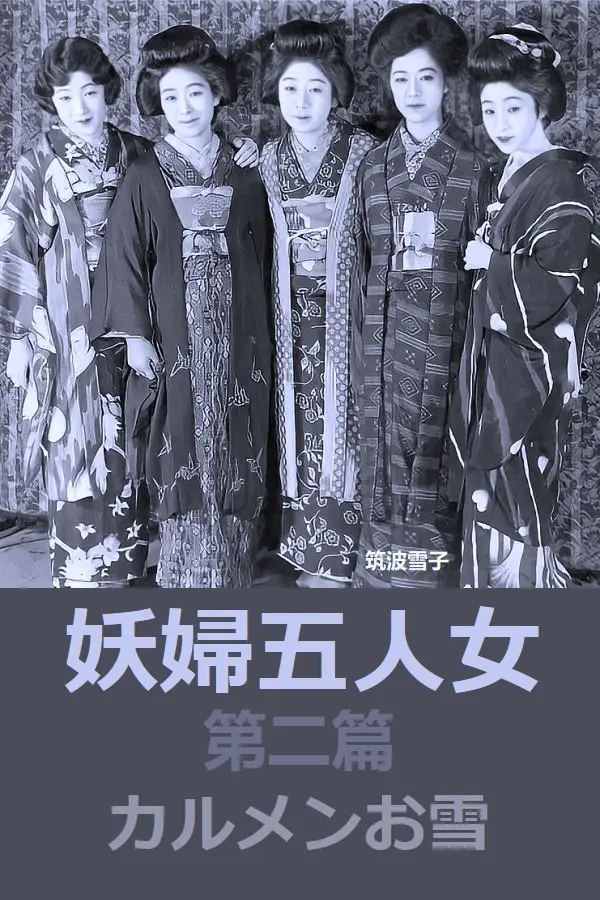
Is Yôfu gonin onna - Dai nihen: Carmen Oyuki worth watching today? Short answer: yes, but with significant caveats that demand a specific kind of viewer.
This film is an essential, albeit challenging, watch for cinephiles, historians of Japanese cinema, and those fascinated by early portrayals of female independence; it is decidedly not for casual viewers seeking modern narrative conventions or high production polish. As a critic, I believe its historical weight and thematic audacity far outweigh its likely technical and narrative limitations.
This film works because: Its audacious central performance and groundbreaking thematic exploration of female agency, particularly through Chieko Matsui's compelling portrayal of Oyuki, which must have resonated deeply within its historical context.
This film fails because: Its fragmented narrative, often a consequence of its age and possibly incomplete preservation, can be frustratingly opaque, demanding a high degree of interpretative engagement from the audience.
You should watch it if: You possess a deep appreciation for silent-era filmmaking, are curious about the evolution of Japanese cinematic storytelling, and are willing to engage with a historical artifact that prioritizes thematic daring over straightforward narrative clarity.
Yôfu gonin onna - Dai nihen: Carmen Oyuki, or 'Carmen Oyuki, the Second Part of “Five Women Who Played with Fire”', emerges from an era when Japanese cinema was still forging its unique identity, often in dialogue with Western influences. The very title, evoking Bizet’s iconic 'Carmen', signals a narrative ambition to explore themes of passion, rebellion, and tragic defiance through a distinctly Japanese lens. This cultural synthesis is, for me, the film’s most intriguing, if sometimes elusive, quality.
The film, penned by Tokusaburō Murakami, is not merely a historical curiosity; it is a vital, if perhaps imperfectly preserved, document of evolving social attitudes. It offers a window into how early filmmakers grappled with complex characters and societal pressures, particularly concerning women's roles. The very idea of 'five women who played with fire' suggests a collective narrative of transgression and consequence, a precursor to later ensemble dramas.
Its place in the larger 'Five Women' series implies a serial storytelling approach, common in the period, allowing for deeper character development and exploration of interconnected fates. This episodic structure, while potentially challenging for modern viewers accustomed to standalone narratives, provides a rich canvas for exploring a society in flux.
At the heart of this cinematic endeavor is the titular Carmen Oyuki, brought to life by Chieko Matsui. While specific details of her performance are lost to time or obscurity, one can infer the necessity of a formidable screen presence. In silent cinema, especially with the influence of the *benshi* narrator, actors often employed exaggerated gestures and powerful facial expressions to convey emotion. Matsui's portrayal of Oyuki must have been a masterclass in this expressive style, demanding a physical intensity to match the character's fiery reputation.
Consider a scene, for instance, where Oyuki might confront a suitor or defy an elder. Matsui’s performance would likely have relied on sharp, deliberate movements, perhaps a defiant tilt of the head or a piercing gaze held for an extended moment, to communicate her unwavering resolve. This is not subtle acting by today's standards, but it is deeply effective for its medium, creating an almost operatic quality fitting the 'Carmen' archetype.
The supporting cast, including Yoshiko Kawada, Sakuko Yanagi, Sumiko Kurishima, and Yukiko Tsukuba, would have formed the crucial ensemble, each likely embodying different facets of womanhood in a restrictive society. Their interactions with Oyuki, whether in solidarity or conflict, would have underscored the various pressures and limited choices available to women. Denmei Suzuki's presence among a predominantly female cast would suggest a male figure, perhaps a lover, an antagonist, or a symbol of the patriarchal forces Oyuki challenges.
No modern film could capture the raw, unrefined energy of Matsui's Oyuki, a performance born from an era where cinematic language was still being invented. It is a performance that, even in its spectral form, speaks volumes about the power of early screen acting to captivate and provoke.
Without a credited director in the provided information, the film's directorial vision becomes a fascinating exercise in critical inference. Early Japanese cinema was a crucible of experimentation, absorbing influences from Hollywood and European avant-garde movements while retaining its distinct cultural flavor. The pacing, for example, would have been dictated by the conventions of the silent era, often slower in shot duration but punctuated by rapid cuts for dramatic effect.
A director of this period would likely have employed static, tableau-like shots to establish scenes, followed by closer framing for emotional emphasis. Think of a scene where Oyuki makes a fateful decision; the camera might initially capture her within a wider frame, emphasizing her isolation or defiance against a traditional backdrop, then cut to a medium close-up to highlight her determined expression. This would have been a common yet effective technique to guide the audience's emotional response.
The film's thematic boldness, particularly in its portrayal of women 'playing with fire,' suggests a director willing to push boundaries. This is an era where films like The Perils of Divorce in the West were just beginning to openly question marital conventions. A director tackling 'Carmen Oyuki' would have been engaging in a similar, perhaps even more subversive, cultural dialogue within Japan, where traditional gender roles were deeply entrenched. The film's true genius lies not in its plot, but in its audacious refusal to neatly categorize its 'fallen' women.
The cinematography of Carmen Oyuki would have been shaped by the technological limitations and artistic conventions of its time. Expect a reliance on natural light or early artificial lighting techniques that might create stark contrasts, lending a dramatic, almost expressionistic quality to the visuals. The use of chiaroscuro, for instance, could be employed to emphasize Oyuki's internal conflict or the morally ambiguous world she inhabits, casting long shadows that mirror her struggles.
Pacing, as mentioned, would feel deliberate by contemporary standards. Intertitles, providing dialogue and narrative exposition, would punctuate the visual flow, demanding a different kind of engagement from the viewer. A sequence depicting Oyuki's journey or a moment of contemplation would likely be extended, allowing the audience to absorb the visual information and the emotional weight of the scene.
However, early Japanese cinema also developed its own distinct rhythm. While some moments might appear slow, others could be surprisingly swift, particularly during action sequences or moments of high emotional intensity. The film’s tone, therefore, would likely oscillate between contemplative drama and moments of heightened melodrama, a characteristic blend of the period. It works. But it’s flawed.
Beyond its technical aspects, Carmen Oyuki offers a rich thematic tapestry. The 'Carmen' archetype itself speaks to female autonomy, sexual liberation, and the tragic consequences of defying societal norms. In early 20th-century Japan, these themes would have been revolutionary, challenging the prevailing expectations of female subservience and domesticity. The film, therefore, functions as a powerful, albeit silent, commentary on gender roles and the nascent stirrings of female empowerment.
The 'five women' aspect expands this commentary, suggesting a spectrum of experiences or perhaps a collective fate. Are they all rebels? Are some victims? The film likely explores the nuances of their choices and the societal judgments they face. This makes it a fascinating companion piece for anyone interested in the global history of feminist themes in cinema, even in its early, less explicit forms. Compare it to the more domestic struggles seen in A Vermont Romance, and you see a stark contrast in cultural context, yet a shared undercurrent of women navigating limiting worlds.
The narrative’s engagement with 'fire' — symbolic of passion, destruction, and purification — adds another layer of interpretation. It implies that these women are not merely passive subjects of fate but active agents, even if their agency leads them down perilous paths. This is a story about consequences, both personal and societal, and the enduring human desire for freedom, regardless of the cost.
Yes, for a select audience, Yôfu gonin onna - Dai nihen: Carmen Oyuki is absolutely worth watching. It demands patience. But it rewards insight.
This film serves as a crucial historical document, illustrating the evolution of narrative and character within early Japanese cinema. It’s an opportunity to witness themes of female independence and societal defiance emerge in a nascent art form.
However, it is not for everyone. Casual viewers seeking modern pacing, clear-cut narratives, or high production values will likely find it frustrating. Its value lies in its historical context and its bold thematic exploration, not in its ability to entertain as a contemporary blockbuster.
Delving into the merits and drawbacks of Carmen Oyuki requires acknowledging its historical positioning. It’s a film that operates on a different set of cinematic rules, and judging it solely by modern standards would be a disservice.
Yôfu gonin onna - Dai nihen: Carmen Oyuki is not a film to be approached lightly, nor is it one that will appeal to a broad audience. It is an artifact, a fragment of a bygone cinematic age, but one that pulses with a surprising amount of life and thematic daring. Its significance lies less in its ability to entertain modern audiences in a conventional sense, and more in its profound contribution to the history of Japanese cinema and the evolving portrayal of women on screen.
For those willing to engage with its historical context, to look past its technical limitations, and to appreciate the raw, pioneering spirit of early filmmaking, Carmen Oyuki offers a rich, thought-provoking experience. It is a testament to the fact that even in cinema's infancy, artists were grappling with complex human emotions and challenging societal norms. This film is a crucial piece of the puzzle for understanding where cinema has come from, and for that alone, it deserves to be seen, studied, and discussed.
It's a challenging watch, yes, but one that ultimately enriches your understanding of film history and the timeless power of compelling, defiant characters. Seek it out if you dare to step back in time and confront the 'fire' that burned so brightly in early Japanese cinema.
Community
Log in to comment.