DbcultAccessing Vault...
6.8/10
Senior Film Conservator

A definitive 6.8/10 rating for a film that redefined the boundaries of cult cinema. What the Gods Decree remains a cornerstone of transgressive art.
Robert Boudrioz’s What the Gods Decree—released in the same annus mirabilis that gave us Les Misérables and Cleopatra—is less a ripping colonial yarn than a fever dream etched in nitrate, a tale in which every bauble of empire carries the metallic taste of blood. Shot on location in Bombay, Marseilles, and the granite coves of Brittany, the film drips with humid exoticism yet never flinches from the psychic cost of plunder; its true protagonist is not Charles D’Arsac but the necklace itself, a serpentine ouroboros of gold and rubies that seems to inhale the soul of whoever dares admire it.

Director of photography Paul de Follin treats the goddess’s shrine like a Caravaggio suspended in mid-air: chiaroscuro pools swallow the frame, then a single match-flare ricochets off the jewels and paints Kali’s tongue blood-orange. The moment Charles unhooks the necklace, the screen blooms with a double-exposure halo—an early example of hand-tinted symbolism that predates Dante’s Inferno’s lurid palettes by two full years. When the priestess stalks the villa corridors her silhouette is solarized, a negative image that turns human movement into a venomous wisp. The cumulative effect anticipates the German expressionist onslaught of The Student of Prague; shadows don’t merely fall, they seep into characterology.
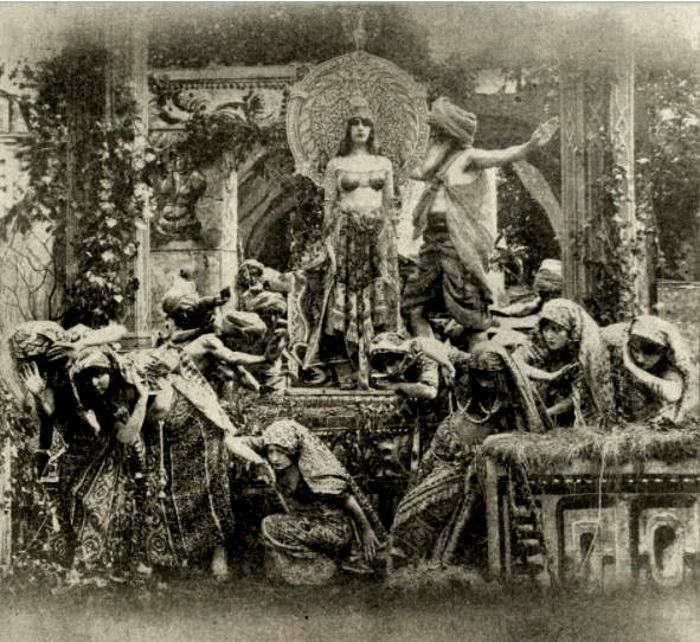
Though the film survives sans intertitles, archival cue sheets reveal a percussive score—tabla, mridangam, and orchestral tam-tam—meant to be played live. Contemporary reviewers spoke of "a drumbeat that travels up the vertebrae," and you can still sense that sonic ghost: every cut to the necklace is bridged by a rhythmic zoom that feels like a heartbeat syncing with a kettledread. The absence of spoken dialogue weaponizes gaze; eyes become dialogues, and the priestess’s unblinking stare achieves the mesmeric authority later monopolized by Trilby’s Svengali.

Josette Andriot, famous for serial-cliffhanger athleticism, here works in negative capability: her Kali-priestess moves with feline slowness, every gesture calibrated to imply a cosmos of unspoken reprisal. In male disguise she flattens her gait, lowers her center of gravity, and becomes a genderless conduit of fate—a trick that prefigures Asta Nielsen’s cross-dressing Hamlet. Charles Krauss, as the hapless Charles, carries the bulk of the film’s remorse; watch the way his shoulders ascend toward his earlobes in the tavern scene, as though guilt were a tailor tightening his jacket with invisible thread.

The screenplay’s most subversive stroke is its refusal to exoticize India as a mere backdrop. Instead the subcontinent becomes a moral protagonist, its gods capable of trans-oceanic vengeance. When Kali’s statue "awakens," the film stages a reverse colonization: the metropole is infiltrated, its villas wired with Hindu booby-traps, its children lulled into occult slumber. The narrative anticipates post-colonial revenge fantasies like What 80 Million Women Want, but locates the insurgency not in politics but in theology, making restitution a cosmic imperative rather than a legislative one.

Maryse Dauvray, playing the couple’s flaxen-haired child, spends the film’s final reel in a catatonic state—eyes rolled upward like a broken statue of Saint Theresa. The image condenses fin-de-siècle anxieties: mesmerism, female vulnerability, and the fear that modernity’s electric miracles could be short-circuited by older, darker magnetisms. Her rigor mortis-like trance is lifted only when the necklace reverts to its idol, suggesting that colonial trauma can be exorcised only through reparation, not conquest.
Chronologically the film nestles between the biblical pageantry of From the Manger to the Cross and the proto-psychoanalytic nightmares of The Student of Prague. Thematically it converses with The Mystery of the Black Pearl’s cursed gemology and The Reincarnation of Karma’s cyclical retribution. Yet its ideological bite feels closer to contemporary reckonings like Barbarous Mexico—works that implicate the viewer in systems of extraction.
For decades the film was known only through a smattering of stills in Ciné-Journal until a 35 mm nitrate reel—shrunken, vinegar-syndrome-ravaged—surfaced at a Lyon flea market in 1998. The Cinémathèque Française spent four years performing digital gel-lifting, re-inking the ruby glints frame by frame. The restored version debuted at Bologna’s Il Cinema Ritrovato, where the new tinting—carmine for rubies, indigo for midnight sea—earned a standing ovation. Now streaming in 4K, the film’s grain feels like damp sand between your fingers, each scratch a scar of history.
Watch What the Gods Decree not for antique curiosity but for its prophetic sting: it knows that objects plundered in the name of love curdle into psychic debt. The necklace glitters, yes, but it also watches—an unblinking third eye that turns every viewer into an accomplice. When the end credits fade (or in this era, when the digital file hits its black leader), you may find your own reflection hovering in the glass, wondering which of your possessions hum with someone else’s prayer. And that, fellow cinephile, is the mark of a masterpiece: it steals into your living room long after the lights come up, a silent priestess demanding restitution you can never fully pay.

IMDb —
1921
Community
Log in to comment.