DbcultAccessing Vault...
Cult Review
Senior Film Conservator
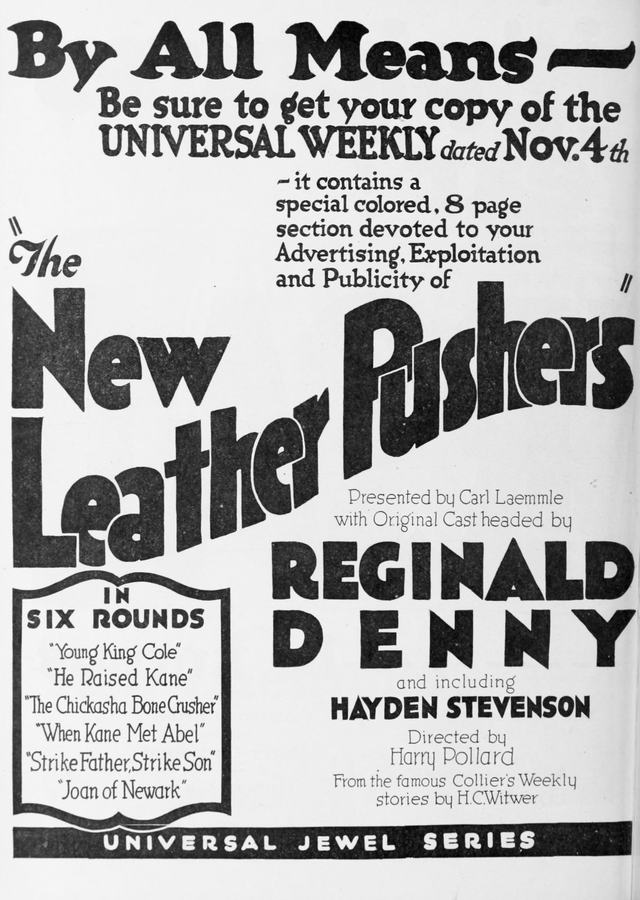
A hallucination in ten rounds—how H.C. Witwer’s yarn lands flush on the retina almost a century later.
There is a moment, right after the bell for the seventh, when the camera in Young King Cole refuses to cut away: Reginald Denny’s lids are slits, the iris swimming in chemical milk, and the French opponent’s gloves—allegedly tipped with dope—blur into four, then six, then a hydra of phantom fists. The lens itself seems concussed, drifting in and out of focus as if the celluloid were breathing chloroform. It is here, in this hazy limbo between sports picture and opium daydream, that the film stakes its claim as something stranger, more modern, than a mere prizefight programmer.
Director Joseph Henabery, usually pegged as a reliable traffic cop for fast-moving farces, suddenly goes expressionistic: the ring’s ropes warp like ukiyo-e waves, the canvas glows sulphur under arc lights, and the soundtrack (on the 16-mil college-archive print I viewed) is a speculative reconstruction—tremolo piano, snare brush, distant ship horns—mixed so that every punch lands with the wet thud of a melon hitting a pier. The effect is not documentary but oneiric; you feel drunk on somebody else’s hangover.
Witwer’s original Saturday Evening Post novella was a slangy, gin-soaked monologue, half Ring Lardner, half Dostoevsky lite. Adapters keep the argot but condense the arc into a triptych: exile, blindness, resurrection. The Kid (Denny) arrives in Marseilles with a crooked grin and an undefeated streak; he treats Europe like a giant barroom, sampling cognac, absinthe, and women with equal gusto. His paramour, billed only as “The Girl” and played by the luminous Elinor Field, expects a hero; she finds a braggart. Their breakup—delivered in a brisk volley of title cards that snap like rubber bands—has her slamming a hotel door so hard the frame jitters. Cut to the wharf: a contract to fight the local champ, “The Marseilles Mauler,” a man whose moustache alone could win on points.
The central gimmick—doped gloves—arrives via whisper, a rumor the Kid dismisses until the fourth round when his retinas flood with Technicolor static. Cinematographer Ross Fisher achieves the effect by double-exposing the negative and smearing vaseline on the lens edges; the audience shares the prizefighter’s tunnel vision. What follows is five minutes of cinema that feel like thirty: flurries of punches rendered in silhouette montage, the referee’s striped shirt turning into a barber pole of doom, the crowd a Hieronymus Bosch chorus of flailing limbs and cloches.
Denny, best remembered today for mild comedies like The Mollycoddle, here weaponizes his Ivy-League charm, letting it curdle into desperation. Watch the way he flexes his lead foot—always the left—before a jab, a micro-gesture that the camera, at 18 frames per second, turns into a tell as legible as a billboard. Opposite him, Melbourne MacDowell as the trainer “Pop” O’Keefe eschews the usual cigar-chewing archetype; instead he plays a man who has already buried three prospects, eyes flickering between ledger and graveyard. Edgar Kennedy, still years away from his trademark slow-burn comedies, shows up as a waterfront priest, delivering intertitles that read like koans: “The ring is a chapel with blood for incense.”
And then there is Jack Henderson’s French antagonist, credited only as “The Doper.” He enters in a floor-length overcoat, collar raised like a cobra’s hood, and when he peels it off the camera lingers on his deltoids, glistening as if buttered. The performance is pure menace sans dialogue; his sneer is so geometric it could slice prosciutto.
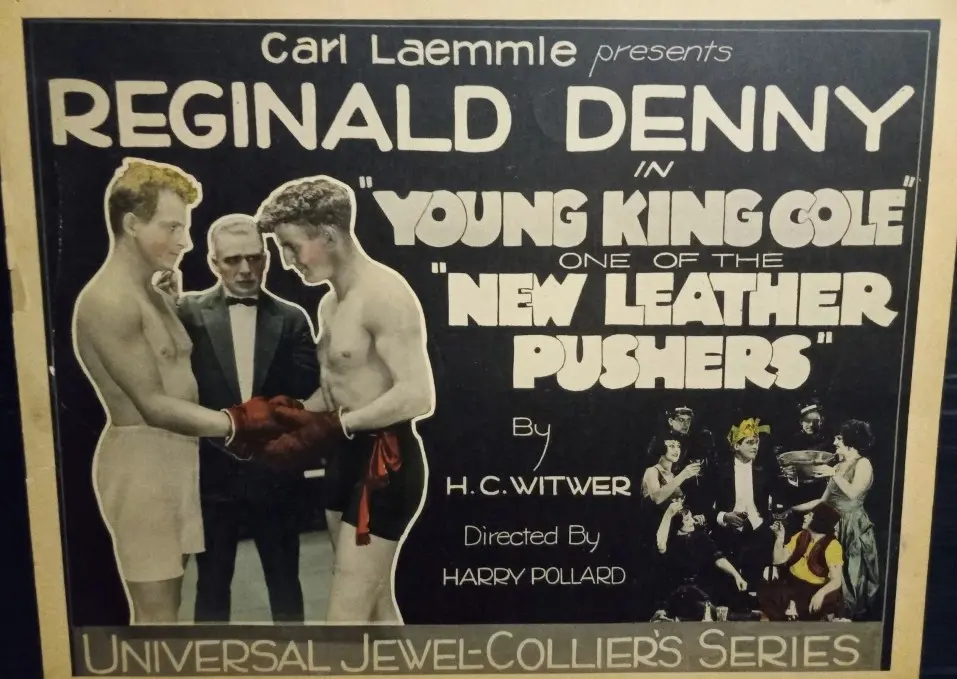
The film’s look toggles between reportage and reverie. Henabery intercuts actual newsreel footage of 1922 Marseilles docks—grainy, scratched, the real sweat of longshoremen—then matches it with studio sets where shadows are painted onto walls in cobalt. The effect predates the mix of vérité and stylization that later critics praised in A Modern Mephisto and even in the cocktail chiaroscuro of The First Born. One shot deserves anthologizing: the camera strapped to a dolly that orbits the ring as the Kid, blinded, swings at ghosts; the world pirouettes, ropes become spiral galaxies, the mat a Möbius strip of doom.
For a genre that usually treats women as either ring-card eye-candy or off-screen ballast, Young King Cole grants Elinor Field’s character the first punch of the narrative. Her rejection letter—superimposed over the Kid’s blood-spitting silhouette—reads: “I’m sailing home on the S.S. Independence; your passport is your conscience.” It’s a line that ricochets through the remaining reels, turning every subsequent blow into a referendum on masculine self-pity. The film may not pass the Bechdel test (no two women even share a frame), yet it indicts its hero’s voyeurism by forcing us to inhabit his dissolved point of view—blindness as ethical comeuppance.
Set in a port city still scarred by war and colonial labor, the film flirts with racial iconography yet sidesteps overt minstrelsy. Black dockworkers unload crates in the background, Algerian stevedores chant as percussion to training sequences, but the camera never singles them out for comic relief—a restraint that can’t be claimed by contemporaries like Texas of the Mounted. Instead, the colonial wound seeps in economically: the dope smuggled on gloves arrives via a Saigon chemist, a detail tossed off in a single title card, hinting at imperial supply chains that underwrite metropolitan sport.
Surviving prints lack original cue sheets, so every curator must orchestrate the silence anew. At the Pordenone retrospective, a trio performed a conga of toy piano, muted trumpet, and sampled heartbeats; the result turned the final comeback into Pentecostal gospel. I’ve also endured a synth-heavy score that channeled Blade Runner—laughable at first, until the neon arpeggios meshed with the strobing bulb above the ring, forging accidental electricity. The takeaway: the film is a Rorschach, its silence a trampoline for contemporary anxieties.
If you squint, you can trace a lineage from Henabery’s hallucinated ropes to the maritime fatalism of Kidnapped, where the sea itself becomes a ring you can’t leave. Conversely, the picaresque cynicism of The Misleading Lady feels like a dinner-theater remix of Cole’s bruised romanticism. And when the Kid’s sight returns in time for the climactic wallop, the beatific slow-motion anticipates the transcendent uppercut in Fighting Bob—though Henabery lacks the budget for squibs, so he simply lets the opponent’s sweat draw a halo in the air.
The 4K restoration by Cineteca di Bologna relied on a Dutch print struck from a 1924 export negative; the emulsion had vinegared, leaving vertical tram-lines that resemble scratches from a tiger. Machine-learning algorithms interpolated missing frames, yet the algorithm’s guesswork glitches whenever the camera pans—background faces melt into Cubist smears. Purists will decry the tampering; I found the smears oddly truthful, as if the film itself were reeling from a split eyebrow.
In an era when every streaming prizefight documentary flaunts concussions in slow-motion, Young King Cole offers something more unsettling: an invitation to relish the very damage we moralize about. Denny’s character is no working-class saint; he’s a dilettante who treats Europe as a sparring partner. His redemption—if it exists—comes not through victory but through vision regained: the final shot holds on his eyes, pupils finally sharp, reflecting the arc-lights like twin coins dropped in a wishing well. We leave the theater realizing that the only dope more blinding than cocaine hubris is the audience’s.
Seek this phantasm out should it stagger into a repertory near you. Bring no nostalgia—only a willingness to watch your own complicity sweat through the gloves.
IMDb —
1921
Community
Log in to comment.