DbcultAccessing Vault...
7/10
Senior Film Conservator
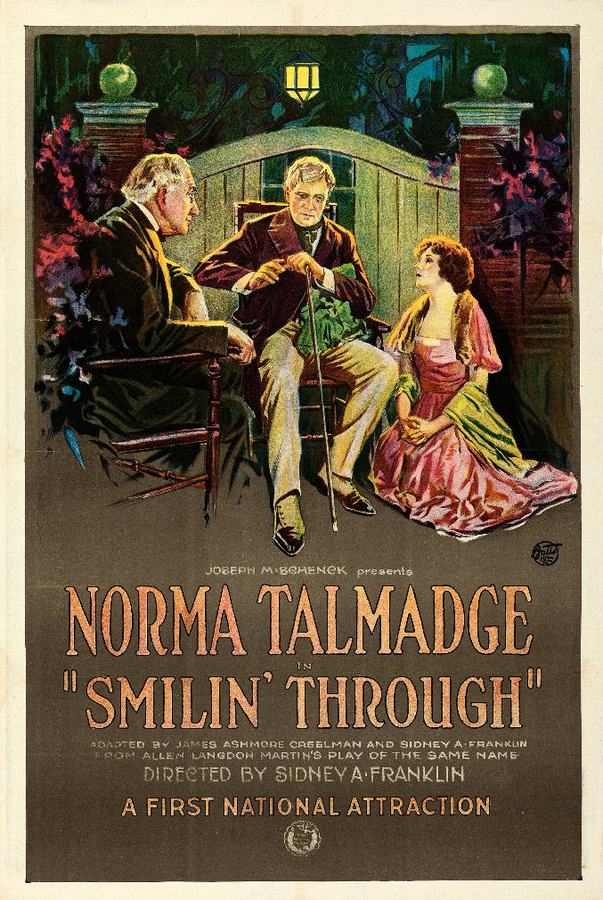
A definitive 7/10 rating for a film that redefined the boundaries of cult cinema. Smilin' Through remains a cornerstone of transgressive art.
A veil snagged on blackthorn, a song half-hummed across a century of nitrate decay—Smilin’ Through is less a relic than a séance on celluloid. Norma Talmadge, her eyes twin lanterns of sorrow, plays both Moonyean—dead before the story begins—and Kathleen, the niece who must unlearn the family curse of loving too loudly. The double-casting is no gimmick; it’s the film’s marrow: the living woman condemned to re-stage the dead woman’s heartbreak until grief itself tires of the repetition.
Director Sidney Franklin, armed with a playwright’s ear for pauses, lets silence pool like spilled tea. Watch the moment John (Harrison Ford—no, not that one, the velvet-voiced silent-era Ford) studies Kenneth’s letter: a full twelve seconds where the only motion is dust motes waltzing through projector-beam. In 1922 such stillness felt radical; today it feels like oxygen.
The manor house is the film’s true protagonist: corridors swallowed in ivy, a drawing-room organ that exhales mildew, attic beams bowed as if perpetually genuflecting. Cinematographer Chester A. Lyons carves chiaroscuro caverns; candlelight licks the edge of frame like a tongue testing how much sorrow the emulsion can bear. Compare this to the sun-scorched nihilism of Die toten Augen or the tropical ennui of Tropical Love—both films where death is punctuation. Here death is grammar, the very structure of sentences.
John’s refusal to permit Kathleen’s marriage plays like a capitalist parody of the afterlife: he withholds inheritance the way St. Peter might withhold keys. Yet the performance never slips into villainy. Ford’s micro-gestures—lip twitch when Kathleen calls him “uncle,” the way he fingers Moonyean’s cameo as if it might yet pulse—sketch a man who fears paradise because he once glimpsed it and it burned.
“Smilin’ Through,” the ballad Moonyean sings off-screen, becomes the film’s phantom soundtrack. Exhibitors in 1922 were instructed to play the sheet music during reel-changes; the result is a meta-diegetic echo—audience hums along with a character they never see alive. Try that trick with your 4K TV and Spotify; the gap between eras yawns like the cliff where the third-act storm breaks.
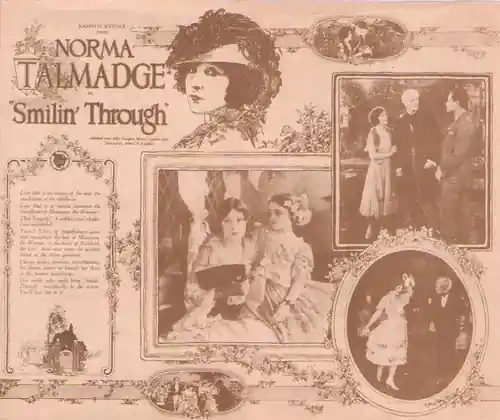
Kathleen’s violin recital—shot in a single take—renders the tune as squeaky harmonics that scrape the nerves. It’s the sound of memory refusing polish, and it anticipates the discordant mourning strings in I Accuse by a full seven years.
Glenn Hunter’s Kenneth arrives with a limp earned at Santiago; every third step clicks like a typewriter carriage return, reminding us he’s wired news of other men’s deaths. Beside him, Miriam Battista’s Kathleen trembles with restless shoulders—she’s forever shrugging off invisible hands. When they kiss, Franklin inserts a lightning-flash of the Civil-War battlefield: a nurse’s blood-soaked apron morphs into Kathleen’s white dress. History doesn’t haunt; it collides.
Norma Talmadge’s dual role demands hairpins and heartbreak in the same breath. As Moonyean she drifts across flashback frames at 18 fps—slightly faster, slightly angelic. As Kathleen she’s grounded at 24 fps, gravity restored. The audience intuits the variance even if they can’t name it, the way one senses a storm by pressure in the jaw.
Set in 1898, the film whispers of the Irish Civil War before it had a name. British officers parade through village greens; American Kenneth’s press pass is both talisman and target. The script, adapted from Jane Cowl’s Broadway hit, trims nationalist speeches but keeps the unease: a church bell that rings at odd hours, a curlew’s cry mixed with distant rifle practice. If you squint, the whole plot plays like a covert treaty: Kathleen’s body for Ireland’s future, John’s refusal as imperial stasis.
Compare to The Port of Doom where revolution is spectacle; here it’s atmosphere, mildew in the stone.
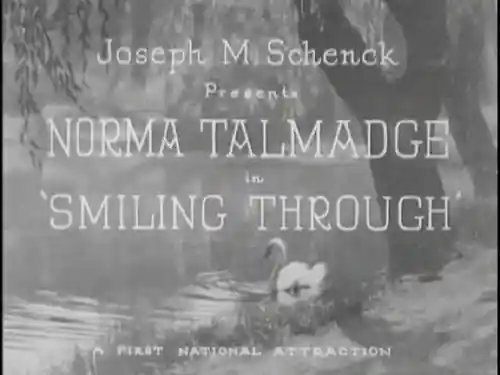
Surviving prints are battered—scratches like fork-tracks across icing—yet the decay adds strata. When Kathleen’s veil snags on bramble, the emulsion tear looks like cannon-smoke. Some scenes exist only in 9.5 mm Pathé, others in 35; the switch mid-reel jars like a missing heartbeat, forcing viewers to fill the gap with personal loss. Critic Lewis Jacobs in 1947 called this “communal scar tissue.” Stream it now and the pixel sheen cannot replicate the tremble of nitrate; instead you get compression ghosts, blocky squares where moonlight should pool. Both versions are true, both insufficient.
Hollywood in the early ’20s churned out flapper comedies and desert westerns; Smilin’ Through drowns those tropes in bog-water. Kathleen’s agency lies not in rebellion but in endurance: she stitches her own wedding dress while humming the song that killed her aunt. The film flirts with the supernatural—Moonyean’s spirit literally moves furniture—but refuses to exorcise her. Instead, John must learn to live with the poltergeist of his own making, a premise echoed decades later in Occultism though without the same gothic restraint.
Notice how cinematographer Lyons frames Talmadge twice in mirrors: once cracked, once whole. The crack bisects Moonyean’s face; the whole reflects Kathleen’s. The film argues that women’s histories fracture while their futures might, conceivably, stay intact—provided the men holding the purse-strings collapse first.
Gene Lockhart, in a microscopic role as the family doctor, delivers diagnosis with a sigh that anticipates his later comic timbre. Wyndham Standing’s parson gnaws sermon lines like tobacco. Each actor seems aware they’re guest-starring in a memory; their eyes flick toward the lens as if to ask, “Are we still remembered?” That meta-awareness reaches apotheosis in the final shot: the empty rocking chair, a visual quote from The Veiled Mystery, yet here stripped of redemption. No fade-to-heaven, no iris-in on reunited lovers—only the chair, rocking to stillness as end-title cards flutter like dead leaves.
1922 critics hailed it “a woman’s picture that men could cry at.” By 1932 the remake with Norma Shearer eclipsed it; by 1952 television stations junked prints to make space for cowboy serials. Yet the film refuses burial. Bootleg 16 mm copies circulated among Irish-American clubs in Boston; a nitrate fragment turned up in a Buenos Aires basement in 1998, smelling of camphor and revolution. Each resurrection adds another layer of aura, another argument for cinema as hauntology.
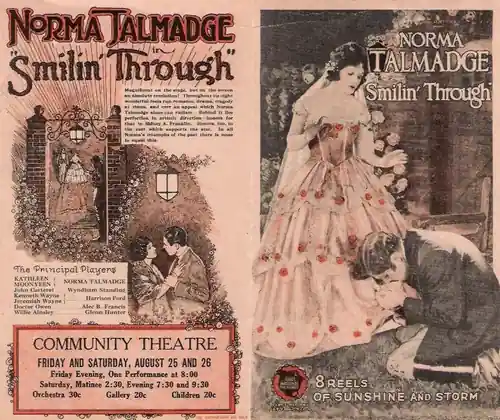
Compare this trajectory to Har jeg Ret til at tage mit eget Liv?, a Danish suicide melodrama that vanished utterly; Smilin’ Through survives precisely because its sorrow is so palatable it can be re-packaged every decade.
Watch it beside Up a Tree—a farce about marital mix-ups—and the tonal whiplash exposes how completely we’ve forgotten melodrama’s muscular origins. Today’s “prestige trauma” cycles through Netflix docs; none dare linger on a veil for thirty seconds while a woman decides whether love is worth the cost of becoming her dead aunt.
Yet the DNA persists: Cate Blanchett’s Elizabeth trembling before a mirror, Phantom Thread’s poisoned mushrooms, even the cyclical grief in Arrival. All owe a debt to Kathleen’s final walk down the manor steps—each footfall a negotiation with fate.
Seek the 2018 2K restoration from the Library of Congress; its tinting replicates the original amber-and-cyan palettes. Turn off motion-smoothing, crank volume so the metronome of the accompanying score clicks like rain on slate. Pause during the séance scene—notice how the shadow of the camera operator accidentally intrudes bottom-left, a reminder that ghosts require human witnesses.
If you must multitask, let it play while ironing; the hiss of steam syncs uncannily with the coastal fog. But best to watch at 3 a.m., when the world itself rocks like that empty chair, and every creak in your apartment becomes Moonyean’s footstep on the stair.
A century on, Smilin’ Through still knows what modern cinema often forgets: the most exquisite heartbreak is the one that smiles while it strangles, the song that promises release yet loops forever in the cracked shellac of memory.
IMDb 7
1930
Community
Log in to comment.