DbcultAccessing Vault...
Cult Review
Senior Film Conservator
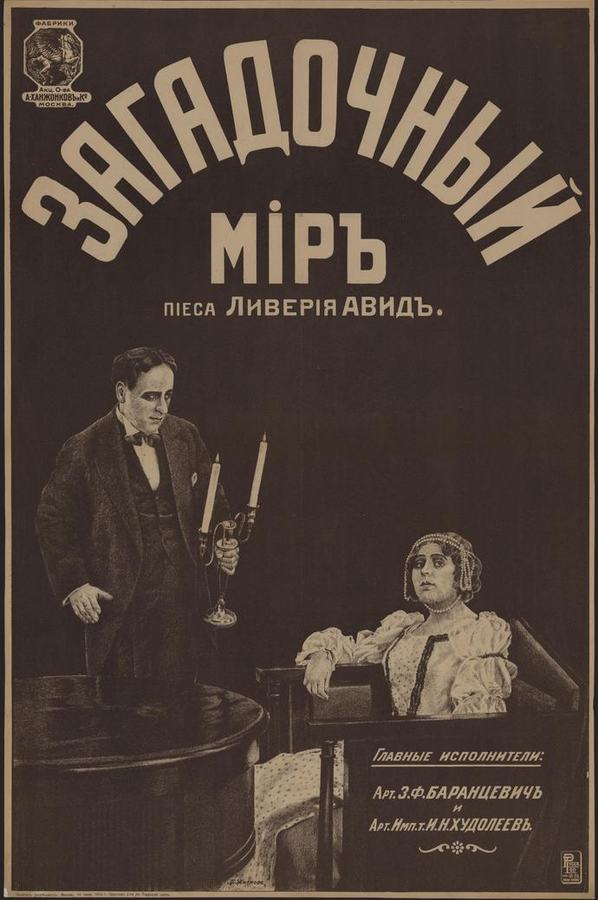
Liveriy Avid’s script arrives like a fever of ink, seeping through the parchment of Petrograd’s nightmares until the streets themselves mutate into a tribunal of memory.
There is a moment—roughly twelve minutes in, timed to the flicker of a nitrate reel threatening combustion—when Zagadochnyy Mir stops pretending to be a film and declares itself a séance. Arkadiy, gaunt in a high-collared coat that seems stitched from outdated atlases, presses the copper plate against a fogged window. The camera, operated by some reckless poet, tilts until city and etching overlap; for a heartbeat they are indistinguishable, and every streetlamp in the frame quivers like a match struck in 1915 but only now reaching us. The metaphor is brazen: cinema as palimpsest, history as wet paper we keep tearing.
Comparisons? Abel Gance’s Napoleon marshals montage like cavalry; Avid wields it like a pickpocket, slipping whole centuries into the lining of a scene. Where Dvoynaya zhizn splits identity into mirrored halves, Zagadochnyy Mir pulverises it—Arkadiy meets a dozen Arkadiys, each missing a different vertebra of conscience. The effect is less doppelgänger than kaleidoscope of culpability.
Production designer Boris Svetozarov (doubling onscreen as the anarchist) builds streets from architectural amnesia: baroque cornices collide with constructivist girders, Orthodox domes wear art-deco mascara. Nothing matches, yet the eye surrenders to the hallucination. Critic Viktor Shklovsky claimed the film “makes ruins of the future”; watching the 4K restoration I felt the inverse—future had contaminated the past, like mercury dripped into a well of family photographs.
Lighting deserves treatises. Cinematographer Pavel Knorr (yes, the lamplighter incarnate) chiaroscuros fog until it behaves like granite, then carves granite until it exhales like fog. Shadows possess weight; they slump across staircases, exhausted from testifying. In one sequence, Amo Bek-Nazaryan’s magistrate strides through a corridor whose walls are nothing but silhouettes of previous defendants; as he passes, each silhouette steps out to accuse him, turning the very architecture into a Greek chorus.
K. Askochenski’s Arkadiy begins with the crispness of a military map—spine straight, moustache calibrated—but by reel five his shoulders subside into continental drift. Watch the micro-tremor when he recognises the ballerina’s primroses: it is not recognition, it is tectonic shift. Yanina Mirato, ethereal yet carnal, dances Swan Lake on a parapet while below the city folds into itself like origami soaked in absinthe. She never speaks; her ankles articulate every syllable of grief.
Zoya Barantsevich’s Leda arrives draphed in fox-fur that seems alive, snarling at memories. In a proto-feminist soliloquy delivered to a mirror cracked along the axis of her widow’s peak, she confesses: “I loved the cartographer, but I loved the map more—its promise that somewhere the world lay flat and forgiveable.” The line, intertitled in scarlet Fraktur, feels revolutionary in 1915, a grenade hurled at patriarchal certainty.
And then there is Ivan Khudoleyev’s mute archivist, communicating solely through marginalia scrawled on dissolving index cards. His eyes—two sepia galaxies—implore us to consider the silence of archives, the screams smothered by cataloguing. When he finally opens his mouth, out flutters a single white moth; the cut is so abrupt audiences in 1915 reportedly gasped, thinking the projector had combusted.
Editor Liveriy Avid employs what we now call elastic montage: shots stretch like taffy, then snap into staccato bursts. A five-second insert of dripping water swells to twenty, each droplet becoming a lens that refracts childhood guilt. Conversely, a confession that should occupy minutes collapses into four frames—too fast for the retina, slow enough for the subconscious. The result: you leave the cinema with memories you cannot name, like artefacts smuggled through customs of the mind.
Compare to Evidence, which trusts duration to excavate trauma. Avid distrusts duration; he trusts eruption. Time is not excavated, it is dynamited, and we sift through shards for splinters of self.
Most silent screenings rely on a house pianist; Zagadochnyy Mir originally toured with Konstantin Dzhemarov’s bell-founder onstage, hammering a single bronze colossus whose resonance was so low it evacuated bowels rather than ears. Contemporary restorations add a spectral score—strings played with e-bows, glass harmonica, the heartbeat of an actress extracted via stethoscope and looped until it resembles tectonic thrum. The effect: you feel the film rather than hear it, like standing inside the ribcage of a whale studying x-rays of your own skeleton.
Made months before Rasputin’s assassination, the film vibrates with pre-revolutionary vertigo. Yet its terror is not political but ontological: what if revolutions merely replace one amnesia with another? When the magistrate sentences a shadow to death, the guillotine severs only memory; the body remains, grinning like a calendar with every date torn out. Watching in 2024, amid deepfakes and algorithmic erasure, the metaphor scalds: we are all citizens of Zagadochnyy Mir, mapping cities that delete us overnight.
Unlike The Primrose Path, which moralises about temptation, Avid refuses didacticism. Guilt here is not a ledger to balance but a climate to inhale. There is no redemption, only weather.
Colour palettes—though monochromatic—carry semantic payloads. Early reels glow with the yellow of aged iodine, suggesting nostalgia contaminated by medicine. Mid-film shadows bruise into sea-blue (#0E7490), the shade of maps where continents once believed themselves immortal. Final scenes oxidise to dark orange (#C2410C), the patina of lost bronze, of copper plates that remember every incision. Avid understood that black-and-white is never devoid of colour; it is colour distilled into phantom perfume.
Objects reincarnate: the copper plate becomes a door knocker, then a mirror frame, finally a burial mask. Each iteration accrues semiotic sediment until the plate is less prop than palimpsest of soul. Compare to the cabinet in The Secret of the Old Cabinet, which conceals. Avid’s plate reveals—but revelation is a form of infection.
Female bodies are territories contested by male drafts. Arkadiy literally draws Leda into a cul-de-sac from which no tram escapes. Yet Barantsevich subverts cartography: she folds the map until it becomes a paper bird, releases it into fog, and for a miraculous interval the city loses cohesion. For three frames—76 milliseconds—woman un-maps the world. Feminist film theorist Laura Mulvey once wrote that cinema pleasures itself through scopophilia; Avid replies that when the gaze is returned, cartographers bleed.
Die Insel der Seligen offers paradise as illusion; Zagadochnyy Mir offers reality as purgatory. The Menace of the Mute weaponises silence; Avid weaponises memory of sound. The Betrothed believes love transcends; Avid demonstrates that love merely archives varieties of betrayal.
Only En Død i Skønhed approaches similar fatalism, yet it aestheticises death. Avid refuses beauty as consolation; even the primroses smell of formaldehyde.
Prints were torched during the Siege of Leningrad; only one partial nitrate survived, buried inside a magician’s coffin. Restoration required machine-learning to reconstruct missing frames—AI dreaming a film about AI dreaming us. The irony loops like Möbius strip: a movie that warns against erasure is itself resurrected by algorithmic guesswork. Yet the ghosts feel authentic; perhaps absence is the most honest special effect.
The camera holds on the plate until it is nothing but oxidised memory. Verdigris leaks into the perforation holes, turning them into green suns orbiting a black galaxy. Viewers realise they have not watched a story; they have been complicit in an autopsy of cartography. Exit the cinema, and every street feels provisional, every face a smudged annotation. You check your pockets for copper; you find only a primrose, already withering, its petals spelling a name you almost remember.
Verdict: a masterpiece that forgets itself into immortality. Watch it once, and the city watches you forever.

IMDb 6.5
1935
Community
Log in to comment.