DbcultAccessing Vault...
7.4/10
Senior Film Conservator
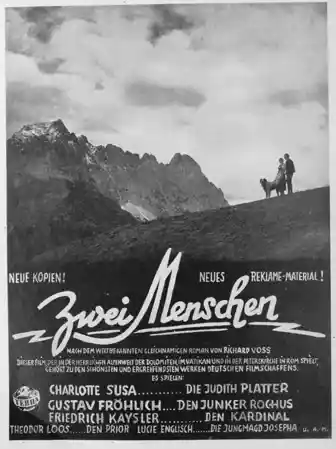
A definitive 7.4/10 rating for a film that redefined the boundaries of cult cinema. Zwei Menschen remains a cornerstone of transgressive art.
Okay, so Zwei Menschen from 1930. Is it worth tracking down? Look, it's not a casual Friday night watch. If you're into really early German dramas, especially ones with a heavy dose of spiritual struggle and beautiful old scenery, you might find something here. But for most folks expecting anything like modern pacing or storytelling, this one's probably a miss. It's definitely not for the easily bored or anyone looking for a happy ending. 😬
The whole thing plays out high in the Tyrolean Alps. You get these lovely, stark shots of mountains and valleys, all very scenic for the time. It really makes you feel the isolation, the quiet life up there. The landscape itself feels like another character, almost, a constant, imposing presence.
Our main guy, Thomas (Gustav Fröhlich), he's just trying to live his life. He's got his sweetheart, Augustina (Charlotte Susa), and for a while, things seem fine. They share these gentle, almost shy moments that hint at a deep, simple affection.
Then there's his mother, played by Hermine Sterler, and she's… well, she's a force of nature. Her devotion is fierce, almost scary in its intensity. She’s got this unwavering belief that Thomas needs to give his life to God, to become a priest. It’s not a gentle suggestion; it’s a constant, *intense* pressure. You can see it in her eyes, this burning conviction. It’s truly something. 👀
There's this one scene where she’s praying, and the camera just holds on her face for what feels like ages. It’s a real masterclass in early film acting, honestly. You can almost feel the weight of her conviction pressing down on everything, on everyone. It’s quite effective, even if it feels a touch long by today's standards. That kind of lingering shot, it tells you a lot about the film's priorities.
Thomas, he’s absolutely caught in the middle. He loves Augustina; you can feel that genuine, if understated, connection in their quieter scenes together. It’s a normal, human bond that feels so incredibly fragile against the sheer force of his mother’s spiritual demands.
The film really leans into this internal tug-of-war. Gustav Fröhlich has to do a lot with his expressions, as dialogue in these early sound films could be a bit stiff, sometimes even a little stilted. He manages to convey a good deal of his torment just through how he carries himself, the way his eyes shift. You really believe he's struggling.
Things take a turn, of course. His mother, in her fanatic zeal, she ends up dying trying to convince him to make this ultimate sacrifice. It’s a pretty dramatic moment, filmed with a sort of stark simplicity that makes it hit hard. The landscape, again, feels like it’s witnessing this profound, personal tragedy.
After that, Thomas's path seems set, but it’s a *heavy* one. He heads off to become a priest. The movie doesn't rush this part at all. It really lets you sit

IMDb 5.5
1936
Community
Log in to comment.