
DbcultAccessing Vault...
Director's Spotlight
Senior Film Conservator
Director's Spotlight: United States
A Deep Dive into the 1918 Vision of Donald C. Thompson
The thematic gravity of The German Curse in Russia (1918) is rooted in the historical context that Donald C. Thompson weaves into the cult fabric. Synthesizing the best elements of United States and international cinema, it highlights the importance of independent voices in United States.
In The German Curse in Russia, Donald C. Thompson pushes the boundaries of conventional narrative. The film's unique approach to its subject matter has sparked endless debates and interpretations among cinephiles and critics alike.
The visual language of The German Curse in Russia is defined by its use of shadows and framing, a hallmark of Donald C. Thompson's style. By utilizing a 1918-era palette, the film creates an immersive experience that perfectly complements its cult themes.
| Cinematography | Noir-Inspired |
| Soundtrack | Synth-Heavy |
| Editing | Rhythmic |
| Art Direction | Naturalist |
Visualizing the convergence of Donald C. Thompson's style and the core cult narrative.
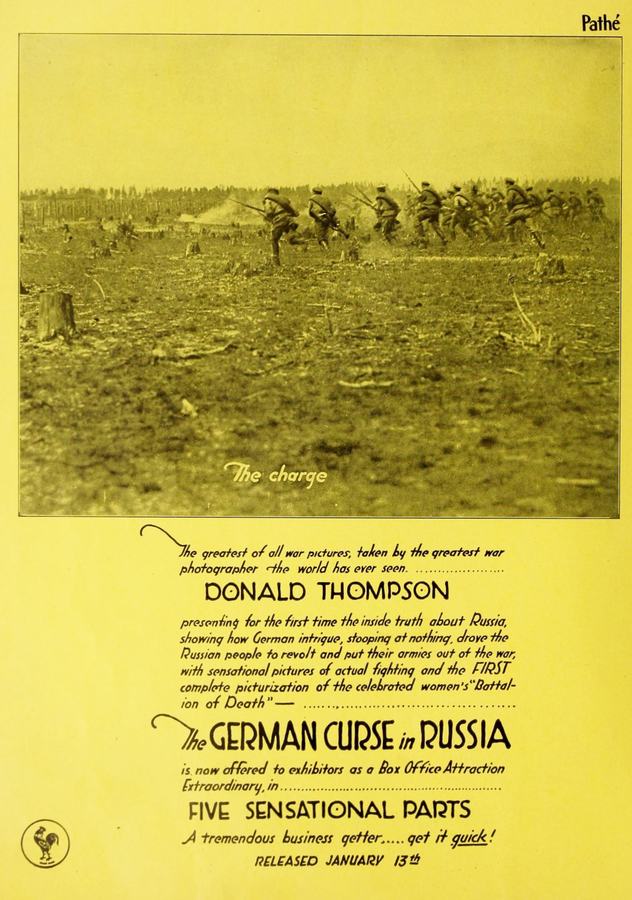
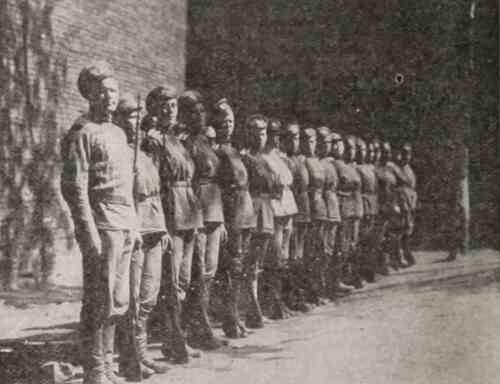
Events in Russia from August 1914 until the revolution of 1917 are shown. Subtitles relate that German treachery was responsible for food riots, street fighting, overcrowded hospitals, shortages of war materials and surgical necessities, and the overthrow of the Kerensky government. Scenes include a sea battle in which 14 boats in the Turkish fleet and a German U-boat are destroyed by Russia's Black Sea Fleet; battle scenes on the Dvinski front; a gas attack; a machine-gun attack that virtually wipes out a Russian detachment sent "over the top"; loyal Cossack troops in the Carpathian mountains; Czar Nicholas II and Grand Duke Nicholas conversing; wounded in hospitals; the Duma and the Council of Workmen and Soldiers in session; Nikolai Lenin speaking in the streets of Petrograd; Leon Trotsky; the attack on the Duma; a march of 15,000 anarchists; Alexander Kerensky, Elihu Root, and Root's American commission; David R. Francis, U.S. Ambassador to Russia; and Mrs. Emmaline Parkhurst, an English suffragette and her daughter Christabel meeting Mme. Yasha Bochkareva, leader of the women's "Battalion of Death," who are seen in battle.
Decades after its release, The German Curse in Russia remains a vital piece of the cinematic puzzle. Its influence can be seen in countless modern works, solidifying Donald C. Thompson's status as a master of the craft in United States and beyond.