
DbcultAccessing Vault...
Director's Spotlight
Senior Film Conservator
Director's Spotlight: United States
A Deep Dive into the 1915 Vision of Fred E. Wright
Peeling back the layers of Fred E. Wright's In the Palace of the King exposes the technical innovation that Fred E. Wright introduced to the cult format. Driven by an uncompromising commitment to cult excellence, it stands as the definitive 1915 statement on cult identity.
In In the Palace of the King, Fred E. Wright pushes the boundaries of conventional narrative. The film's unique approach to its subject matter has sparked endless debates and interpretations among cinephiles and critics alike.
To fully appreciate In the Palace of the King, one must consider the cinematic climate of 1915. During this period, United States was undergoing significant artistic shifts, and Fred E. Wright was at the forefront of this cult movement, often challenging established norms.
| Cinematography | Handheld |
| Soundtrack | Orchestral |
| Editing | Slow-Burn |
| Art Direction | Brutalist |
Visualizing the convergence of Fred E. Wright's style and the core cult narrative.
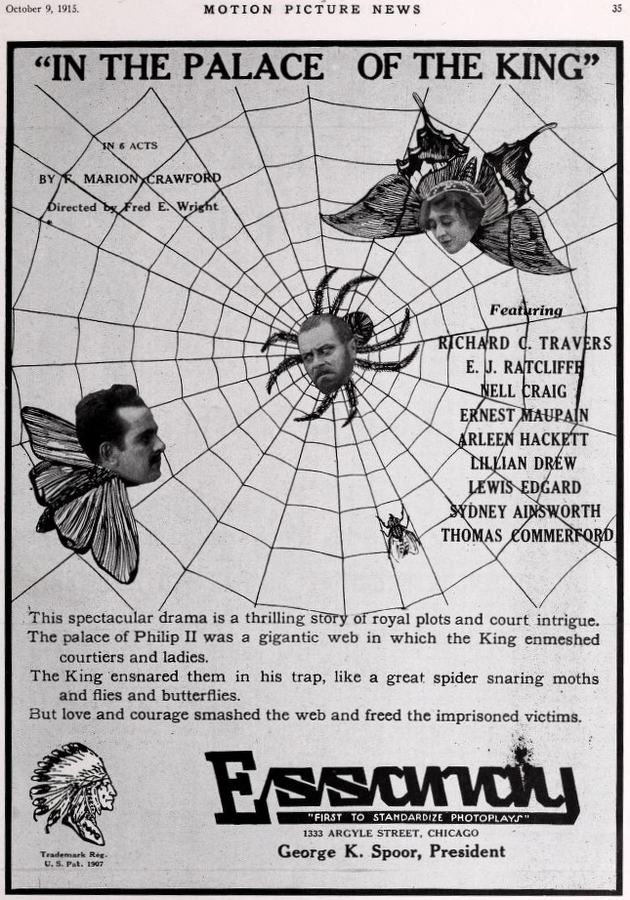
"In the Palace of the King" is wholly a romance of the court of Spain, in which Don John of Austria is in love with Dolores de Mendoza, daughter of the commander of the King's Guard. The action opens with the victorious return to Madrid of Don John and his army after defeating the Moors and conquering Granada for Spain. Don John is acclaimed by the people as a national hero and his popularity arouses the envy of his half-brother, King Philip II of Spain, who opposes his relations with Dolores. Perez, the King's secretary, and the Princess Eboli, lady in waiting to the Queen, meanwhile are involved in a conspiracy to overthrow their sovereign, and plot to use Don John's love for Dolores as a vehicle to attain their ends. The King, when he learns of Don John's affection for Dolores, orders the commander of his guard to put an end to the attachment, and Mendoza, torn between love for his daughter and what he considers loyalty to his King, finally orders Dolores put under lock and key and threatens to kill Don John if he attempts to see her. Through the quick wit of Inez, blind sister of Dolores, the latter is enabled to escape and meets Don John. She tells him of their danger and he hides her in his study. Perez and the Princess Eboli take advantage of the situation and the princess offers to take Dolores away from Don John. Mendoza consents, but the princess, in the darkness, fails to recognize Inez, who had changed clothing with Dolores and when Inez slips into a secret passage she believes it was Dolores who escaped her. Perez informs the King that Dolores is to be found in Don John's quarters, and the sovereign, raging, goes there and accuses his half-brother of conspiring to dethrone him. Arguments follow, in which the King stabs Don John, and, Mendoza, ever loyal, agrees to shoulder the blame for Don John's death, and announces to the assembled court that he killed him. King Philip craftily weaves a net of evidence around Mendoza, but Dolores, who, hidden in Don John's study, had heard all that passes, rushes in and threatens to expose the King's falsehood unless her father is released. The King, fear-stricken, signs an order for the release of Mendoza. Meanwhile the court jester learns that Don John is not dead, but merely slightly wounded, and Dolores is summoned. A priest is obtained and the sweethearts are married, just as the king and other court officials arrive, and a general rejoicing ends the play.
Decades after its release, In the Palace of the King remains a vital piece of the cinematic puzzle. Its influence can be seen in countless modern works, solidifying Fred E. Wright's status as a master of the craft in United States and beyond.