
DbcultAccessing Vault...
Director's Spotlight
Senior Film Conservator
Director's Spotlight: United States
A Deep Dive into the 1918 Vision of Roy Clements
Deciphering the layers of The Reckoning Day (1918) reveals a monumental shift in cult filmmaking spearheaded by Roy Clements. With its avant-garde structure and atmospheric tension, offering layers of thematic complexity that demand repeated viewing.
In The Reckoning Day, Roy Clements pushes the boundaries of conventional narrative. The film's unique approach to its subject matter has sparked endless debates and interpretations among cinephiles and critics alike.
While deeply rooted in United States, The Reckoning Day has achieved a global reach, influencing directors from various backgrounds. Its ability to translate cult tropes into a universal cinematic language is why it remains a cult staple decades after its 1918 release.
| Cinematography | Noir-Inspired |
| Soundtrack | Orchestral |
| Editing | Invisible |
| Art Direction | Kitsch |
Visualizing the convergence of Roy Clements's style and the core cult narrative.
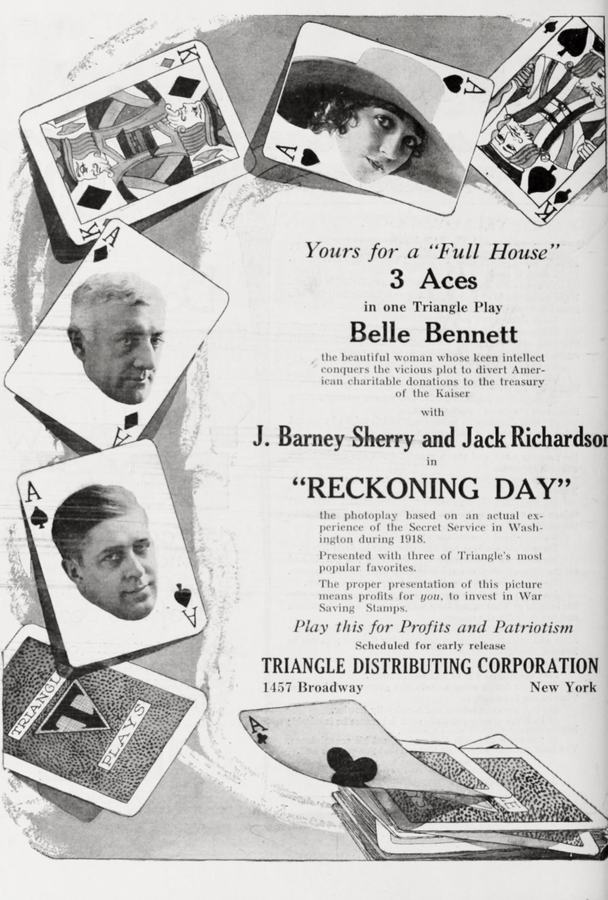
During World War I, Jane Whiting, a bright young lawyer who is engaged to Senator Wheeler, is assigned by the district attorney to expose a gang of spies who are collecting money for the German government through the operation of a fraudulent charity organization. Wheeler's son Frank has fallen in love with Lola Schram, whose pro-German mother is forcing the girl to work for Frederick Kube, the head of the spy ring, but when Kube learns of the romance, he orders Mrs. Schram to break it off. When Lola finally confesses her activities to Frank, Kube kills her and then frames Frank for the murder. Meanwhile, Jane, through the help of Jimmy and Tilly Ware, has discovered Kube's headquarters and modus operandi . By means of a carefully set trap, she finally succeeds in clearing Frank's name and bringing Kube and his gang to justice.
Decades after its release, The Reckoning Day remains a vital piece of the cinematic puzzle. Its influence can be seen in countless modern works, solidifying Roy Clements's status as a master of the craft in United States and beyond.