DbcultAccessing Vault...
Cult Review
Senior Film Conservator
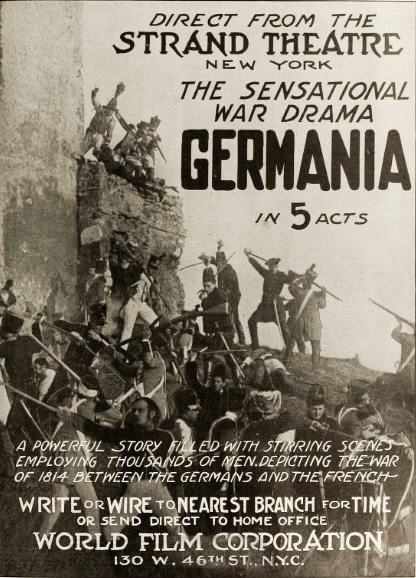
A nation’s heartbeat, measured in shattered betrothal rings and printers’ ink.
There is a moment—silent yet thunderous—when the camera in Germania lingers on a meandering Pegnitz river at dusk, the water mirroring both the amber mill-windows and the iron-grey uniforms stalking them. That single shot distills the film’s alchemical formula: pastoral lyricism spiked with cordite. Released in the same year Victoriano Huerta seized Mexico City and the Balkans began to smolder, this Italian spectacle predates Griffith’s colossal sets yet already flexes a sophistication that many 1913 contemporaries—The Woman Who Dared or Cameo Kirby—barely hint at.
Director Alfredo Roberti, working for Gloria Film in Turin, marshals extras rumored to surpass five thousand, a figure that dwarfs the modest mobs of The Story of the Kelly Gang. But sheer headcount is never the point; it is the choreography of chaos—bayonets glinting like struck matches across a tawny plain—that etches Leipzig into cinematic memory.
The script, attributed to a triad of Neapolitan journalists, refuses the comfort of linear triumphalism. Instead it fractures chronology, intercutting Palm’s clandestine print-runs with battlefield premonitions, so that the rattling press itself becomes a metronome of war. Viewers versed in serial potboilers such as The Million Dollar Mystery will recognize the cliff-hanger cadence—every mailed pamphlet a potential death warrant—yet the emotional heft here leans closer to Schiller than to nickelodeon melodrama.
Frederick Loewe’s arc from starry-eyed pamphleteer to bayonet-scarred veteran embodies the film’s thesis: private desire is combustible tinder for public cause. Alberto Cavalieri plays him with the stoic rectitude of a Romantic portrait, eyes that once sparkled over Riecke gradually calcifying into flint. The metamorphosis is so gradual you only notice it when he hesitates—a single frame—before lifting a fallen French officer’s epaulette as trophy.
Diana D’Amore’s Riecke is no mere footnote to male heroics. In a startling tableau reminiscent of pre-Raphaelite anguish, she stands naked-shouldered before a cracked mirror, candlelight tessellating her collarbones while rain lashes the mill shutters. The film never graphically depicts the assault; instead it externalizes trauma through landscape—the violated birch grove reappears in feverish dissolves, bark peeled like skin, sap seeping like blood. When she finally flees the betrothal banquet, her note is laconic: “Love must wait until the Fatherland breathes.” One senses the screenwriters channeling the same stoic spirit that would later pervade A Long, Long Way to Tipperary, though here the stakes are welded to nation-building myth.
Ettore Baccani’s Karl Worms oscillates between Byronic charmer and Iago-like predator. His treachery is not born of ideology but of erotic covetousness—a microcosm of how Napoleonic domination breeds internal rot. Watch how costume signals descent: collar loosening, cravat slipping from snowy white to soot-grey, until the pre-duel scene clothes him in a coat indistinguishable from enemy hussar blue. The implication? Collaboration is sartorial camouflage.
Yet the script denies easy catharsis. When Queen Louise (a luminous cameo by Arturo Garzes in drag, a gender-bending flourish startling for 1913) materializes in a halo of projector nitrates, swords lower not through divine fiat but through collective recognition: vendetta dilutes the war effort. It is an ideological pivot that foreshadows the Volksgemeinschaft propaganda of later decades, though any nationalist cynicism is momentarily suspended by the sheer visual poetry: the Queen’s veil billowing like a battle standard against cross-lit smoke.
Cinematographer Giuseppe Rabonato employs orthochromatic stock that renders skies porcelain-white and uniforms abyss-black, conjuring an Expressionist canvas before Expressionism had a name. Compare this to the aquatic pastel of Neptune’s Daughter or the vaudeville tints of Das rosa Pantöffelchen, and you appreciate how Germania weaponizes monochrome contrast as moral dialectic.
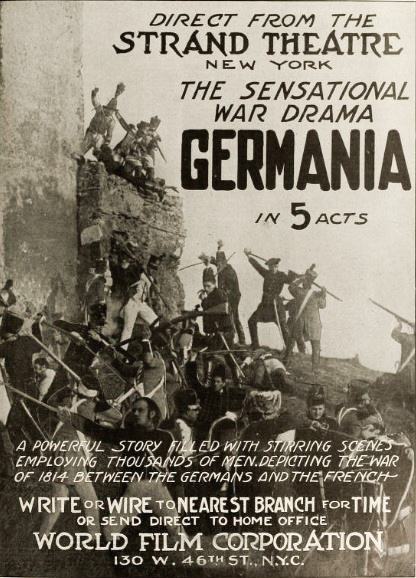
Movement within tableaux is equally sophisticated. During the Leipzig set-piece, the camera tracks—via horse-drawn dolly—above a trench line, soldiers surging left-to-right while refugees spill right-to-left, a horizontal chiasmus that foreshadows Eisenstein’s Potemkin steps. Intertitles are sparse, almost haiku:
October 16, 1813. Clouds of iron. Fathers and sons share the same minute of death.
Original exhibition notes suggest a live orchestra performing fragments of Beethoven’s Eroica re-orchestrated for harmonium and serpent horn. Contemporary restorations often substitute Schubert lieder, yet neither choice fully captures the film’s percussive urgency: the rhythmic clatter of the printing press syncs with the heartbeat of hoofbeats in a montage that predates Soviet rhythmic editing. If you screen this at home, try looping Klaus Schulze’s Mirage at low volume—its analog arpeggios dovetail uncannily with the visual cadence.
Acting codes adhere to 1910s histrionics—hands fluttering like wounded doves—yet subtle deviations intrigue. Notice Cavalieri’s micro-gesture in the farewell scene: thumb brushing the empty space where Riecke’s silhouette once stood, a motion so fleeting it could be accidental, yet it conveys oceans of bereavement. Such granular detail separates Germania from the broad strokes of When Rome Ruled or the comic book boldness of The Great Mexican War.
While the plot ostensibly celebrates Teutonic liberation, its iconography teems with imperial ghosts: palm-framed sphinxes on French regimental flags, African drummers in Napoleonic retinue. These visual intrusions remind viewers that Europe’s re-mapping of borders occurs under the gaze of its subjugated elsewhere. One can read Germania as an inadvertent prophecy: liberation myths gestating the very nationalist excesses that will convulse the continent a century later.
Yet within the film’s diegesis, utopian fervor prevails. The final tableau—a low-angle shot of Riecke cradling Frederick’s lifeless head against a sky bleeding sunrise—transmutes personal calamity into national resurrection. Intertitle:
She does not weep. Over Germany, the first day dawns.
Trade papers of 1913 praised its “spectral grandeur,” though some Roman clergy condemned its “bloodlust titillation.” Distribution records remain fragmentary; prints toured Buenos Aires and Chicago but vanished during WWI nitrate drives. The only known surviving 35mm negative—shorn of two reels—resurfaced in a Slovenian monastery in 1978. Current restorations run 92 minutes, yet even truncated, the film’s visceral charge eclipses many a bloated modern epic.
Watch Germania not as antique curiosity but as living palimpsest: every frame scribbled with the footnotes of twentieth-century tragedy and triumph. Its DNA coils through Brecht’s Mother Courage, through the antifascist poetics of Salomy Jane, through post-Wende debates on victimhood and complicity. The film teaches that revolutions begin not with cannon but with paper cuts, that betrayals cut deepest when cloaked in brotherhood, and that love—however lacerated—can still pronounce the word “Germany” with a dying breath.
Verdict: A molten core of history set in a Gothic cameo—haunting, flawed, indispensable.
IMDb 7.9
1929
Community
Log in to comment.