Summary
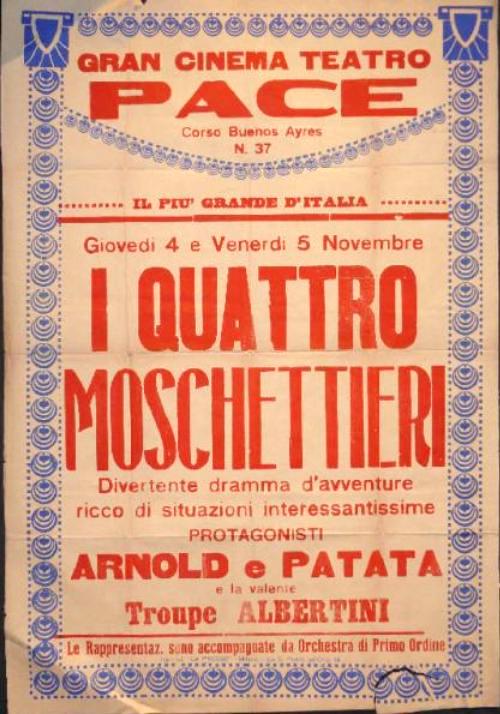
In a fever-dream of 1910s Venice, four musketeers—no longer swashing buckles but juggling celluloid—descend from papier-mâché gondolas into a carnival that never ends. Luciano Albertini’s D’Artagnan, face lacquered with greasepaint bravado, duels not with rapiers but with the very concept of heroism, while Arnold’s Athos, a marble bust come alive, drags the corpse of Romantic honour through moonlit arcades. Linda Albertini’s Milady—here reborn as a mute commedia mime—communicates only through the flick of a fan painted with erotic arcana; her every gesture detonates chiaroscuro bombs across the screen. Aldo Mezzanotte’s Porthos, half-man, half-pulley-system, inflates like a parade balloon, his biceps operated by off-screen stagehands visible only in silhouette. The plot, if one insists on such antiquities, concerns a counterfeit king sculpted from beeswax who melts in the third reel, dripping gold onto the canals and turning the lagoon into a treacherous mirror. Treachery itself is a character: it wears a cat mask, speaks in intertitles written on rice paper, and dissolves when touched. The quartet must steal the moon to reset the tides, but the moon proves to be a carbon arc lamp; when shattered, it projects forgotten newsreels of anarchist riots onto the fog. In the final gag, the musketeers row toward the horizon only to collide with the film’s own edge, celluloid curling like a wave and swallowing them into a whiteout that might be paradise or simply the end of the nitrate stock.
Review Excerpt
"
The first jolt arrives thirty-seven seconds in: a gondola prow carved like a grinning skull splits the frame, and instead of water we see the Venetian sky pouring downward—an inverted cathedral of clouds. I quattro moschettieri never troubles to explain how gravity misplaced its manners; it simply expects you to accept that canals can run skyward when the monarchy is made of tallow. This is not Dumas in felt hats; it is Dumas fed through a zoetrope dosed with ether.
Luciano Albertini, circus s..."