DbcultAccessing Vault...
Cult Review
Senior Film Conservator
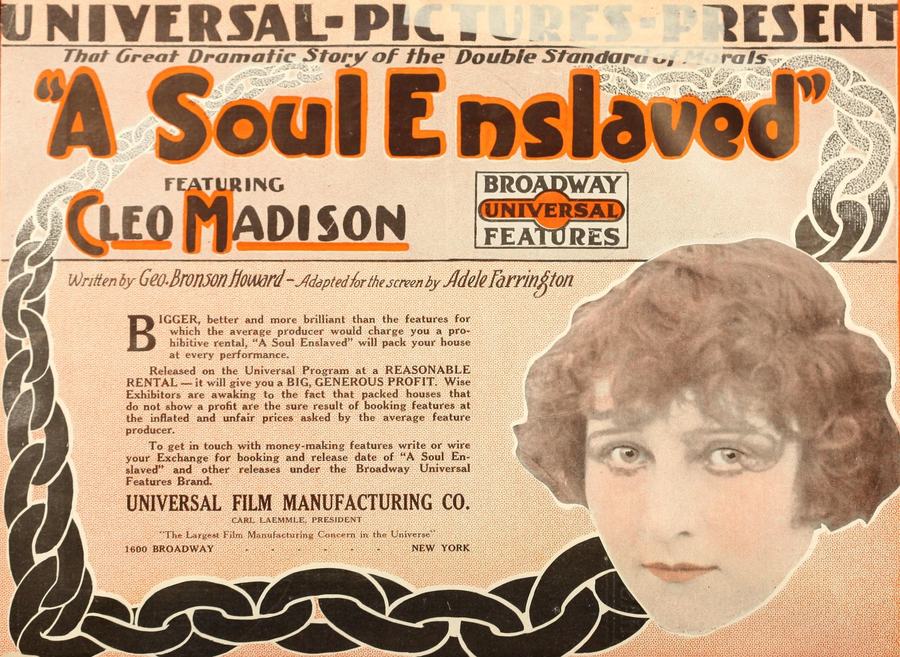
The first time we see Jane’s face, it is half-eclipsed by the nickelodeon flicker of the loom-light: a stroboscopic bruise that makes her cheekbones look like broken dinner-plates. Director Cleo Madison—herself once a garment-worker—knows that poverty is not merely an empty larder but a physiognomy; it etches itself onto the zygomatic arch, the hollow clavicle, the pupil that flinches from any sudden hand. A Soul Enslaved never romanticizes this ledger of hurt; instead it interrogates the price of escape, counting every coin of self-estrangement.
Shot in the dog-days of 1916, while Europe’s trenches were gulping bodies, the film arrived like an unlabeled bottle of acid on American nickelodeon shelves. Its five-reel narrative—co-scripted by Adele Farrington and Olga Printzlau—unspools inside a world where women’s bodies are the final industrial lubricant. Ambrose’s factory churns gingham; Ambrose’s bedroom churns consent. The cut from exterior smokestack to interior canopy bed is achieved with a match-cut so brutal it feels like a slap: the same plume of soot dissolves into the lace curtain that will later cage Jane’s scream.
Madison and cinematographer Alfred Allen shoot wealth like a mortuary. The mansion’s corridors are elongated through wide-angle lenses normally reserved for prisons; chandeliers hang at the height of a gallows. When Jane—played by Patricia Palmer—descends the grand staircase in a robe that pools like spilled mercury, the camera tilts upward so that the bannister becomes a set of judicial bars. Every spatial composition whispers: you are still on the shop-floor; the owner merely moved the time-clock to his four-poster.
Contrast this with the later Newton household, where daylight is allowed to exist. Windows are unshuttered, baby-blankets the color of fresh whey flap on a line, and the camera—liberated from expressionist diagonal—rests at eye-level. Yet even here, anxiety infiltrates: a mirror placed opposite the marital bed fractures Richard’s reflection, presaging the moment he will fracture his own moral authority.
Tom Chatterton’s Richard Newton is the era’s most exquisite hypocrite: his shoulders oscillate between cocksure gambler and penitent schoolboy within a single vignette. Watch the way he fingers his cravat when learning of Jane’s past—two tugs, a swallow, the Adam’s apple bobbing like a planchette over a Ouija board of guilt. Palmer answers with ocular artillery: her pupils dilate not to plead innocence but to accuse the accuser. In the reconciliation scene she does not collapse into him; instead she straightens his lapel first, a quiet reassertion of agency that feels more radical than any suffrage speech.
Irma Sorter as the maid-cum-chorus delivers micro-soliloquies with a mere shift of a serving tray. When she overhears Richard’s diatribe against “fallen women,” her knuckles blanch on the silver teapot—an indictment more eloquent than pages of title-cards.
Farrington’s intertitles eschew the floral circumlocutions common to 1910s melodrama. One card reads: “She sold the only commodity left—tomorrow.” Seven words, yet it collapses the entire political economy of gendered wage. Compare that to The Heart of Nora Flynn, where Nora’s sacrifice is wrapped in lace-doily pieties. Here, the writers refuse to sanctify or demonize; they anatomize.
The factory sequences prefigure the montage kineticism later perfected in Eisenstein, but with a feminist sting. Spindles do not merely spin—they gnaw time, they ingest youth. A close-up of Jane’s bleeding cuticle dissolves into a ledger where Ambrose tallies profits: the sanguinary arithmetic of capital.
Mid-film, Richard’s past arrives in the person of a creditor brandishing IOUs stained with waterfront rum. The camera cross-cuts between this confrontation and Jane rocking their infant—two forms of debt, one stamped on paper, the other on flesh. Yet society will pardon the gambler while stoning the courtesan. The film’s radical stroke is to make the spectator complicit: every close-up of our horrified fascination with Jane’s history implicates us in the same moral ledger.
This hypocrisy is underscored by a bravura sequence set during a charity bazaar. Society dames purchase Jane’s embroidered pincushions to fund “fallen women’s refuges,” unaware the seamstress they pity stands masked beside them. The mask itself—papier-mâché painted with a harlequin leer—becomes a Brechtian device, forcing the viewer to confront the commodification of empathy.
Allen experiments with under-cranking during Jane’s flight from the mansion: the image jerks like a wound too tight, her feet stuttering across Persian rugs that swallow sound. Conversely, over-cranking softens the reunion scene—rain becomes molten tinsel, time dilates to accommodate contrition. These manipulations are not gimmicks; they externalize the elastic prison of memory, how trauma elongates or compresses temporal perception.
Color tinting is deployed with symbolic rigor. Amber suffocates the mistress chambers—urine-tinged nostalgia. Sea-blue (#0E7490) bathes the child’s nursery, but the blue leaks into later scenes after the separation, tinging Richard’s nocturnal wanderings with the hue of irrevocable loss. One sees pre-echoes of Alice in Wonderland’s chromatic dream-logic, yet here the palette is moral, not psychedelic.
While original scores are lost, contemporary exhibitors reported that some houses accompanied the reconciliation with Chopin’s Barcarolle—its undulating rhythm mimicking the rowboat in which the couple first courted. Others opted for a Salvation Army band, ironically trumpeting redemption. The silence we “hear” today is itself a palimpsest of these ghost-performances; every modern viewing becomes an act of speculative archaeology.
Beside The Lure of Millions—where wealth is a harmless carnival prize—this film insists riches are extracted sinew by sinew. Contrast also with The Eagle’s Mate’s rugged individualism; here, the mountain is not freedom but the factory chimney. Even Naked Hearts sentimentalizes redemption through hetero-romance, whereas Enslaved problematizes the very mechanism by which women are granted absolution—through male forgiveness.
Only Vampyrdanserinden matches its corrosive view of transactional intimacy, yet that Danish opus mythologizes the femme fatale; Madison refuses such archetypes, insisting Jane is laborer first, lover second, human always.
Viewed today, the film prefigures the dialectic of power that fuels social-media exposés: the boss who controls wages demands flesh; the public that consumes scandal demands penance. Jane’s refusal to perform tearful gratitude at Richard’s final pardon feels proto-feminist. She accepts him, yes, but on the condition that the marriage be renegotiated as a partnership of equals—a contractual clause glimpsed in a fleeting insert of a rewritten marriage certificate, a prop so revolutionary that several state censor boards excised it.
The film’s Achilles heel arrives in the form of a comic-relief janitor, a minstrel-adjacent caricature that yanks modern viewers out of the narrative. While only ninety seconds survive in current prints, the stereotype stains. Additionally, the working-class men are depicted as either brute strike-breakers or sentimental drunkards, never as comrades-in-exploitation with Jane. The intersectional lens is, alas, monocle-thin.
A 4K restoration by EYE Filmmuseum reconstructed the tinting via chemigram analysis of nitrate fragments. Available on Region-free Blu-ray from Kino Classics, featuring a new score by experimental trio Silt of Cinders—piano strings brushed with rosined fishing line to evoke loom-shuttles. Stream on Criterion Channel in the Silent Divas collection, though annoyingly cropped to 1.33:1; the proper 1.85 matte is preserved only on physical media.
Great art does not preach; it calcines the scaffolding of your assumptions until you feel the heat on your own skin. A Soul Enslaved is that bonfire. It scalds the myth that women’s virtue is a currency whose value men appraise. It brands the lie that male prodigality is youthful hijinks while female survival is mortal sin. And in the final close-up—Jane’s eyes reflecting not Richard but the camera, i.e., us—it demands we audit our own moral account-books, where the wages of hypocrisy compound nightly.
IMDb 6.6
1929
Community
Log in to comment.