DbcultAccessing Vault...
Cult Review
Senior Film Conservator
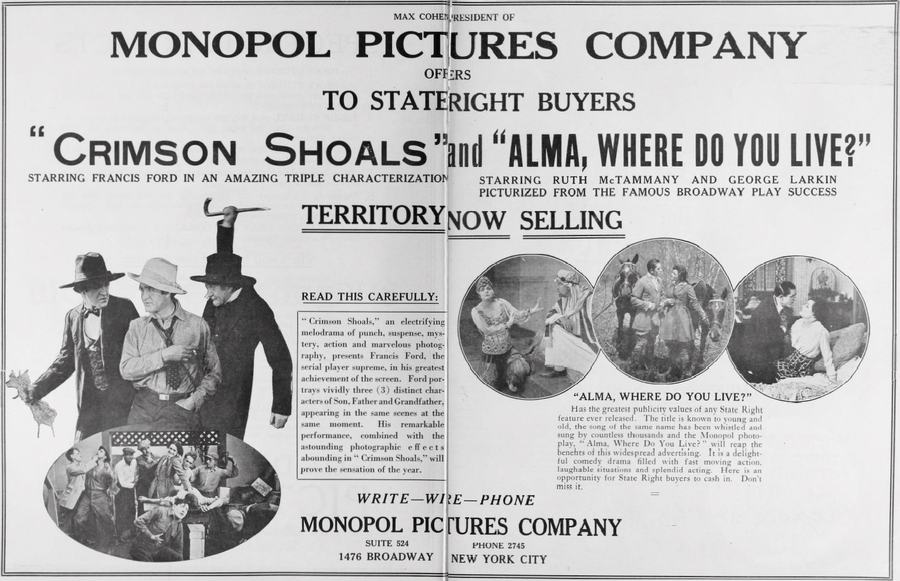
To witness Crimson Shoals is to step into a time capsule where the boundaries of melodrama and nautical adventure blur into a singular, evocative experience. Directed with a tactile sense of urgency by Francis Ford—a man whose cinematic contributions are frequently, and perhaps unfairly, eclipsed by the towering shadow of his younger brother, John—this film is a testament to the raw power of silent-era storytelling. It is not merely a tale of lost treasure, but a profound exploration of the calcified resentments that define familial legacies. Much like the coral that serves as the film's central motif, the relationships in Crimson Shoals are built upon layers of historical sediment, hardened by time and pressure.
The film opens with a sequence of clandestine passion that sets the stage for a decades-long tragedy. Frederick Fielding, portrayed with a stoic vulnerability by Peter Gerald, defies the atavistic hatreds of his lineage to marry Marguerite Quinn. This act of rebellion is punctuated by the exchange of a signet ring—a small, circular emblem of continuity that will eventually serve as the narrative’s gravitational center. When Frederick is summoned to the island of Crimson Shoals, the audience is transported to a locale that feels both exotic and claustrophobic. The cinematography captures the shimmering allure of the atoll, yet there is an underlying sense of rot, a premonition that the wealth being extracted from the seabed is tainted by the secrecy of its owner’s heart.
As the narrative leaps forward in time, we find a Frederick who has traded the fire of youth for the cold comfort of prosperity. The news of Marguerite’s death arrives like a delayed echo, leaving him adrift in a sea of regret. However, the film avoids wallowing in sentimentality by introducing a high-stakes corporate espionage subplot. The theft of the coral reserves serves as a brilliant catalyst for Frederick’s return to the island, forcing him to confront the ghosts of his past. Unlike the more straightforward morality found in The Law of Men, Crimson Shoals thrives on ambiguity. Who is the real thief? Is it the foreman with the hated surname, or someone lurking within the inner sanctum of the company?
The introduction of Jack Quinn (James Fitzer) provides the film with its most complex dynamic. Jack is a man defined by his labor, a figure of rugged integrity who stands in stark contrast to the boardroom machinations of the city. When Frederick and his father Thomas sail for the island, the tension is palpable. The salt air seems to sharpen the edges of their suspicion. It is here that the film’s lexical diversity in visual language truly shines. Ford uses deep-focus shots to position characters against the vastness of the ocean, highlighting their insignificance against the forces of nature and fate. This visual strategy reminds one of the elemental struggles depicted in The Storm, where the environment acts as both judge and jury.
In a surprising subversion of contemporary tropes, the character of Helen (Martha Dean) emerges as the narrative’s investigative engine. While the men are blinded by their historical biases and masculine posturing, Helen possesses a clarity of vision that allows her to look past the obvious. Her romance with Jack is not merely a romantic diversion; it is the lens through which the truth is filtered. When she discovers that Rex Burke, the company auditor, is the true architect of the coral theft, the film shifts gears from a slow-burn drama into a pulse-pounding thriller. Burke represents a modern kind of villainy—the white-collar predator who uses ledgers and balance sheets as weapons of plunder.
The comparison to Behind Closed Doors is inevitable here, as both films grapple with the corruption hidden beneath a veneer of professional respectability. However, Crimson Shoals takes this conflict to the skies and the depths. The climax of the film is a masterclass in early special effects and stunt work. The sight of Jack Quinn dropping dynamite from a primitive airplane to destroy Rex Burke’s submarine is an image that lingers in the mind long after the credits roll. It is a collision of eras—the ancient coral, the industrial submarine, and the nascent technology of flight—all converging in a moment of cathartic violence.
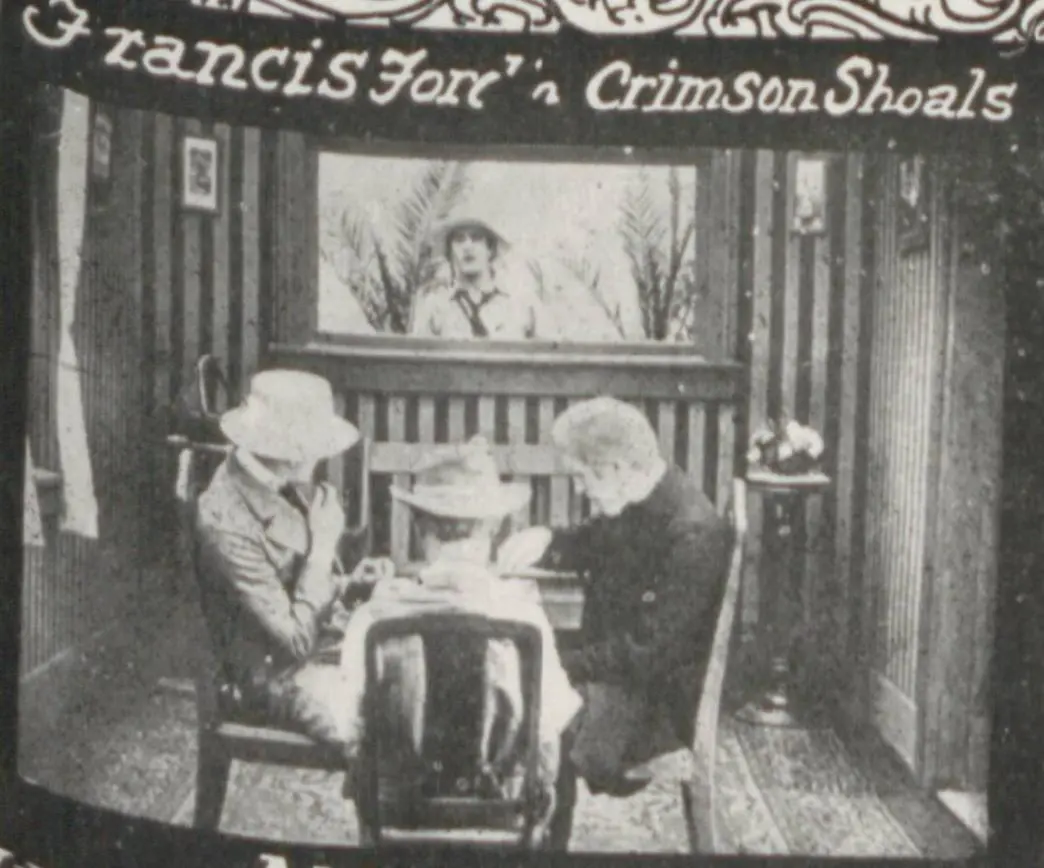
The true genius of the screenplay by Francis Ford and Elsie Van Name lies in its final revelation. The discovery of the signet ring on Jack’s finger is handled with a restraint that maximizes its emotional impact. It is a moment of recognition that transcends words, a silent epiphany that reconciles the Fielding and Quinn bloodlines. The ring, which began the film as a symbol of defiance, ends it as a symbol of continuity. It suggests that while we may try to bury our pasts in the deepest trenches of the ocean, the truth has a way of rising to the surface, buoyed by the very objects we leave behind.
This thematic resonance is what elevates Crimson Shoals above the standard fare of its time, such as A Successful Failure or the more comedic Cohen's Luck. There is a gravity here, a willingness to engage with the concepts of legacy and legitimacy. The film posits that Jack’s romance with Helen is not just a personal victory, but a cosmic correction—a way for the Fielding family to finally move beyond the cycles of enmity that have plagued them for generations.
Technically, the film is a marvel for 1919. The use of natural lighting in the island sequences creates a sense of place that is both beautiful and forbidding. The "crimson" of the shoals, though rendered in shades of grey in the original nitrate, is felt through the intensity of the performances and the sharpness of the editing. One can almost see the vibrant hues that Ford intended to evoke. The pacing is deliberate, allowing the mystery to breathe before plunging the audience into the chaotic energy of the final act. It shares a certain rhythmic DNA with The Thirteenth Chair, where the revelation of truth is meticulously prepared for through a series of subtle clues.
The performances are uniformly excellent. Peter Gerald’s transition from a young, hopeful lover to a weary patriarch is handled with nuance. Edna Emerson, though her screen time is limited, casts a long shadow over the entire production, her Marguerite becoming a spectral presence that haunts Frederick’s every decision. James Fitzer brings a physicality to the role of Jack that makes the action sequences believable, while Edward Warren’s Rex Burke is a masterclass in understated menace. There is no mustache-twirling here; Burke is a man of cold calculation, making his eventual defeat all the more satisfying.
In the broader context of silent cinema, Crimson Shoals stands as a bridge between the simplistic morality plays of the early 1910s and the sophisticated psychological dramas of the 1920s. It lacks the overt didacticism of The Food Gamblers, opting instead for a narrative that prioritizes character growth and atmospheric immersion. It is a film that rewards the attentive viewer, offering a rich tapestry of motifs and metaphors that are as relevant today as they were a century ago.
Ultimately, Crimson Shoals is a story about the resilience of the human spirit and the inescapable nature of our origins. It reminds us that we are all, in some way, searching for our own signet rings—those tangible proofs of who we are and where we belong. Whether we find them in the wreckage of a submarine or in the eyes of a long-lost son, the discovery is always transformative. For those seeking a cinematic experience that combines high-seas adventure with a deeply moving human core, this film remains an essential piece of the silent era’s vast, and often hidden, treasure chest. It is a work of art that, much like the coral it depicts, has only grown more intricate and valuable with the passage of time.
Reviewed by the Cinephile's Journal Editorial Team.

IMDb —
1933
Community
Log in to comment.