Summary
In a Manhattan of ticker-tape and top-hats, John Harden’s silhouette slices across the stock-exchange floor like a scalpel of arrogance; the camera, almost trembling, watches him sign contracts with a flourish that feels Luciferian. His penthouse glowers over Central Park—an art-deco Babel where laughter ricochets off Lalique glass and the wives of board members pirouette in pearls. Aida Horton’s wide-eyed spouse, once his parish sweetheart, now a trophy flayed by lamplight, senses the chill of idolatry long before the Crash. When the bells of St. Patrick’s toll, Harden mocks them with a cigar, a plume of smoke curling like a question mark against the nave of skyscrapers. Cue intertitles—white letters on velvet black—announcing ruin: margins called, friends evaporating into cigar-smoke, creditors swarming like carrion. The film’s chiaroscuro deepens; faces become cavernous, furniture pawned, children’s shoes cracked. In a Bowery flophouse, Harden’s reflection fractures across a broken mirror while outside Salvation Army hymns seep through brickwork, each note a thorn. Rita Rogan, as the consumptive daughter, coughs blood onto a tattered hymnal—her sacrificial body the price of paternal hubris. A night journey follows: freight trains rattling toward nowhere, frost on stubble, until he collapses at the gate of the rural monastery where he once served Mass. There, in a single close-up that lasts an eternity, Augustus Anderson’s abbot lifts the prodigal’s chin; light finally enters Harden’s irises like dawn breaching a mausoleum. The final tableau—family reunited in a candlelit chapel, shadows dancing like forgiven sins—leaves the viewer suspended between grace and the lingering taste of ash.
Synopsis
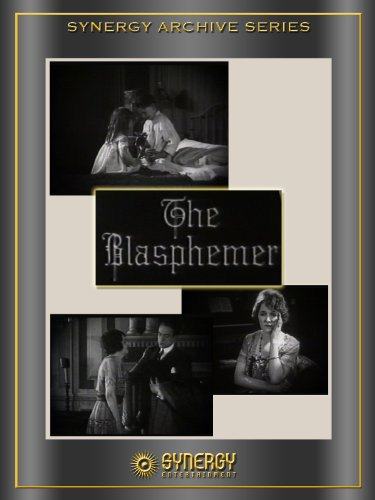
This rarely seen, silent religious feature was produced by the Catholic Art Association. After making it big on Wall Street, John Harden boasts that he is the master of his own fate and believes in neither God nor the Devil. Needless to say, he pays mightily for this hubris. His family is reduced to poverty, his friends desert him, and things turn from bad to worse until his childhood faith is restored.
Review Excerpt
"
Imagine a cathedral built not of stone but of celluloid, each frame a stained-glass panel flickering at 18 fps, and you begin to approach the sepulchral grandeur of The Blasphemer. Produced by the Catholic Art Association in that feverish post-WWI moment when Wall Street smelled of fresh minted coin and Protestant modernity was busy deleting hell from its maps, this 1922 silent arrives like a gargoyle suddenly vocal—grotesque, urgent, weirdly tender.
Its narrative arc is deceptively simple: Mi..."