DbcultAccessing Vault...
Cult Review
Senior Film Conservator
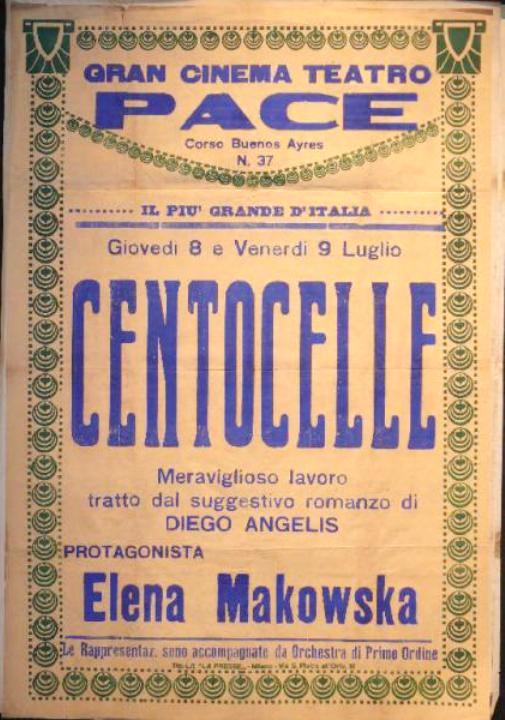
The year 1919 represents a fascinating crossroads in the evolution of European cinema, a temporal junction where the exuberant theatricality of the early decade began to yield to a more nuanced, visually sophisticated form of storytelling. In this fertile ground, Augusto Genina’s Centocelle emerges not merely as a relic of the silent era, but as a profound meditation on the shifting sands of Italian identity. The film, featuring the ethereal Helena Makowska and the stoic Guido Trento, serves as a quintessential example of the verismo influence creeping into the high-drama aesthetic of the period. Unlike the overt spectacle of Mazeppa, der Volksheld der Ukraine, which leans heavily into nationalistic myth-making, Centocelle finds its power in the quietude of the peripheral, focusing on the human cost of progress and the inescapable gravity of one's social origins.
At the heart of this cinematic endeavor is Helena Makowska, an actress whose screen presence was often compared to the great divas of her time, yet who possessed a specific, haunting quality that set her apart. In Centocelle, her performance transcends the standard histrionics of the silent screen. She portrays a woman caught between worlds, her expressive eyes conveying a depth of interiority that predates the psychological realism of later decades. When we look at her work here in contrast to the archetypes presented in Saint, Devil and Woman, we see a more grounded, albeit still tragic, representation of femininity. Makowska does not merely occupy the frame; she haunts it, using the chiaroscuro lighting of Genina’s cinematographers to create a sense of impending doom that feels both personal and universal.
Guido Trento provides the necessary masculine counterpoint, his performance characterized by a ruggedness that would later make him a success in Hollywood. The chemistry between Trento and Makowska is palpable, even through the flickering grain of a century-old print. Their interactions are framed with a spatial awareness that emphasizes the distance—both physical and social—between them. This tension is reminiscent of the class-based friction found in Amarilly of Clothes-Line Alley, though Genina treats the subject matter with a distinctly Continental cynicism that avoids the sentimental resolutions common in American productions of the same year.
Augusto Genina’s direction in Centocelle is nothing short of revolutionary for its time. He utilizes the actual location of Centocelle—then a dusty, developing outpost on the edge of Rome—as more than just a backdrop. The environment becomes a character in itself, a silent witness to the unfolding drama. The way Genina captures the light hitting the Roman plains suggests a director who was deeply attuned to the emotional resonance of landscape. This is not the sanitized, studio-bound reality of The Soul Market; it is a visceral, tactile world where the dirt on the characters' clothes feels real. The cinematography oscillates between wide, sweeping shots that emphasize the isolation of the individuals and tight, claustrophobic interiors that mirror their trapped social positions.
The pacing of the film is deliberate, eschewing the frantic energy of contemporary thrillers like The Grim Game in favor of a slow-burn narrative that allows the themes of betrayal and redemption to simmer. Genina’s use of the camera to explore the nuances of social interaction is masterful. He often places the camera at eye level, inviting the viewer to participate in the gossip and the shared glances of the community. This technique creates an immersive experience that was quite rare in 1919, bridging the gap between the audience and the screen in a way that feels surprisingly modern.
Centocelle is, at its core, a critique of the rigid structures of early 20th-century Italian society. The film explores the concept of 'honor' not as a noble virtue, but as a suffocating cage. This theme is explored with similar intensity in the film Ehre, yet Genina’s approach is more localized and intimate. The tragedy of the film arises not from a single villainous act, but from the collective weight of societal expectations and the inability of the characters to break free from their prescribed roles. The script, though sparse in its intertitles, allows the visual narrative to carry the weight of this commentary.
The film also touches upon the burgeoning industrialization of Italy. The setting of Centocelle, with its transition from rural to urban, serves as a metaphor for a nation in flux. We see the encroachment of the modern world in the background—the distant smoke, the new construction—symbolizing the end of an era. This sense of loss is a recurring motif in Genina’s work, and it is handled here with a delicate touch. While Does the Jazz Lead to Destruction? examines the moral panic of the new age, Centocelle looks at the structural displacement of the old world with a more melancholic, analytical lens.
When placing Centocelle within the broader context of 1919 cinema, its unique qualities become even more apparent. While American cinema was perfecting the art of the narrative arc with films like A Yankee Princess or the adventurous whimsy of Such a Little Pirate, the Italian industry was leaning into a more operatic, visually dense style. Centocelle manages to balance these two worlds, offering a clear, engaging plot while maintaining the artistic flourishes that defined the Italian school. It lacks the overt theatricality of Shades of Shakespeare, opting instead for a realism that feels more authentic and enduring.
Furthermore, the film’s exploration of the 'fallen woman' trope is handled with more nuance than in many of its contemporaries. Instead of the moralistic finger-pointing found in The Love Brokers, Genina offers a sympathetic portrayal of his female lead. She is a victim of circumstance rather than a creature of malice. This progressive stance, though subtle, marks Centocelle as a forward-thinking work. It shares a certain DNA with Sisters of the Golden Circle in its focus on the bonds and burdens of women, though the setting remains uniquely Italian.
The technical aspects of Centocelle deserve significant praise. The restoration efforts that have allowed us to view this film today reveal a sophisticated understanding of lighting and composition. The use of natural light in the outdoor sequences creates a soft, almost impressionistic quality that contrasts sharply with the high-contrast lighting of the dramatic climaxes. This visual duality serves to underscore the central conflict of the film: the beauty of the natural world versus the harshness of human experience. In many ways, the film’s visual language is as complex as the decadent imagery found in Prinz Kuckuck - Die Höllenfahrt eines Wollüstlings, though it applies this complexity to a much more humble setting.
The editing, too, is noteworthy. Genina uses cross-cutting to build tension in a way that feels organic rather than forced. The sequence where the protagonist’s secret is finally revealed is a masterclass in suspense, utilizing the rhythmic pulse of the editing to mirror her racing heart. It is this level of craftsmanship that has allowed Centocelle to remain relevant to film scholars and enthusiasts alike. It stands as a testament to the power of silent cinema to communicate complex emotional truths without the need for spoken dialogue.
In the final analysis, Centocelle is more than just a historical curiosity. It is a vibrant, breathing piece of art that continues to resonate with modern audiences. Its themes of social inequality, the search for identity, and the destructive power of passion are as relevant today as they were in 1919. While it may not have the name recognition of some of its contemporaries, it remains a vital chapter in the history of Italian cinema. The film’s ability to capture a specific moment in time—the transition of a city, the evolution of an art form, and the enduring struggles of the human spirit—ensures its place in the pantheon of silent masterpieces.
For those looking to understand the roots of neorealism or the evolution of the European drama, Centocelle is essential viewing. It provides a bridge between the grandiosity of the early silent epics and the gritty realism that would define the post-WWII era. Much like the rugged landscapes of Bushranger's Ransom, or A Ride for Life or the visceral tension of Red Blood and Yellow, Centocelle reminds us that cinema, at its best, is a mirror held up to the world, reflecting both our greatest aspirations and our deepest flaws. It is a film that demands to be seen, discussed, and remembered.
Review by the Cine-Aesthetic Critic, 2024. A deep dive into the archives of the silent era.
IMDb 6.3
1935
Community
Log in to comment.