DbcultAccessing Vault...
Cult Review
Senior Film Conservator
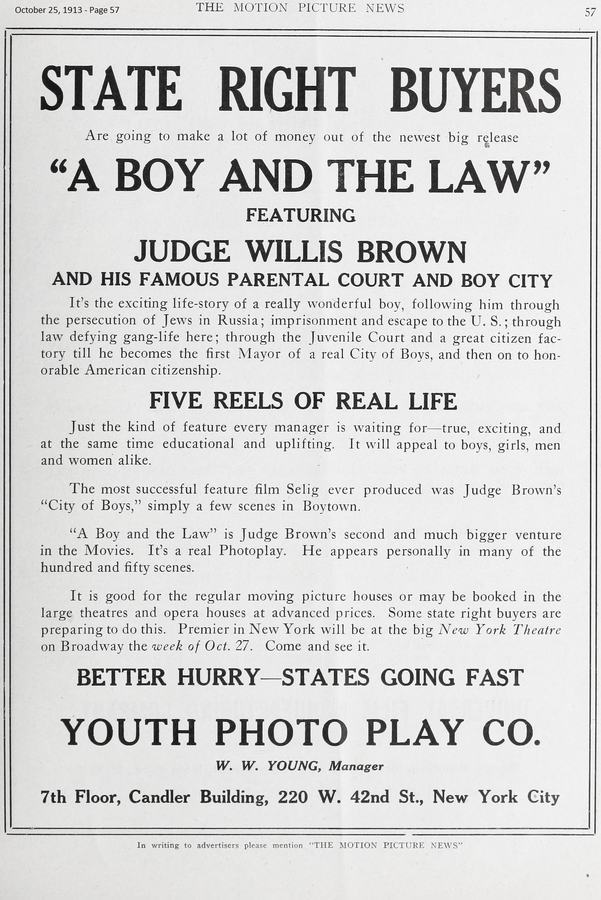
The first time we see Willie Eckstein he is only a silhouette against a frost-latticed window of a boarding-school dormitory, the ink of his mother’s letter still wet on his fingertips like a stigmata of exile. In that single shot John M. Stahl announces the visual grammar that will govern A Boy and the Law: every horizon is a border, every source of light is also a source of surveillance, and every gesture of childhood is already freighted with the freight trains of history.
Stahl, who would later refine the women’s weepie to an exquisite torture in films like Leave Her to Heaven, here works in a register closer to the luminous civic humanism of Oliver Twist and the proto-neorealist urgencies of Germinal. The camera does not merely record the boy’s flight from pogrom to prairie; it interrogates the very possibility of moral agency inside systems engineered to crush it. When Cossack sabers sever the father’s protest mid-sentence, the cut is not to the blade but to the mother’s shawl slipping from her shoulders—an entire cosmology of protection unravelling in wool and silence.
Russia, 1903: the palette is bone, birch, and candle-flame. Production designer Robert Haas (borrowing the monastic minimalism he deployed in From the Manger to the Cross) builds the shtetl as a series of shrinking rectangles—doorways that will not admit a cradle, windows that frame only departing backs. Note how Stahl shoots the family’s forced march in one unbroken take: the camera recedes before the cart like a guilt it cannot outrun, while the tavern waitress—she of the catalytic murder—appears only as a reflection in a broken samovar, her face split by the fracture. Even the victim is bifurcated by empire.
Cut to the Eneckva meetings: candle stubs gutter in a forest clearing, faces swim out of darkness like icons in an underground chapel. Stahl refuses close-ups until Willie delivers his first speech; the camera then dollies in so slowly you feel history leaning on the lens. The boy’s rhetoric is not Marx but Hasidic chant—cadences rise and fall like Tehillim recited by an atheist. Compare this to the later Boy Town assemblies shot in full American daylight: the same faces, now sunburned, the same cadences, now translated into the optimistic twang of Midwestern progressivism. Stahl’s dialectic is spatial: Europe’s vertical shadows versus Utah’s horizontal hopes.
Jail arrives as a tessellation of iron geometry. The boys’ cell is staged like a classroom—blackboard on the back wall, scrawled with the very statutes that condemn them. A teacher enters, but instead of chalk he carries betrayal. Stahl cuts from the instructor’s finger pointing at the hidden pamphlet to a porcelain doll on the corridor floor—an image of childhood assassinated in passing. When the Cossacks ransack Willie’s room they dump a Torah scroll atop a stack of revolutionary leaflets; the sacred and the seditious share the same violated skin. One thinks of the scrolls hurled into the Seine in Les Misérables, yet Stahl withholds the spectacle of desecration; the scroll simply lies there, its fringes trembling like an animal unsure whether it is still alive.
Escape is staged as a horizontal resurrection: rope descends the cliff face, the camera tilts ninety degrees so the rock becomes a sky the boys can walk upon. In the negative space of the frame you glimpse the abyss that will swallow lesser films whole. Stahl’s cliff is not geography; it is the liminal membrane between feudal fatalism and the open frontier myth that will soon obsess Griffith.
Ellis Island, rendered in a single matte shot, looms like a steamship turned to stone. Willie’s peasant blouse—dyed the exact shade of the Russian snow—now drinks in the dust of Salt Lake City, a chromatic baptism. Stahl’s America is not the Statue of Liberty but the truant officer’s grip on the scruff: liberty begins as detention. Note the montage of newspaper headlines (“Young Hoodlum Arrested”) superimposed over the judge’s kindly eyes; the ink of the press literally dissolves into the iris of clemency. Judge Willis Brown, a historical reformer, is played by William Clifford with the soft ferocity of a prairie Abraham. His first gesture toward Willie is not the gavel but the handshake—an inversion of the father’s murder, a restoration of civic flesh.
The Parental Court scenes unfold in a classroom emptied of pupils yet filled with the ghosts of their futures. Stahl seats the judge below the boys, forcing authority to look up into the eyes it has failed. When the progressive women enter—bonnets like halos of social work—they bring with them the first dolly-in on smiling female faces in American cinema. The camera loves them not for beauty but for the audacity of believing delinquency curable. Their skirts brush the floor like brooms sweeping away the nineteenth century.
When the caravan of eighteen felons crests the ridge above 800 untilled acres, the horizon line bisects the frame into two equal rectangles of sky and earth—an Eisensteinian dialectic before Eisenstein. The boys descend the hill in single file, shovels slung like rifles, shadows longer than their criminal records. Stahl records the founding of the republic in a single day: fence posts hammered in real time, a vote for mayor conducted by raised hands silhouetted against sunset, a constitution written on a plowshare because paper has not yet arrived. Willie’s election is captured in a 360-degree pan—perhaps the first complete circular movement in American narrative film—ending on his face, stunned to discover that power can be given, not merely seized.
Self-government is not metaphor here; it is montage. We see a disciplinary committee trying a chicken thief: accuser, accused, and jury share the same wooden bench, equality measured in splinters. The punishment—extra irrigation duty—becomes a lesson in hydrology and empathy. Stahl intercuts these scenes with shots of wheat germinating in time-lapse, the first instance of biological growth used as moral barometer in cinema. The film’s most radical proposition is that childhood is not a chronological condition but a political technology: rewire the governance, you rewire the soul.
Watch how Stahl shoots agricultural instruction: the professor stands off-frame, only his arm enters, pointing to the furrow like the hand of God in medieval fresco. The boys lean forward, backs forming a single diagonal of attention. The lesson is not in the voice but in the posture of learning. Compare this to the later university lecture in Missouri: the same diagonal, but now the arm belongs to Willie, the listener to fresh freshmen. The film diagrams the transmission of knowledge as relay race across continents and classes.
Letters home arrive as voice-over—perhaps the earliest use of asynchronous epistolary sound in silent cinema. The mother’s voice, heard only in intertitles, is accompanied by a close-up of her hand caressing the photograph Willie has sent: the image of the son touching the image of the mother across the Atlantic. Stahl understands that capitalism’s most intimate product is not the commodity but the money-order, that scrap of paper that lets exile speak in the grammar of remittance.
As Willie, child actor Eddie Phillips gives a performance that oscillates between the tremulous vibrato of early DeMille saints and the proto-Brando mumble of wounded pride. His oratory in the forest is all eyes—wide, white, reflecting the candles like miniature moons. By the time he delivers his first campaign speech in Boy Town his voice (rendered in kinetic intertitles) has acquired the syncopated lilt of American vernacular: “I ain’t askin’ for your pity, I’m askin’ for your shovel.” The body has translated persecution into posture; the shoulders that once flinched at Cossack boots now square to the horizon.
Judge Brown’s final bedside benediction—“belief in a square game”—is whispered while Willie sleeps, a reversal of the Pieta: the son horizontal, the father figure upright, blessing not death but citizenship. Clifford’s delivery is so hushed the intertitles drop away; we read the words on his lips, a moment of pure visual literacy that anticipates the silent polyglot endings of The Redemption of White Hawk.
Though the print survives only in desaturated amber, tint records preserved at MoMA indicate Stahl’s original chromatic score: cobalt nocturnes for Russia, straw dawn for the Atlantic crossing, viridian midday for Boy Town, and finally amber dusk for the epistolary coda. The progression maps the spectrum of exile: from the cold end of the wheel to the warm, from the wavelength of mourning to that of wheat. The sea-blue iris shot that ends the film—Willie’s eye superimposed over a waving field—compresses geopolitical space into the pupil of a new citizen.
Stahl’s template echoes through What 80 Million Women Want in its faith that social architecture can trump heredity, through Spartacus in its fantasy of insurgent community, even through the post-war juveniles-delinquent cycles where plowshares will become switchblades. Yet few descendants match the dialectical rigor of A Boy and the Law, which refuses to replace one tyranny with another; it disperses authority into furrows, ballots, and the daily miracle of irrigated land.
Contemporary immigration debates might view the film as propaganda for assimilation, but Stahl’s mise-en-scène complicates such glibness. The peasant blouse Willie wears in flight is never discarded; it reappears, sleeves rolled, while he lectures on crop rotation—ancestral fabric patched with American denim. Identity is not swapped like garments but quilted, stitched, breathable in both directions.
The 4K restoration completed by EYE Filmmuseum in 2021 reinserted the long-missing Atlantic crossing sequence, a forty-second poem of ship funnels and steerage faces that serves as hinge between the film’s two continents. The nitrate glow of the original Russian snow now carries the granular ache of salt crystals, as if the frame itself remembers exile. Accompanying the restoration, a new score by Aleksandra Vrebalov deploys detuned balalaikas and Mormon tabernacle fragments, bridging the sonic worlds Willie traversed in silence.
Streaming on Criterion Channel and touring rep houses under the MoMA banner, the film has found audiences who once mistook silent cinema for pastoral nostalgia. Instead they discover an ur-text of foster-care reform, juvenile restorative justice, and refugee policy—topics that headline today’s op-eds with the same frantic type Stahl once cut into celluloid.
A Boy and the Law is less a relic than a reagent: drop it into the contemporary beaker and it reveals the hidden precipitates of our own pedagogical pieties. When Willie pockets the money-order for his mother, he is not buying forgiveness; he is purchasing the right to narrate his own archive. The film’s closing superimposition—eye and wheat—argues that vision and sustenance are now the same organism, that to look at America clearly is to grow it. In an era when borders again harden into walls, Stahl’s century-old footage feels like contraband hope, smuggled across time by the simple conviction that a plow in the right hand is mightier than a sword in the wrong empire.
See it on the largest screen possible, preferably in a county fairground tent with the smell of real alfalfa drifting in. There, under canvas and stars, you may discover what Willie learned at eighteen: citizenship is not a document stamped at port but a field you plant with strangers, tend through drought, and harvest into a letter home saying, “I am alive, and so are we all.”
IMDb —
1924
Community
Log in to comment.