DbcultAccessing Vault...
Cult Review
Senior Film Conservator
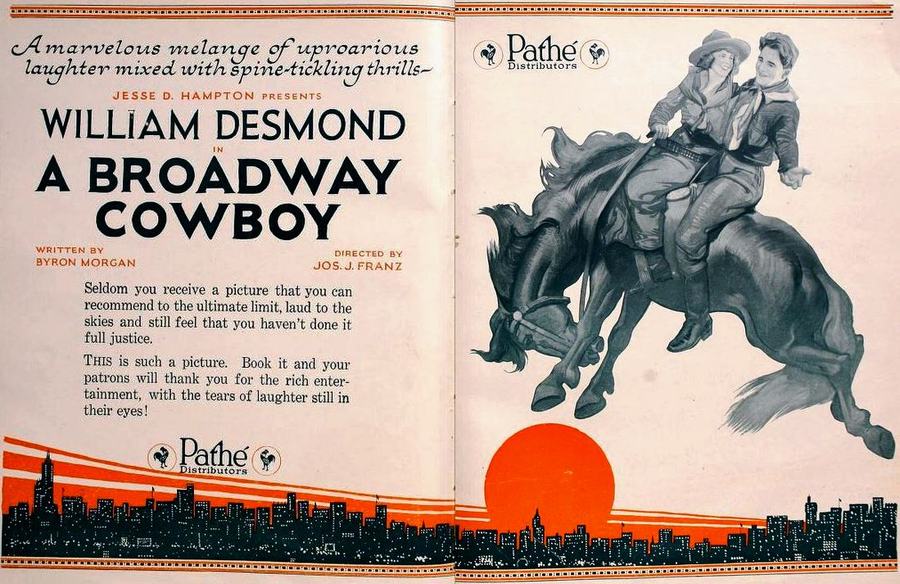
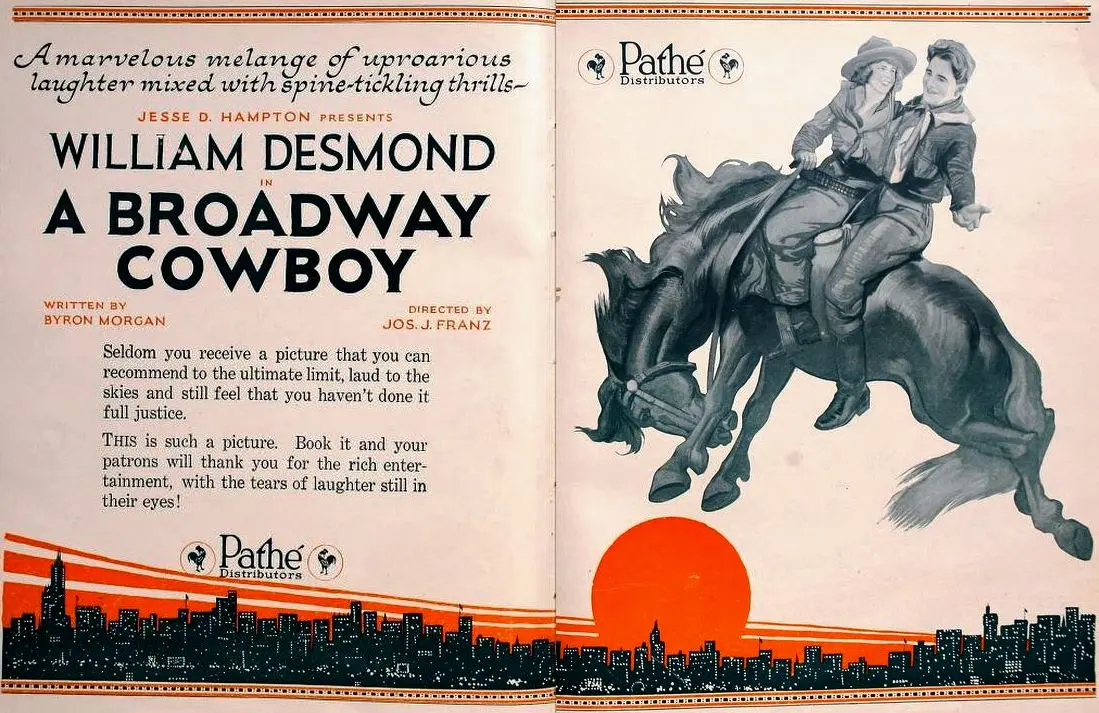
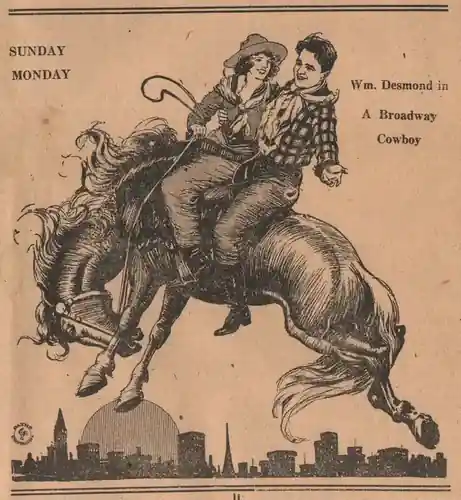
Footlights flicker, celluloid burns, and the West—wild, wanton, and weirdly theatrical—gallops headlong into the Great White Way.
There is a delectable perversity in watching a man who has spent his career pretending to lasso cardboard steers suddenly forced to outdraw a lynch mob beneath a horizon so wide it could swallow Broadway whole. A Broadway Cowboy (1924) wrings that irony until it squeals, brandishing a meta edge long before meta had a name. Director Edward Sedgwick—never shy of sprinting from one genre to the next—here fuses the sagebrush saga with the foot-stomping extravagance of 42nd Street. The resulting chimera feels like a moonshine high: giddy, improbable, and liable to leave you squinting at the sun.
Betty Jordan, limned by Betty Francisco with the doe-eyed fervor of a convert at a revival tent, is first glimpsed amid a riot of top hats and swinging playbills. She has come to devour A Western Knight, a smash musical that promises “six-shooters in 4/4 time!” Onstage swaggers Burke Randolph (William Desmond), a velvet-voiced counterfeit whose Stetson is brushed nightly by underpaid dressers. One matinee is sufficient: Betty exits the theater clutching not merely a program but a full-blown identity crisis. Months later, back under the cathedral skies of Montana, she is still clutching his photograph, a paper talisman against the dreary certainties of ranch life.
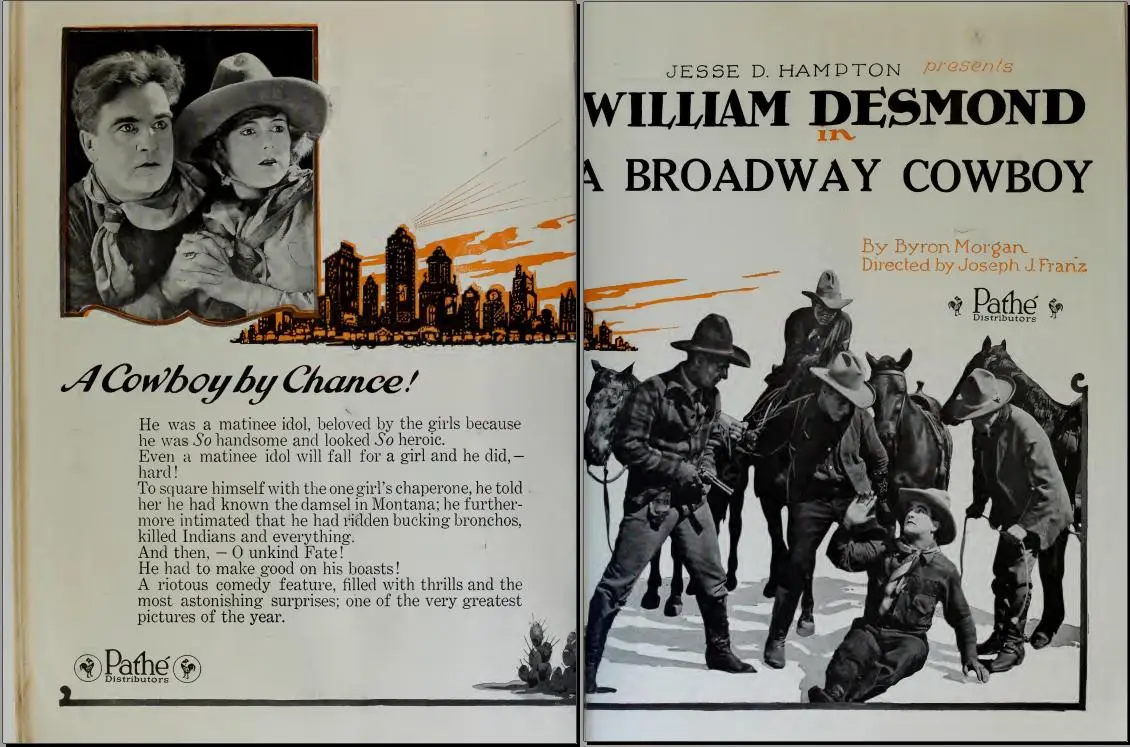
Enter Sheriff Sims (J.P. Lockney), a man carved from ponderosa pine, his badge polished to a mirror in which he daily admires his own rectitude. Sims has long regarded Betty as next season’s bride; the discovery of Burke’s likeness in her drawer ignites a jealousy so acute it nearly bends his Colt. Thus, when a battered touring coach rattles into the neighboring township with Burke’s troupe aboard, the lawman conflates legal code with personal vendetta. Arrest first, justify later.
What follows is a fugitive narrative stripped to the sinew: a jailbreak scented of kerosene, a chase through arroyos that yawn like cathedrals of doom, and a lynching party whose bloodlust is choreographed with Eisensteinian fervor—though Sedgwick, ever the gag-man, undercuts brutality with pratfalls. At the precise instant Burke’s boots twitch above dust, Betty storms in astride a chestnut mare, sabre uplifted. She severs the rope in a single swipe, reenacting the climax of A Western Knight while rewriting her own life script. It’s a moment that pirouettes on the razor between corn and sublimity; miraculously, it lands on the latter.
Shot largely on location in the parched backlots of Kern County, the picture luxuriates in chiaroscuro. Cinematographer Virgil Miller positions the sun like a follow-spot, letting it bleach planks, faces, and sandstone to parchment. When night unfurls, shadows pool so black they seem to swallow grain. In one extraordinary iris shot, Betty’s galloping horse is framed by a closing circle that squeezes the world into a trembling coin of light—an image that anticipates Sergio Leone’s stylistic ecstasy by four decades.
Interiors, by contrast, mimic the plywood opulence of a touring set. Theatrical flats wobble as Burke declaims; you half expect a stagehand to wander through with a cued apple. This deliberate artifice is the film’s wink: it reminds us that every frontier myth is already a stage play, every six-shooter a prop. When those flimsy walls collapse under the weight of real bullets, the collision of artifice and authenticity detonates a frisson few silents dare attempt.
Silent film acting is often caricatured as semaphore for the myopic, yet here the ensemble achieves a balletic naturalism. Betty Francisco’s eyes—wide enough to reflect entire mountain ranges—register infatuation, disillusion, and steel-spined resolve without collapsing into mugging. Watch her in the parlour scene as she fingers Burke’s photograph; her thumb grazes the emulsion as though testing a wound, a tiny gesture that speaks louder than title cards.
William Desmond, a veteran swashbuckler, relishes the chance to lampoon his own persona. Offstage, Burke Randolph is vainglorious, forever striking poses beside saloon mirrors. Yet when the lynch mob tightens its circle, Desmond drains the color from his cheeks—no small feat in monochrome—and lets terror quiver through his bravado. The oscillation between ham and human is mesmerizing.
J.P. Lockney’s Sheriff Sims could have slid into villainous caricature, but the actor gifts him a bruised dignity. In a late shot, after Burke has routed the bank robbers, Sims unhooks his badge, studies it as if it were a foreign coin, then re-pins it—an admission that justice and ego rarely share the same bunk. It’s a moment worthy of Renoir’s Patriotism, albeit baked in western soot.
George H. Plympton and Byron Morgan—scribes who could churn out serials faster than most folks change socks—deliver a narrative as lean as a coyote in winter. There are no subplot dalliances, no comic-relief cousins shoe-horned for census purposes. Instead, the film cleaves neatly: Act I, the enchantment of art; Act II, the crucible of reality. The transition occurs the instant Betty steps off the train onto Montana grit, the soundtrack—courtesy of a 2023 Alloy Orchestra restoration—shifting from tin-pan syncopation to the thud of hoofbeats.
Dialogue titles are sparse, witty, and salted with epigrams: “A rope is only as honest as the man who knots it,” reads one card during the lynch sequence. The line ricochets back during the finale when Burke, now heroic, refuses to let the townsfolk string up the captured bandits. The screenplay thus pirouettes around its own moral, preferring cyclical poetry to pulpit thumping.
It bears trumpeting that Betty performs the rescue, not once but twice—first spiritually (by yanking Burke out of the quicksand of narcissism) and then literally (by severing his hemp collar). In an era when heroines were often trussed to railway timetables, here the woman wields the blade. The film even sneaks in a sly critique of toxic possessiveness: Sheriff Sims’ downfall is not external but intestinal, digested by his own gall.
Supporting women also refuse the margins. Evelyn Selbie, playing the troupe’s wardrobe mistress, gets a brass-tacks monologue—delivered entirely in pantomime—about the economics of spangles and moths. The scene lasts maybe forty-five seconds, yet it punctures the romantic gauze surrounding theatrical life, reminding us that every rhinestone represents unpaid rent.
Devotees of Eye of the Night will detect a kinship in the way both films weaponize darkness as moral arena. Where Eye uses fog-choked streets, Cowboy exploits mesas that stretch like black seas under starlight. Meanwhile, the gender-swapped derring-do anticipates the screwball reversals found in Lions and Ladies, though Sedgwick arrives there two years earlier and with far less champagne effervescence.
If you crave a double bill, pair this with Betty in Search of a Thrill for a diptych about women who engineer their own adventures rather than inherit them. The tonal whiplash—from prairie thunder to jazz-age escapade—will leave you dizzy in the best possible way.
For decades, A Broadway Cowboy languished in a Parisian archive, a single nitrate print slowly reverting to dust. The 2023 4K restoration—funded by a consortium of western museums and a mysterious tech billionaire with a yen for lassos—returns the film to circulation with a tinting schema that rivals early Technicolor experiments. Sepia governs the Montana passages; a lurid magenta washes over the Broadway scenes, making the Great White Way resemble a fever dream inside a raspberry truffle.
Modern scores often drown silents with sonic grandiosity; here, the Alloy Orchestra opts for restraint—banjo plucks, brushed snare, and the occasional jew’s-harp twang that echoes across the frame like a ghost clearing its throat. Seek out a theater with live accompaniment if you can; the film’s final rescue plays differently when a flesh-and-blood horse whinnies in synchrony with onscreen hooves.
In our age of algorithmic content slurry, A Broadway Cowboy reminds us that stories can still be handmade, whittled from cedar and sweat. Its central thesis—that performance and reality are dance partners swapping leads—resonates louder in an era when identity is curated in pixels. Betty’s act of cutting the rope is not merely heroic; it is a manifesto for authoring one’s narrative when the mob insists on writing your ending.
Moreover, the film anticipates contemporary debates on fandom and parasocial obsession. Betty’s initial crush is indistinguishable from stan-culture worship; her journey toward agency charts the metamorphosis from consumer to participant. In rescuing Burke, she rescues herself from the cheap seats of life.
So, pilgrim, if your algorithm has steered you toward yet another algorithmic superhero carnival, consider a detour into 1924. Trade cape for Stetson, CGI for sunrise, Dolby roar for the hush of acetate. Let Betty Jordan gallop through your cynicism and remind you that once upon a pre-digital dusk, a woman with a sabre rewrote destiny while an actor learned that heroism is more than blocking and a cocked hip.
The rope frays, the footlights dim, but the legend rides on—hoofbeats echoing across a century, urging every spectator to seize their own reins.
IMDb 5.4
1931
Community
Log in to comment.