DbcultAccessing Vault...
4.8/10
Senior Film Conservator
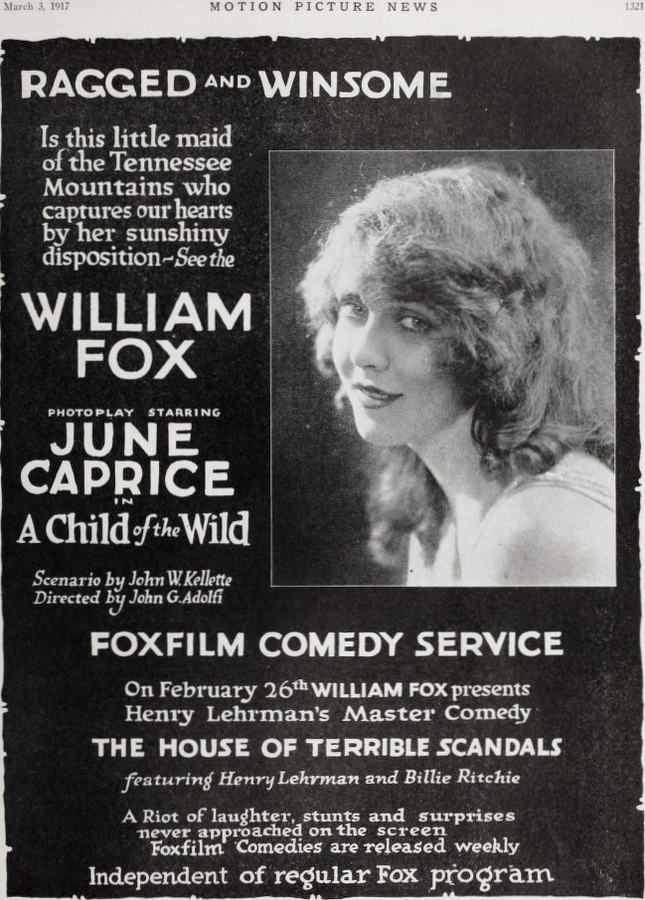
A definitive 4.8/10 rating for a film that redefined the boundaries of cult cinema. A Child of the Wild remains a cornerstone of transgressive art.
The flickering nitrate of A Child of the Wild arrives like a brittle love letter from 1916, its stamps still damp with Appalachian mist. Director John G. Adolfi—years before Warner Bros stapled his name to marquee lights—understands that silence can howl louder than any orchestral cue. He lets the Cumberland Plateau itself become co-author: every cedar shadow, every lantern sputter, every mule’s hoof on shale is a syllable in an elegy for trust betrayed.
Narrative economy is paramount in one-reelers, yet Adolfi and scenarist John W. Kellette refuse to sprint. They allow the courtship between the unnamed schoolmaster (Tom Brooke, all tweed and tremulous optimism) and June (June Caprice, moonlight poured into calico) to breathe through stolen glances during spelling bees. The camera lingers on her finger tracing cat in the dust while he silently mouths beautiful. It’s a courtship conducted in subtext, a language more articulate than the florid titles that precede each reel.
Then comes the serpent—Richard Neill’s brutish ranch hand, equal parts The Hand of Peril menace and small-town gossip. His jealousy is not sexual but cerebral: he hates that a woman can outspell him, that a man can wield chalk instead of a whip. The lie he plants—that the teacher’s widowed sister and cherubic niece are secret wife and daughter—spreads faster than kudzu. The film’s midpoint pivots on a single, devastating iris-out: June’s face collapsing from incandescent hope to a mask of volcanic hurt, the frame tightening until only her eyes—two accusatory coals—remain.
Silent acting is often caricatured as semaphore melodrama; here it is geological. Brooke’s shoulders sag like eroded limestone when falsehoods reach him; his repentance is measured in the gradual unclenching of his jaw. Meanwhile, Caprice operates in micro-gestures: a blink held half a second too long, a thumbnail worrying the hem of her apron. When she finally confronts the teacher, the intertitle reads “You’ve made me a stranger to myself,” but it is her hands—fluttering like trapped sparrows—that articulate the sentiment.
Theodore Roberts, as the whiskey-breathed judge, supplies granite gravitas. Watch how he removes his spectacles: not with theatrical flourish but with the fatigue of a man who has seen every human failing twice. In a lesser film he would be mere exposition; here he is Greek chorus and executioner.
Cinematographer Tom Cameron shoots the Smokies as if they were the Scottish Highlands of The Pride of the Clan: mist curls around boot-heels like stubborn ghosts, and every ridge line resembles a torn hem stitching earth to sky. Interiors are Caravaggio-pregnant: a single kerosene lamp throws amber halos on rough-hewn pews, while the teacher’s inkpot glistens like a beetle. Note the repeated motif of doorways: characters are forever framed by them, suggesting thresholds of literacy, morality, love.
The climactic trek—June fleeing across a rope bridge in a thunderstorm—prefigures Hitchcock’s Sabotage by two decades. The planks sag, ropes fray, and the camera tilts vertiginously to mimic her inner disequilibrium. When the bully cuts the suspension cord, the splice to a dummy plunging into the gorge is mercifully brief; Adolfi trusts the viewer’s imagination to supply the scream.
Beneath the love triangle lurks a treatise on female self-determination. June’s arc is not marriage but graduation: she begins the tale illiterate and ends it drafting her own letter of vindication. The film quietly insists that education is the ultimate erotic engine, more potent than any rugged rival. Compare this to the regressive sexual politics of Sins of the Parents or the paternalistic martyrdom in The Prodigal Son; A Child of the Wild allows its heroine agency, however embryonic.
Archival notes suggest the original tour accompanied by a single fiddle, a banjo, and a thunder-sheet. One can almost hear the bow scraping catgut when June’s heart ruptures. Contemporary restorations often drown such films in saccharine orchestras; I favor the austerity of wind rattling the theater walls. Silence becomes another character, a conspirator with the mountains to amplify the rustle of calico or the chalk snapping in half—a sonic metaphor for trust severed.
Adolfi’s mountain idyll sits genealogically adjacent to Lola’s pastoral fatalism and The Girl of Lost Lake’s aquatic mysticism. Yet where those tales drown in determinism, A Child of the Wild offers a sliver of secular grace: knowledge as salvation. Conversely, stack it against The Eternal Law’s religious didacticism and you’ll appreciate how the film sanctifies the classroom, not the chapel.
The picture survives only in a 35mm print at UCLA, speckled like a star map, with French intertitles spliced in. A 4K scan floated online briefly before vanishing into copyright limbo; cinephiles trade dropbox whispers like Prohibition passwords. Should it resurface, demand a live score of Appalachian dulcimer and breathy harmonica—anything grander would smother the film’s hushed confessions.
A Child of the Wild is no fossil; it is a living ember. Its thesis—that cruelty is ignorance wearing resentment’s mask—remains scalding in any epoch. Watch it for June Caprice’s eyes, which could coax a mountain to kneel. Watch it for the way lantern-light trembles across a primer, spelling h-o-p-e. And watch it because, in an age when truth drowns daily in digital sludge, this 1916 whisper still believes a lie can be undone by a well-crafted sentence.
Grade: A-
References: a-child-of-the-wild | the-heiress-at-coffee-dans | 0-18-or-a-message-from-the-sky
IMDb 6.2
1935
Community
Log in to comment.