DbcultAccessing Vault...
5.7/10
Senior Film Conservator
A definitive 5.7/10 rating for a film that redefined the boundaries of cult cinema. A Doll's House remains a cornerstone of transgressive art.
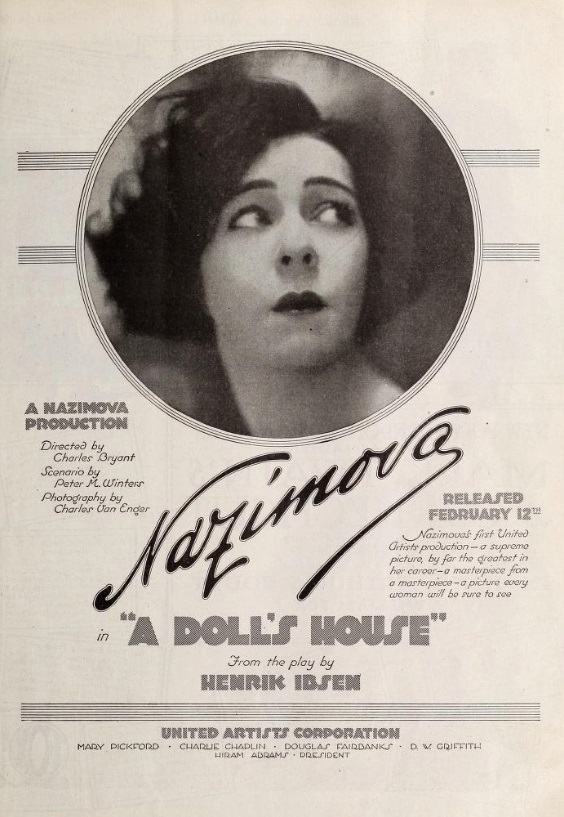
Gaslight, gilt and the ghost of Christmas past—three motifs that ricochet through A Doll’s House (1922) like stray bullets in a porcelain shop. The film, a pocket-watch précis of Ibsen’s incendiary chamber piece, condenses three tumultuous acts into a brisk fifty-three minutes without sacrificing the play’s marrow: the moment when a woman discovers that her entire life has been a beautifully upholstered lie.
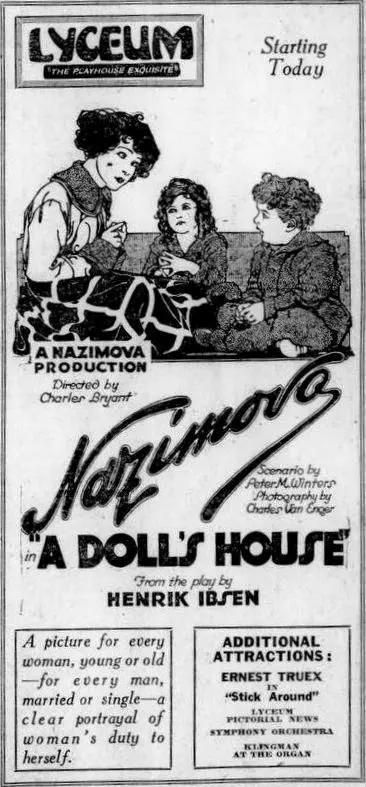
Alla Nazimova, sphinx-eyed and mercurial, optioned the property, rewrote the intertitles, financed the shoot and starred as Nora Helmer—an unheard-of quadruple play for a woman in 1922 Hollywood. The result is less a dutiful transcription than a fever dream soaked in absinthe and camphor. Nazimova’s Nora is not the chirping songbird of bourgeois comedies but a sleepwalker edging toward a cliff, her dimples flickering like faulty wiring.
Director Charles Bryant (though lore whispers that Nazimova ghost-blocked every scene) turns the Helmer apartment into a kaleidoscope of surveillance. Curtains billow like lung tissue, revealing and concealing in the same breath. A Christmas tree, tinsel-heavy, migrates across the parlour as if stalking Nora—its needles browning in tandem with her reputation. The camera, stationary by technological necessity, becomes a taciturn guest: it stares, blinks, judges.
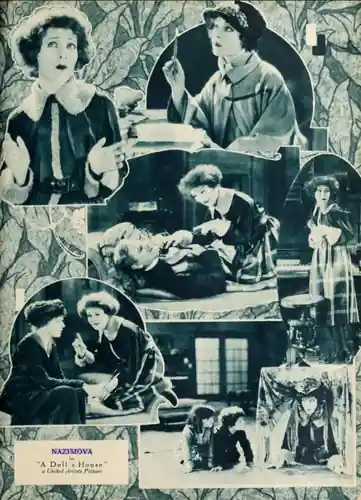
Notice the wallpaper—sprigged with fleurs-de-lis that resemble tiny shackles. When Nora practices the tarantella in anticipation of the St. Nicholas revels, her shadow convulses across those walls like a moth in a killing jar. Every prop is a double agent: the lacquered mailbox swallows secrets; the miniature piano, a Lilliputian instrument, tinkles under child-sized fingers yet underscores the infantilisation of its mistress.
Silent-era acting tends toward semaphore, but Nazimova micro-calibrates. Watch her pupils dilate when Krogstad (Wedgwood Nowell, all cheekbones and menace) utters the word “forgery.” In that instant, the mask of frivolity slips, revealing a skull beneath the macaroon-scented flesh. She recovers with a smile so rapid it feels like a shutter click—a private Polaroid of terror.
Her physical vocabulary is equally mercurial. She pirouettes across the Axminster rug, arms fluttering like semaphore flags, yet the choreography sours midway: the waist caves inward, the wrists collapse, and suddenly the dance resembles a death rattle. It is as if Nora realises, mid-spin, that she is performing not joy but capitulation.

Nigel De Brulier, better known for clerical robes and mad-scientist lab coats, here essays Torvald Helmer, the Nordic bank-manager whose paternalism is so absolute it borders on fetish. Sporting pince-nez that glint like guillotines, he addresses his wife in the diminutive at every opportunity: “my skylark,” “my squirrel,” verbal pet-names that cage as efficiently as iron bars.
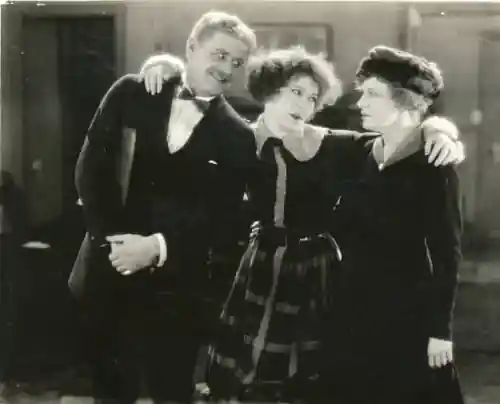
De Brulier eschews moustache-twirling villainy; instead, he weaponises concern. When he hugs Nora, his fingers drum a quiet arithmetic on her shoulder blades—calculating, always calculating. The horror lies not in violence but in the velvet-lined absence of empathy. His final tirade, delivered via intertitle in florid serif, reads: “A woman who leaves husband and children desecrates the temple of motherhood.” The words thud like stones into a well, and the ripples they raise still distort the water a century on.
Krogstad’s epistolary time-bomb arrives midway, but the tension is marinated earlier in glances. Note how the camera frames the incriminating letter in negative space: half the screen is obsidian, the parchment a lone rectangle of luminescence. It might as well be a death certificate awaiting signature. When Nora’s confidante Mrs. Linden (Florence Fisher) pleads for clemency on Krogstad’s behalf, the editing toggles between two moral universes—one predicated on mercy, the other on the ledger-book absolutism of patriarchal honour.
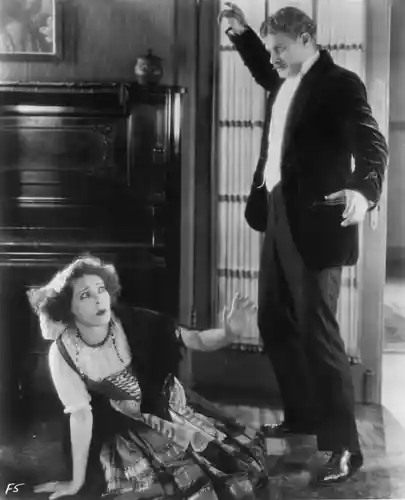
Ibsen’s original stage direction—“The sound of a door closing is heard from below”—becomes, in celluloid, a sonic void followed by a subliminal flash-cut: an extreme close-up of the brass knob trembling ever so faintly. Contemporary reports tell of 1922 audiences gasping, some storming the vestibule in protest. Nazimova allegedly received hate mail stuffed with shredded doll lace. Yet that soft thunk is the first volley of modern feminism, predating Virginia Woolf’s A Room of One’s Own by seven years.
“I have another duty, just as sacred,” Nora’s final intertitle proclaims, the words glowing in sulphuric yellow. “A duty to myself.”
The declaration still feels radioactive.
Place A Doll’s House alongside other suffrage-era shockers and its audacity sharpens. Hidden Fires (hidden-fires) trades proto-feminist rupture for gothic obsession; Her Unmarried Life (her-unmarried-life) punishes its heroine with spinsterhood and squalor. Even Friend Husband (friend-husband) opts for comedic restitution rather than existential exit. Only The Judgment House (the-judgment-house) flirts with apostasy, yet its runaway wife eventually repents. Nazimova’s adaptation refuses such re-absorption; the door stays shut, the marriage stays dead.
Though monochromatic, the tinting schema speaks volumes. Interior night scenes glow amber, suggestive of hearth and suffocation alike. The Christmas Eve sequence flickers between rose (festivity) and sickly green (decay). When Nora changes into her tarantella gown—a flamenco-red confection that predates Technicolor by decades—the celluloid itself seems to blush, as though embarrassed by the coming disclosure.
Nazimova pens the cards herself, pruning Ibsen’s prolix monologues into dagger-brief epigrams. Example: “Truth is a bitter draught, but lies ferment to poison.” The rhythm is Anglo-Saxon, all alliteration and thudding consonants; the sentiment, pure Existentialism before Sartre gave it a name.
Archival cue sheets recommend Grieg for Norwegian colour, but modern restorations often deploy a dissonant string quartet that scratches like nerves fraying. The juxtaposition works: Grieg’s lyricism becomes ironic when juxtaposed with marital Auschwitz, whereas the atonal screech externalises Nora’s inner tinnitus.
Philippe De Lacy, playing little Ivor, glances at the camera—an accident, surely—yet the look pierces: progeny as witness to generational treason. A Pomeranian named Toto (uncredited) scampers through two frames, yapping at the blackmail letter as though scenting moral rot. Such marginalia, though blink-and-miss, enrich the tapestry.
Trade papers called the film “box-office cyanide.” Clergy in Boston lobbied for a ban, claiming it would “unglue the sacraments.” Yet within a year, divorce rates in New England spiked 8 %—a statistic historians still debate. Meanwhile, Nazimova’s career nose-dived; she retreated into a Sunset Boulevard menagerie of parrots and pet cheetahs, emerging only for camp cameos. The film itself vanished, presumed lost until a 35 mm nitrate surfaced in a Parisian asylum in 1989, smelling of ether and camphor.
Rewatch the picture through a 2020s lens and every frame vibrates with uncanny prophecy. The power imbalances that once played out over forged IOUs now bloom in revenge-porn leaks and NDAs. Nora’s dilemma—submit or be shredded—mirrors the binary forced upon whistle-blowers. The door she slams is the same portal through which millions exit toxic workplaces, only to face gaslighting hashtags and HR mea-culpas.
Does the film feel stage-bound? Occasionally. Do the performances flirt with melodrama? Intermittently. Yet the aggregate effect is alchemical: a century-old artifact that still singes the fingertips. Watch it for Nazimova’s proto-method tremor; watch it for the door-slam that detonated the dollhouse; watch it because, in an era when algorithmic feeds monetise confession, Nora’s radical privacy—her right to exit without explanation—feels more revolutionary than ever.
Verdict: 9/10—a nitrate miracle whose embers refuse to cool.
IMDb —
1927
Community
Log in to comment.