DbcultAccessing Vault...
Cult Review
Senior Film Conservator
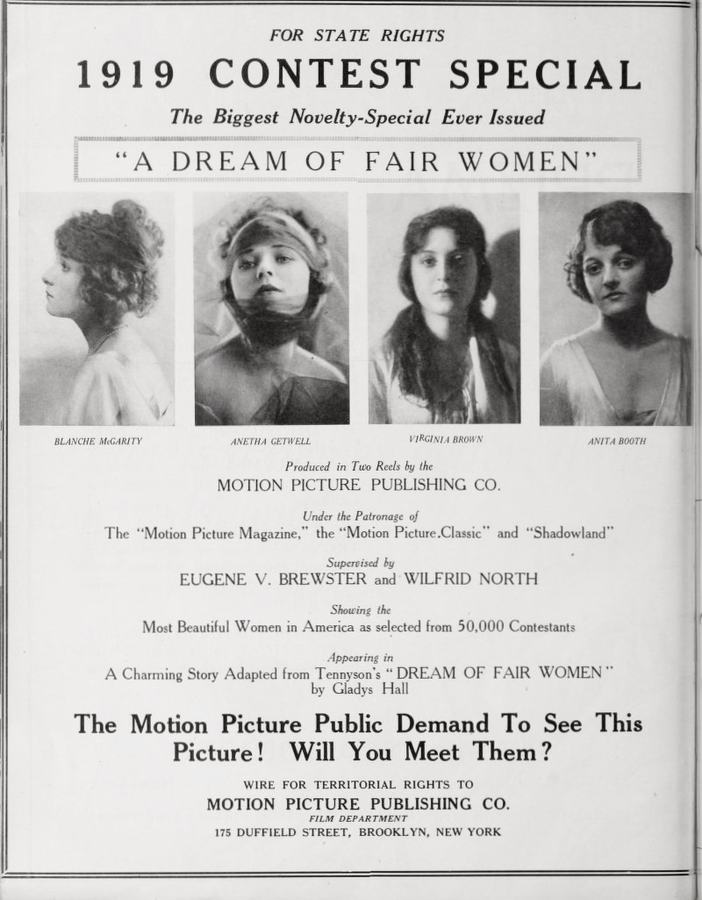
Celluloid orchids bloom only once; some shed perfume so intoxicating the audience forgets the thorns. A Dream of Fair Women is such a flower—an opiate sonnet stapled to newsprint, a beauty contest turned fever dream, a cultural x-ray smuggled inside a fan-magazine confection. Ninety-nine percent of 1924 moviegoers lapped it up as froth. The remaining one percent—those who listened to the negative space between the title cards—felt the chill of prophecy.
Start with the numbers: 75,000 entrants, four victors, one film. The contest, bankrolled by syndicated fan weeklies, promised "a passport to immortality." In hindsight the phrase reeks of snake oil, yet it sold papers the way Valentino’s gaze sold sighs. The producers—half moguls, half carnival barkers—shoved the winners straight onto an ice-cold soundstage in February 1924, ordered them to embody "Tennyson’s ideals of feminine grace," and hoped the alchemy of klieg lights and cheap verse might yield prestige. What they got instead was a hall of mirrors reflecting every anxiety the decade had about commodified femininity.
Virginia Brown Faire, barely seventeen, had the translucent pallor of a cameo; the camera loved the way shadows pooled in her collarbones. Anita Booth, brassy and broad-shouldered, hailed from storefront musical revues and possessed the confident swagger of a woman who already understood that beauty is a job. Blanche McGarrity brought Broadway diction that sliced through the silence like a stiletto. The fourth winner, listed simply as Virginia Brown, remains a phantom—her surname perhaps cannibalized for marquee symmetry. Their real names did not matter; the contest had rechristened them as brand archetypes.
The scenarist Gladys Hall—later infamous for ghosting When a Woman Sins—braided lines from "A Dream of Fair Women" and "The Idylls of the King" into gossamer intertitles that flutter like pennants of ennui. Hall’s genius lay in juxtaposing archaic cadences with the blunt vernacular of fan-mag headlines: "The mirror cracked from side to side; the selfie failed to filter grief." The dissonance is delicious, a cultural paper cut that stings long after the film ends.
Director Russell Ball, primarily a society photographer, understood faces as topographies rather than personalities. He lights each woman as if she were a monument at dusk—haloed yet already eroding. In one prolonged medium shot, Virginia Brown Faire lowers her opera gloves with the lethargic grace of a queen abdicating. The camera lingers until the gesture becomes unbearably intimate, then cuts to a marble bust whose chiseled nostrils echo her own. The montage implies lineage: Galatea begat Gibson who begat Brown Faire, each generation more porous, more marketable.
Halfway through, the film abandons its flimsy narrative and becomes a cyclopedia of gazes. We see the women through the opera glasses of a predatory critic, through the newsreel lens of a jittery cameraman, through the kaleidoscope eyes of a child who wants to be them. Each optical device distorts; none clarifies. The multiplicity anticipates Laura Mulvey by five decades, yet it never feels academic—more like a striptease where the clothing removed is the spectator’s complacency.
Consider the wax museum sequence. The quartet wander among dummies of themselves, posed in tableaux lifted from Tennyson: "The Lady of Shalott" floating in a papier-mâché boat, "Godiva" astride a hobbyhorse. Spotlights flicker, and the dummies seem to breathe. Anita Booth leans close to her simulacrum, lips parted as if about to kiss or bite. The moment suspends itself like a drop of mercury—beauty contemplating its own embalming. A jump cut hurls us into the roaring street where newsboys hawk the latest contest results. We feel the whiplash of modernity: in the space of a splice, reverie becomes commodity.
Because A Dream of Fair Women is silent, the spectator becomes complicit in manufacturing desire. We fill the aural void with our own soundtrack of fantasies, half-remembered poems, the rustle of popcorn undercut by heartbeats. The film weaponizes that silence. When a jealous actress—Blanche McGarrity in a subplot that feels grafted from A Wife’s Sacrifice—plots to disfigure a rival, the screen goes completely black for twelve seconds. Today the gag would feel sophomoric; in 1924 it was tantamount to an earthquake. Patrons screamed, fainted, demanded refunds. One Chicago exhibitor inserted a slide that read "Please do not panic—merely think of darkness as beauty’s shadow." The line sounds like something out of Erträumtes, but it worked.
Surviving prints are amber-washed, yet production notes describe a more flamboyant palette: cyan for the "lake of dreams," magenta for the "coronation of tears," sulfur yellow for the backstage catwalk. Those hues survive only in the mind of anyone lucky enough to attend the 1924 premiere, leaving the rest of us to hallucinate them like mirages. The absence is poetic; color becomes another woman the film once loved and lost.
Ball’s most audacious flourish arrives in the final reel. The women, draped in chiffon that behaves like liquid mercury, step toward the camera until their faces eclipse the frame. Their eyes meet ours, unblinking, until the image overexposes and burns to white. In the ensuing void, an intertitle queries: "Did you vote in the contest? Did you buy the magazine? Did you dream of being fair?" Nothing in pre-Code cinema, not even the Brechtian shenanigans of The Bullshevicks, weaponizes spectatorship so brazenly. The film ends, but the interrogation lingers, a brand burned onto the retina.
Virginia Brown Faire, often dismissed as merely decorative, achieves something close to transcendence in her solo ballroom scene. She glides past a colonnade of mirrors, each reflection offset by half a second, producing a stuttered accordion of selves. The choreography is simple, yet her gaze—equal parts knowing and bereft—imbues the moment with the ache of someone who suspects paradise is gilded plywood.
Anita Booth, conversely, weaponizes the carnivalesque. When her character (credited only as "The Entertainer") performs a bawdy hootchy-kootchy, she does so with the defiant swagger of a woman cashing in on the only coin men accept. Watch her eyes: they mock the very spectators they seduce, presaging Marlene Dietrich’s insolence by half a decade.
Blanche McGarrity, saddled with the villainous subplot, plays it like Lady Macbeth trapped in a Sears catalogue. Her lineless close-ups—merely glances—drip arsenic. When she finally repents, the contrition reads as sarcasm; the film refuses to grant moral absolutes the comfort they crave.
Hall and Tennyson make strange bedfellows. Where the poet idealizes, the journalist dissects; where Tennyson’s women drift like lilies, Hall’s slog across the mud of modernity. The tension crackles in every intertitle. "The mirror cracked from side to side" becomes a description of a starlet’s first wrinkle; "Out flew the web and floated wide" accompanies a fashion show where gowns unravel as models walk. The pastiche should collapse under its own weight, yet it holds, buoyed by earnest conviction that beauty and ruin are conjoined twins.
Viewed today, the film reads as an unwitting #MeToo parable. Contestants sign contracts they cannot read; photographers demand smiles like alms; magazine editors trade phone numbers like poker chips. The more things change… Yet the indictment is too diffuse to feel didactic. The camera adores these women even as it documents their entrapment, implicating itself and, by extension, us. The contradiction is the point: desire cannot exist without exploitation’s ghost trailing behind.
Curiously, the picture anticipates reality television’s parasitic rituals. Swap the wax museum for Instagram filters, swap fan-magazines for subscriber counts, and the narrative remains identical. Only the speed accelerates. The film’s languid long takes—some stretch beyond forty seconds—feel like acts of resistance against the frantic scroll of modern attention spans.
For decades, A Dream of Fair Women was lost, its negatives rumored melted for silver salvage during the war. Then in 1987, a canister labeled "misc. beauty reels" turned up in a Slovenian monastery attic, nestled beside reels of Azra. Restoration yielded only twenty-three minutes, but the fragments were enough to ignite scholarly obsession. Various archivists have since stitched in production stills, surviving continuity sketches, even frames from a 1926 Japanese bootleg to produce a 56-minute "phantom version." Criterion currently streams this assemblage, accompanied by a score that blends Debussy with glitch-hop—an anachronism that somehow deepens the film’s aching modernity.
Your best bet is Criterion Channel’s "Pre-Code Reveries" collection, though it disappears at month’s end. A 2K restoration screened last year at Bologna’s Il Cinema Ritrovato, drawing audible gasps during the blackout sequence; expect a Blu-ray announcement imminently. For adventurous cinephiles, a 16mm print with German intertitles circulates among private collectors under the title Schöne Frauen, Tödliche Träume, occasionally surfacing at underground festivals alongside The Tavern Knight or The Infant at Snakeville.
There is no moral, no takeaway, no comforting thesis. A Dream of Fair Women offers only a hall of mirrors and the dare to step inside. You emerge seeing your own hunger refracted a thousandfold, aware that the contest never ended; it merely rebranded. In the closing shot, as the women dissolve into overexposed white, you half-expect them to reappear on a smartphone screen, lips plumped by filter, eyes pleading for likes. They do not age because they were never alive in the conventional sense; they are avatars of our oldest transaction—beauty bartered for immortality, paid for with flesh.
Watch it once for the historical frisson, twice for the feminist subtext, thrice for the vertigo of self-recognition. After that, the film watches you.
IMDb —
1936
Community
Log in to comment.