DbcultAccessing Vault...
6/10
Senior Film Conservator
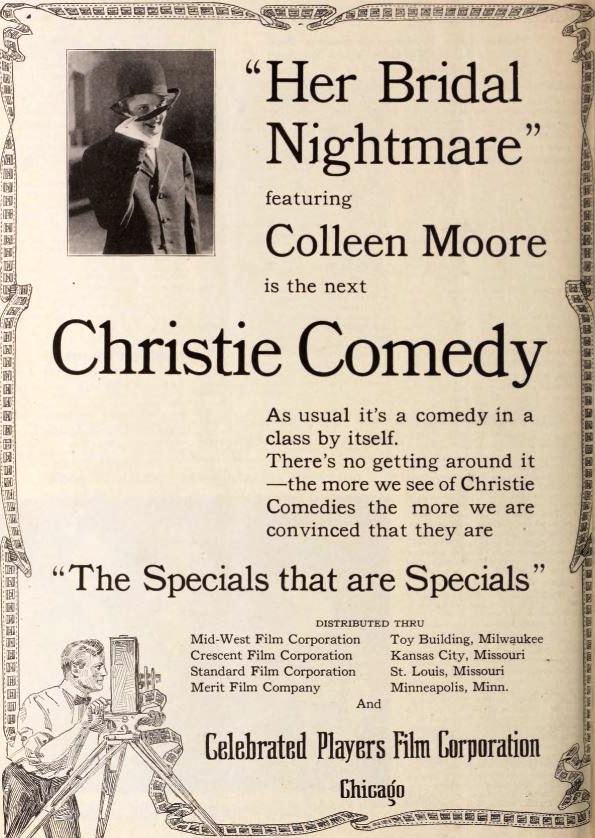
A definitive 6/10 rating for a film that redefined the boundaries of cult cinema. Her Bridal Night-Mare remains a cornerstone of transgressive art.
Mary’s wedding combusts like nitrate in Her Bridal Night-Mare, a 1920 one-reel grenade lobbed by slapstick’s late-teens anarchists. Clocking a breathless twelve minutes, the film stitches Keystone chaos to a bridal gown and lets every stitch pop. The result is a celluloid panic attack that feels closer to Cocteau than to Under the Top’s trench-war yuks.
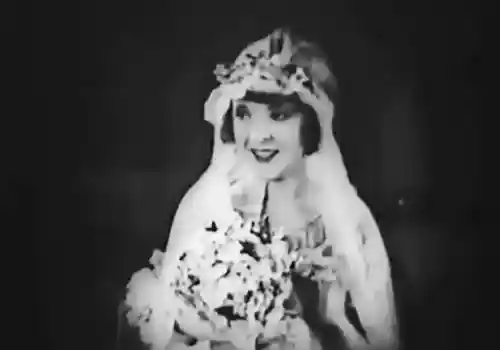
Colleen Moore, months shy of her flapper immortality, plays Mary as a kohl-rimmed Cassandra in satin pumps. She enters in a lattice of morning light, bouquet trembling like a guilty heart. The camera—static yet merciless—watches her glide past a hallway of wedding gifts: silver ashtrays reflecting her face into infinity, each reflection paler, more spectral. Already the film hints that marriage is a hall of mirrors, identity fracturing into marketable roles.
Director Ora Carew, a name scrubbed from most histories, stages disaster like a cubist: she fractures time, loops gestures, lets continuity slit its own throat. A maid trips, a cake plummets, the groom’s tux splits at the crotch—each gag ricochets off the previous one until causality itself feels tipsy. Compare that to Hitting the Trail, where gags land like polite hiccups; here they detonate in overlapping chords, a staccato nightmare overture.
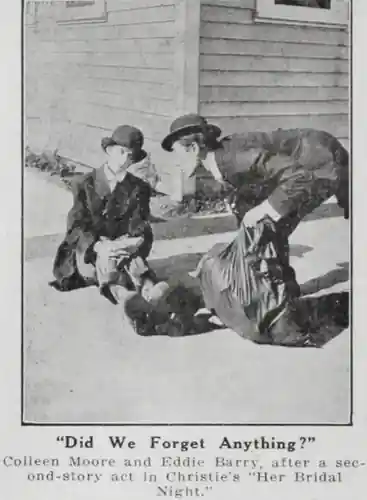
The groom, played by Earle Rodney, is a masterpiece of emasculation: thin moustache, pocket watch ticking louder than his pulse, shoes so polished they mirror the ceiling. When the ring rolls down a gutter grate, his shriek is silent yet deafening—intertitles simply read “—” as if language itself had fainted. Gino Corrado’s leering best man circles like a vulture in morning coat, sniffing calamity, while Eddie Barry’s drunken reverend misplaces the vows, leafing frantically through Dr. Jekyll and Mr. Hyde instead of the Bible—a meta-wink that weds Victorian duality to Jazz Age jitters.
Helen Darling’s bridesmaid, a flapper before the term existed, keeps applying rouge until her cheeks blaze like signal flares. She is the film’s Greek chorus, smirking at every mishap, her laughter a metronome for impending doom. Watch her eyes when Mary’s veil catches fire (a stray candle, a clumsy acolyte): pity flickers, then glee—the thrill of watching perfection burn.
Technically, the short is a marvel of thrift-shop surrealism. Double exposures let Mary’s future self—tired, bloated, clutching triplets—hover over the ceremony like a balloon of regret. The camera cranks faster during chase sequences, so bodies smear into ghost comets. Lighting swings from over-exposed noon to tungsten dusk without apology, as if the sun itself were impatient. In contrast, The Lure of Millions bathes every fortune-hunter in even klieg glamour; here, shadows gorge on faces.
Sound, of course, is absent, yet the film shouts. Intertitles arrive in fractured free verse: “Vows—velvet—void.” The typography jitters, letters slipping like loose type downstairs. Music directions scrawled on exhibitor cue sheets call for “Wagner segued into turkey gobble”—a joke on the solemnity of Mendelssohn. Contemporary reports claim some projectionists substituted machine-gun sound effects during the cake-collapse, merging matrimony with battlefield, a pun on the marital “war.”
Plot, nominally, traces the twelve hours before vows. Yet causality is a drunkard. Mary loses her garter, finds it on the family dog, repurposes it as a tourniquet for the fainted organist. The ring, recovered from the sewer, slips onto a policeman’s truncheon—suggesting authority, not love, will clamp her future. Each gag scalds the institution it mocks: the white dress, the tiered cake, the father-give-away ritual—all exposed as cargo cult accouterments.
Feminist undertones seethe beneath the slap. When Mary finally bolts—veil streaming like a comet tail—she sprints past rows of storefront mannequins in bridal gowns, their glassy eyes locking onto hers. Consumerism and chastity fuse into a prison. The shot predates similar imagery in Why Women Sin by seven years, yet feels rawer, less didactic, more howl.
The climax arrives inside a dream-logic chapel: stained-glass saints wink, pews melt into sand, the groom multiplies into a dozen identical grooms who surround Mary in a danse macabre. She spins faster, the camera matching her delirium, until the footage itself appears to shred—achieved by scratching emulsion in diagonal furrows. A jump cut: Mary wakes on a bench outside the real church, no ceremony begun, the nightmare merely the engagement ring’s weight on her finger. Ambiguity reigns: has she fainted from dread, or has the universe granted a cosmic mulligan?
Historians label the film a “minor one-reeler,” yet its DNA infects later wedding satires from Monsoon Wedding to Bridesmaids. Carew anticipates the anarchic pacing of Looney Tunes: objects possess vendettas, physics hold grudges. Compare that to The Kentucky Colonel, where plantation nostalgia plods; here, modernity shrieks.
Performance-wise, Moore is revelation. She toggles from ingenue to hysteric without the crutch of dialogue, her eyebrows hieroglyphs of dread. In close-up, freckles show through pancake makeup—a human stain under the bridal lacquer. Watch her fingers when the ring falls: they twitch like moth wings, a micro-gesture that speaks volumes on class anxiety (the ring, we learn, cost two months of the groom’s salary).
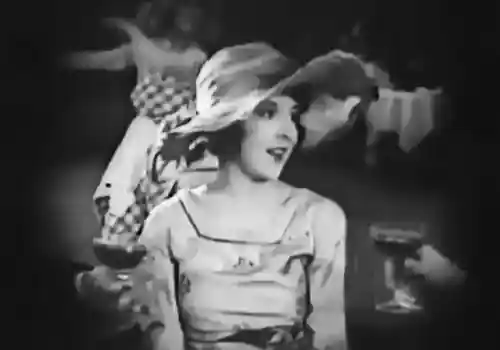
The supporting cast orbit her like deranged planets. Gino Corrado, later typecast as urbane waiter, here channels a predatory charm, his smile a switchblade. Eddie Barry’s drunk minister, stumbling over Latin, turns sacrament into burlesque—a preview of the clerical lampoon in The Dead Alive, yet bleaker because 1920 audiences still feared hellfire.
Production lore claims the shoot lasted three days on a backlot the size of a tennis court. Rain forced interiors, so Carew leaned into claustrophobia: walls close like vise jaws, ceilings lower between takes. Budget constraints birthed innovation: the sewer grate is a painted oatmeal can; the multi-groom effect achieved by triple-exposing the same strip, each time masking Moore in black velvet. Ingenuity born of poverty—an ethos later embraced by The Speakeasy’s guerrilla aesthetics.
Reception, tragically, was muffled. Released as filler after a Dempsey fight reel, reviewers called it “a nuptial hiccup.” Yet Variety noted “a queasy undertow beneath the frosting,” sensing subversion. The film vanished for decades, resurfacing in a 1974 Slovenian archive mislabeled “Wedding Stooge.” Restoration required frame-by-frame bleaching to remove mold, yet scars remain: blotches hover like memories of scandal.
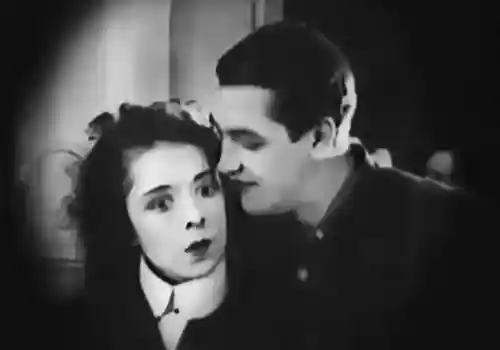
Today, amid TikTok weddings choreographed to synthpop, Her Bridal Night-Mare feels prophetic. It foresaw the performance anxiety of modern brides, the Instagram pressure for perfection, the capitalism lurking under every cutesy hashtag. Watching Mary’s unraveling is to confront your own curated bliss, the possibility that the ceremony is not culmination but curtain.
Technically, the restored 4K scan reveals textures lost in standard prints: satin’s warp, the groom’s razor nicks, a background poster for Willard-Dempsey Boxing Contest—a reminder that mass spectacle, nuptial or pugilistic, sells tickets. The tinting follows period conventions: amber for interiors, cyan for dusk, rose for the nightmare. Yet the nightmare spills into other scenes, suggesting trauma’s refusal to stay color-coded.
Comparative note: fans of With Serb and Austrian’s wartime absurdism will find similar existential slapstick here—both films weaponize laughter against institutions that devour individuals. Meanwhile, The Fighting Brothers offers fraternal brawls; Night-Mare offers marital melee—bloodless yet bruising.
Scholars of early female directors often overlook Carew, partly because only this reel survives. Yet her compositional daring—split diopters, jump cuts, meta-gags—places her beside Lois Weber and Alice Guy. The loss of her other works (rumored to include a jazz-age Salome) feels criminal, like misplacing a sunrise.
Audience takeaway: if you crave silent comedy beyond Chaplin’s ballets or Keaton’s stoneface epics, this bite-sized morsel delivers vertigo. It mocks the wedding-industrial complex a century before Etsy, exposes the virgin-bride myth stickier than rice, and gifts Moore a moment to blaze pre-flapper ferocity. Watch it at midnight, veil optional, ring off, expectations low; let its nihilist confetti rain.
Final paradox: the shorter the reel, the longer the shadow. Twelve minutes of Her Bridal Night-Mare haunt harder than three hours of The Man from Bitter Roots’ melodrama. Perhaps because nightmares, like marriages, compress eternity into a heartbeat.
IMDb —
1922
Community
Log in to comment.