DbcultAccessing Vault...
Cult Review
Senior Film Conservator
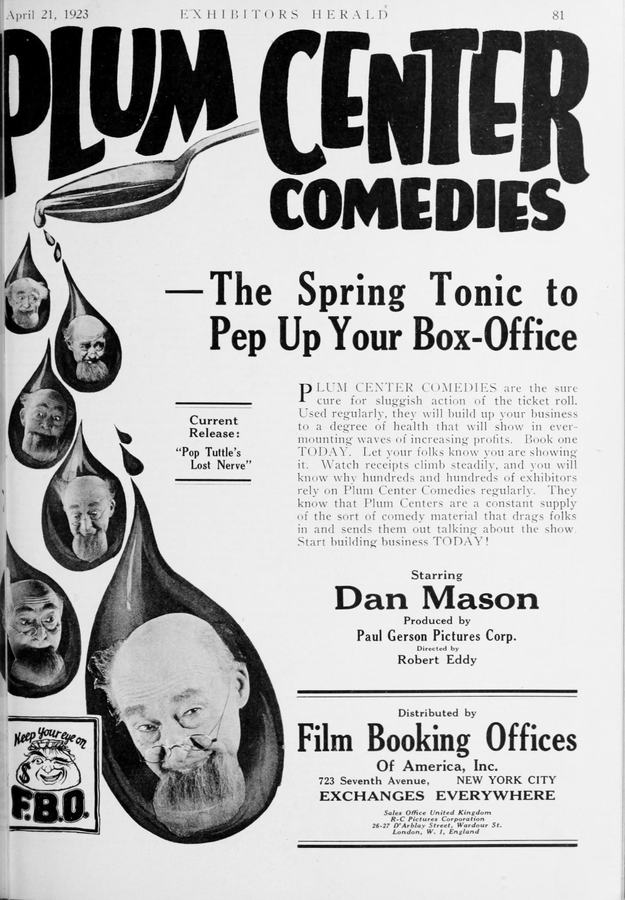
The silent era was frequently preoccupied with the vulnerability of the human body, turning the visceral anxieties of the early 20th century into a playground for kinetic comedy. In Pop Tuttle's Lost Nerve, we find a quintessential example of how the burgeoning field of dentistry—specifically the 'painless' variety that once dominated American street corners—served as a catalyst for both laughter and a deep-seated, relatable dread. This isn't merely a film about a toothache; it is a meticulously crafted exploration of the fragile facade of masculine bravado when confronted with the cold, gleaming steel of a dental forceps.
The arrival of the dentist in Pop’s town is framed not as a medical necessity, but as a carnivalesque event. The Al Giebler script brilliantly captures the social dynamics of a small town where the promise of something for nothing—even something as inherently unpleasant as a tooth extraction—can draw a crowd. This thematic obsession with 'the deal' or the shortcut to prosperity is a recurring motif in the era, reminiscent of the frantic pace seen in A Million a Minute, though here the stakes are far more intimate and painful.
The 'painless' dentist is a character archetype that modern audiences might find baffling, yet at the time, figures like 'Painless Parker' were household names. By offering free services to onlookers, the film’s antagonist creates a public theater of suffering masked as benevolence. The crowd’s reaction is a masterpiece of silent ensemble work. We see the faces of Thomas Rooney and Oliver Eckhardt, reflecting a spectrum of emotion from sadistic glee to empathetic winces. It is a social commentary on the voyeurism of the masses, a theme that echoes through more serious contemporary works like The Spy, albeit through a comedic lens.
At the heart of this storm is Dan Mason. As Pop Tuttle, Mason employs a physical vocabulary that is nothing short of virtuosic. His performance relies on the 'lost nerve'—a double entendre referring both to the anatomical nerve of a tooth and the psychological collapse of his courage. Mason’s face is a topographical map of rural anxiety. Every twitch of his mustache and every frantic roll of his eyes communicates a specific stage of panic. Unlike the more polished, urban protagonists of the time, Pop is a man of the soil, much like the characters in The Clodhopper, making his vulnerability feel grounded and painfully human.
Helen Howell and Wilna Wilde provide the necessary domestic grounding that elevates the film beyond a simple series of gags. Their presence reminds the audience that Pop’s ordeal isn't just about a tooth; it’s about his standing in the community and his household. In many ways, the female characters in these comedies acted as the 'straight men' to the male lead's hysteria, a dynamic that was often inverted in more dramatic fare like The Hungry Heart. Here, their reactions serve to heighten the absurdity of Pop’s situation, as they oscillate between genuine concern and the exasperation of dealing with a man-child in the throes of a minor medical crisis.
"The genius of the Giebler script lies in its ability to turn a clinical setting into a Roman coliseum, where the 'nerve' is the only gladiator and the dentist is the lion."
The cinematography of Pop Tuttle's Lost Nerve utilizes the limited depth of field of the early 20s to create a sense of claustrophobia within the dentist’s office. The camera lingers on the instruments—oversized, menacing, and archaic by today's standards—transforming them into characters in their own right. The pacing is deliberate; it doesn't rush into the chaos. Instead, it builds the tension through a series of 'near-miss' extractions, a technique that builds anticipation in the audience similar to the suspense found in Around Corners.
One must also consider the editing. The rhythmic cutting between Pop’s terrified face and the dentist’s oblivious, professional cheerfulness creates a comedic friction that sustains the middle act. This isn't the high-concept humor of Lloyd or Keaton; it is something more visceral and earthy. It taps into a universal human experience—the fear of the chair—and amplifies it through the lens of early 20th-century skepticism toward 'new' medicine. This skepticism is a frequent trope, also explored with a different flavor in One-Thing-at-a-Time O'Day.
While the surface level of the film is pure farce, there is an underlying critique of the era’s lack of regulation and the vulnerability of the rural populace to urban 'experts.' The dentist’s office is a microcosm of the predatory capitalism of the time. By offering the first extraction for free, he isn't performing a service; he is performing a marketing stunt. This manipulation of the 'innocent onlookers' speaks to a larger cultural anxiety about the loss of autonomy in the face of modern progress. While a film like Pride and the Devil might deal with these themes in a moralistic, heavy-handed fashion, Pop Tuttle manages to skewer the same societal flaws through the simple act of a botched tooth pulling.
The 'lost nerve' is not just Pop’s; it is the collective nerve of a society transitioning from the familiar, if painful, traditions of the past to the slick, deceptive promises of the future. The dentist, with his clean white coat and his 'painless' claims, represents a new world that is just as brutal as the old one, but far more dishonest about its intentions.
In the pantheon of silent comedy, the Pop Tuttle series occupies a unique space. It lacks the surrealist heights of some of its contemporaries but makes up for it with a gritty, recognizable reality. The film’s aesthetic—dark shadows, crowded frames, and highly expressive acting—prefigures some of the more psychological comedies of the later decade. It shares a certain DNA with European works of the same period, perhaps even the tonal shifts found in Lord Saviles brott, where the absurdity is rooted in a very specific, almost rigid, social context.
Ultimately, Pop Tuttle's Lost Nerve survives as more than a relic because it refuses to sanitize its subject matter. The pain is the point. The fear is the fun. By inviting us to laugh at Pop’s cowardice, the film allows us to confront our own anxieties about the dentist’s chair, the charlatan’s pitch, and the high cost of a 'free' gift. It is a masterclass in the comedy of discomfort, proving that even a century later, a well-timed wince is worth a thousand words. The film stands alongside other character studies of the era, such as C.O.D., as a testament to the enduring power of the everyman facing the insurmountable, yet mundane, horrors of daily life.
As we reflect on the contributions of Al Giebler and the cast, it becomes clear that this film was a vital cog in the machine of 1920s entertainment. It didn't aim for the high-brow aspirations of Der Alchimist, nor the epic scale of Giuditta e Oloferne. Instead, it stayed close to the ground, focusing on the nerves—both literal and figurative—that keep us all human. In the end, Pop might have lost his nerve, but the film found its heart in the most unlikely of places: the bottom of a dentist's basin.
IMDb 6.6
1928
Community
Log in to comment.