DbcultAccessing Vault...
Cult Review
Senior Film Conservator
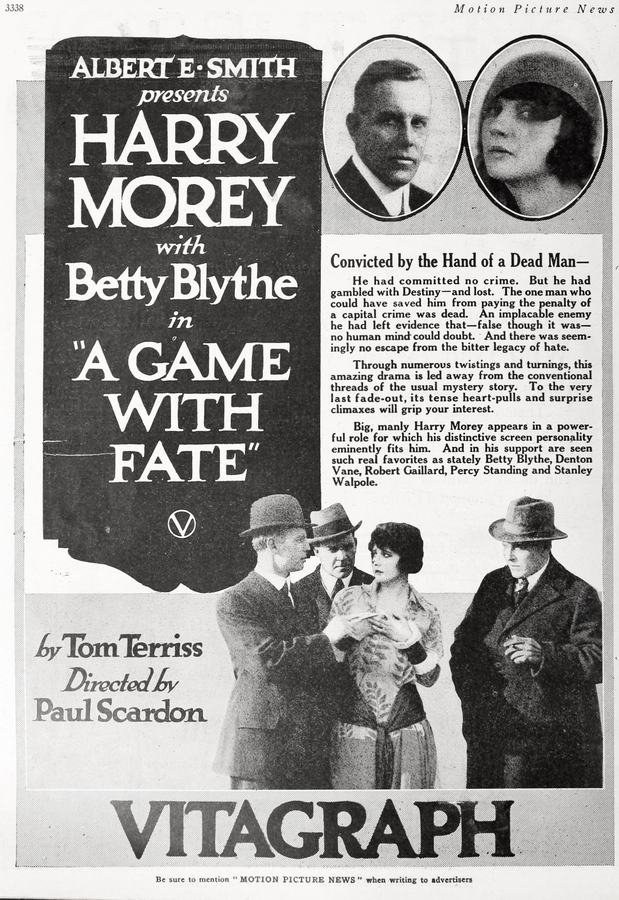
The celluloid landscape of 1918 was often a playground for moralistic fables and high-stakes melodrama, but few films from the Vitagraph stable carry the peculiar, haunting resonance of A Game with Fate. Directed with a keen eye for tension by Tom Terriss, this production serves as a harrowing exploration of the fragility of truth and the terrifying momentum of a legal system fueled by appearances.
At the heart of the narrative is Robert Harwell, portrayed with a brooding intensity that anticipates the noir protagonists of decades hence. Harwell is not a victim of circumstance in the traditional sense; he is an architect of his own potential destruction. His decision to wager his life on the fallibility of the courts is a narrative conceit that elevates the film beyond a mere mystery. It becomes a philosophical inquiry into the nature of evidence. In an era where the public was increasingly fascinated by the mechanics of crime—seen in contemporary works like The Crimson Stain Mystery—this film takes a more cerebral approach, focusing on the psychological toll of a self-imposed death sentence.
Every great silent melodrama requires a foil, and in Richard Shields, we find a villain of Shakespearean proportions. His malice is not born of a desire for wealth, but of a toxic cocktail of unrequited love and envy. When Elaine Huntington pleads for the papers that could save Harwell, Shields’ refusal and subsequent destruction of the documents is a moment of pure, cinematic cruelty. This sequence highlights the film's preoccupation with the power of the written word—or the lack thereof. Without the physical proof of the wager, Harwell’s reality is erased, replaced by a legal fiction that demands his life. This theme of the 'erased man' was a popular trope of the time, also explored in different facets in The Man Who Disappeared.
The visual storytelling here is particularly striking. Terriss utilizes the shadows of the prison cell to contrast with the bright, airy vistas of the Huntington estate. This dichotomy serves to emphasize Harwell's transition from a man of leisure to a man of the state. The cinematography doesn't just record the action; it traps the protagonist within the frame, mirroring his legal entrapment. Unlike the more episodic nature of What Happened to Mary, A Game with Fate maintains a tight, propulsive focus that builds toward its inevitable, albeit miraculous, conclusion.
The inclusion of the U-boat attack on Henry Dawson’s steamer is a fascinating historical artifact. In 1918, the threat of submarine warfare was a visceral reality for audiences. By weaving this into the plot, writers Garfield Thompson and Edward J. Montagne ground the melodrama in the anxieties of the Great War. It is a brilliant, if somewhat convenient, narrative pivot. The very event that was supposed to ensure Harwell's death—the disappearance of the only man who could prove his innocence—becomes the mechanism of his salvation. Dawson’s survival and eventual return is handled with a sense of divine intervention that was common in silent era morality plays, reminiscent of the providential turns in The Country That God Forgot.
Critical Comparison: The Cinematic Landscape
While The Squaw Man dealt with the weight of social exile and honor, A Game with Fate focuses on the internal mechanics of a lie. It shares a certain DNA with Politik och brott in its cynical view of how easily the truth can be manipulated by those in power. However, it remains uniquely American in its obsession with the individual's battle against a monolithic system.
One cannot discuss this film without praising the presence of Betty Blythe. Before she became the definitive 'Queen of Sheba', Blythe displayed a remarkable range here. Her Elaine Huntington is not merely a bystander to the tragedy; she is the detective, the negotiator, and ultimately the savior. Her performance provides a necessary warmth to a film that could otherwise feel clinical in its exploration of legal theory. The chemistry between Blythe and the cast, including the stalwart Percy Standing and Robert Gaillard, elevates the material, ensuring that the stakes feel personal rather than purely academic.
The pacing of the final act is a masterclass in silent film editing. The cross-cutting between the preparation for the execution and Dawson’s journey back to the city creates a rhythmic tension that is almost unbearable. It is a precursor to the 'last-minute rescue' trope that would become a staple of Hollywood cinema. When compared to the more whimsical tone of A Bunch of Keys or the romantic focus of Little Lady Eileen, this film stands out for its grim commitment to its high-stakes premise.
In retrospect, A Game with Fate remains a potent reminder of the era's sophisticated approach to narrative. It refuses to offer easy answers about the nature of justice. Even though Harwell is saved, the film leaves us with the unsettling knowledge of how close the system came to murdering an innocent man—a man who, admittedly, invited that very danger. The film’s exploration of the 'wager' serves as a meta-commentary on the audience's own relationship with fiction: we enter into a contract to believe the unbelievable, and we are often punished or rewarded for our faith in the narrative.
For collectors of silent cinema or students of Vitagraph’s history, this film is an essential piece of the puzzle. It lacks the flamboyant exoticism of A Princess of Bagdad, but it replaces it with a gritty, domestic realism that is far more unsettling. It is a work that demands to be viewed not just as a historical curiosity, but as a vibrant, breathing thriller that still manages to quicken the pulse over a century later. The film’s ability to weave together a personal vendetta, a legal critique, and a global war event into a cohesive seventy-minute experience is a testament to the skill of the 1910s studio system.
VERDICT: A HAUNTING TRIUMPH OF SILENT SUSPENSE

IMDb 6.7
1915
Community
Log in to comment.