DbcultAccessing Vault...
Cult Review
Senior Film Conservator
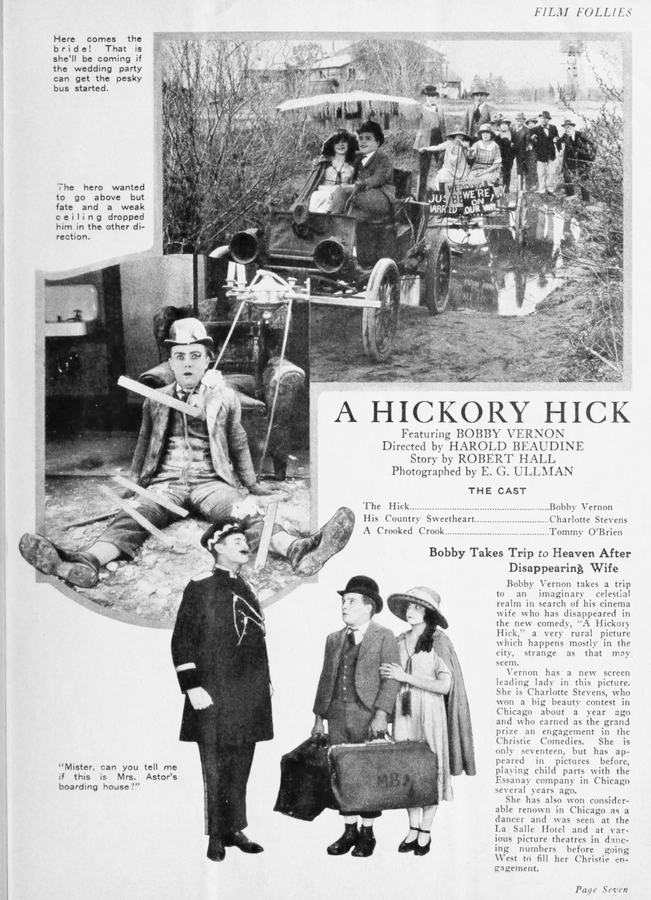
Imagine, if you can, a nickelodeon flickering inside a tent of canvas and sawdust: the projector’s carbon arc spits blue fire, and suddenly the screen blooms with a title card that reads A Hickory Hick—a phrase as gnarled and fragrant as the branch it evokes. What follows is not merely a yarn about marital innocence mugged by metropolitan rapacity; it is a pocket-sized morality play disguised as barnyard burlesque, a film that tickles the funny bone while pickpocketing your faith in human prudence.
Director Robert Hall, working in that tremulous year of 1921, understood that the quickest way to an audience’s heart is through its ribcage. His palette is the chiaroscuro of hope and despair: the farmer’s moonlit boardinghouse room, wallpapered in bargain-bin damask, looks like a sepulcher once the gaslight snuffs; the wife’s excursion car on the Trip-to-Heaven railway is lacquered a cherubic butter-yellow, an ironic wink at the hereafter she’s supposedly chasing.
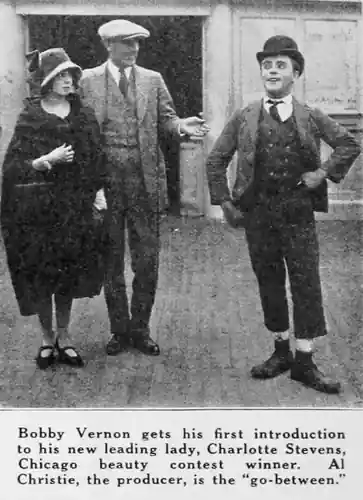
Bobby Vernon, whose comic persona always seemed one banana-peel removed from cardiac arrest, plays the hayseed husband with a quavering lower lip and eyes that oscillate between starry and starved. Watch the way he fondles the stock certificate—paper never felt so hymeneal. Opposite him, Peggy Cartwright exudes prairie freshness; her smile is a clandestine sunrise that even the city soot cannot smudge. When she boards the scenic railway, her gloved hand waves from the observation deck like a handkerchief lowered into a well—an omen the husband misreads as abandonment rather than loneliness.
The urban carnival that swallows them is rendered in matte shots and forced perspective: skyscrapers rear like quartz tombstones, elevated trains slither overhead like iron adders. Hall’s camera, starved for depth by two-dimensional orthodoxy, nevertheless finds vertiginous angles; one overhead shot of the stock exchange floor resembles a swarm of bees wearing bowler hats, each insect screaming buy-sell-buy through invisible pheromones.
And then comes the film’s bravura middle passage—an encyclopedia of self-destruction staged as slapstick sonata. The farmer, discovering the note, attempts to drown himself in the river only to be buoyed by a passing crate of Prohibition-bound bootleg gin. He tries hanging from a basement pipe, but the pipe coughs out a geyser of steam and drops him into a laundry basket. A revolver misfires, punching a hole through a portrait of McKinley whose painted eyes continue to judge. Even the gas oven rebels; the flame sputters like a vaudevillian heckler. These gags, morbid on paper, play as cathartic laughter—a reminder that Depression still wears diapers in 1921, its full hunger not yet gnawing.
Compare this sequence to The Invisible Hand, where suicide is a sterile boardroom statistic, or to Der Weg des Todes, where death is a grand Teutonic abstraction. Hall keeps things intimate, almost blasphemously playful. The camera lingers long enough for us to register the sweat beads on Vernon’s temples, then cuts to a title card of biblical brevity: “Even the grave spat him back.”
The film’s structural elegance lies in its circularity. The opening shot—a rusted weathercock spinning on a barn—finds its echo in the final image of the same cock now gilded by sunrise, a talisman of restored prosperity. When the wife disembarks from the Trip-to-Heaven railway, she is met not by Saint Peter but by her harried husband, pockets newly fat with recovered cash. The camera cranes back to reveal the crooks being marched into a Black Maria, their silk hats now comically askew. Order, that antique crockery, is glued together again with the brittle paste of coincidence.
Yet cynics may balk at the deus-ex-police paddy-wagon. To them I say: remember the era. In 1921, audiences craved restitution more than realism; they had seen the world’s ligatures snap in the Great War and wanted reassurance that the cosmos still kept a sheriff on retainer. A Hickory Hick is less a documentary of finance than a bedtime story for bankrupt grown-ups.
Stylistically, the picture sits at the crossroads between the rustic yokel comedies of Mack Sennett and the urban sophistications of The Red Viper. Intertitles appear in a font that mimics split wood, each letter oozing sap; yet the lighting—especially in the boardinghouse hallway—is pure Germanic expressionism, all jagged shadows and knife-sharp angles. The marriage of barn-dance typography with Caligari darkness gives the film its uncanny frisson.
Listen, too, to the rhythm. Editors in 1921 often cut on the punchline, but Hall withholds, letting scenes dangle an extra beat so the laugh festers into anxiety. When the farmer’s noose snaps, the camera holds on his trembling knees; we chuckle, then feel guilty for chuckling, then chuckle again at our own guilt—a Möbius strip of emotion.
The supporting cast functions like a Greek chorus in straw hats. Tom O’Brien’s con-man oozes the oleaginous charm of a state-fair barker; William Irving’s cop has the puffed chest of a kettledrum, punctuating each arrest with a cymbal-clap of authority. Charlotte Stevens, as the boardinghouse vamp, supplies a flirtatious counterpoint to Cartwright’s prairie virtue, her cigarette a glowing exclamation point whenever she enters the frame.
Restoration-wise, the surviving 35-mm print housed at MoMA is speckled like a leopard, yet the scratches feel curiously apposite—like age-wrinkles on an octogenarian clown. A 2K scan would doubtless unearth nuances: the microscopic glint of a gold tooth, the half-moon sweat stain beneath an armpit. Until then, we make do with what ghosts we have.
Comparative cinephiles will note tonal overlaps with Back to the Woods, wherein rustic protagonists likewise collide with modernity, and with Dog-Gone Tough Luck, another tale of cosmic pratfalls. Yet A Hickory Hick differs in its theological undertow; the Trip-to-Heaven railway is no mere amusement but a purgatorial escalator, a mechanical metaphor for the soul’s transit. The fact that the wife returns from her excursion alive is either evidence of grace or proof that purgatory now issues round-trip tickets.
Musically, the film originally shipped with a cue sheet recommending “Heaven’s Express Rag” and “Down on the Farm Two-Step.” One aches to hear these tunes resurrected under a contemporary score—perhaps a chamber ensemble plucking banjos against a backdrop of urban field recordings: clacking typewriters, honking Model-T horns, the pneumatic sigh of a tram. The dissonance would amplify the film’s central tension between soil and steel.
In the end, A Hickory Hick survives as a cautionary valentine: a reminder that the quickest route to paradise may still involve a round-trip ticket, that the soul’s greatest wealth lies not in petro-stock but in the fragile covenant of two hearts beating against an indifferent skyline. Watch it at midnight, with the windows open to summer cicadas, and you may find yourself laughing at the cosmos—only to discover the cosmos laughing back, a shade more kindly than you feared.
IMDb 6.4
1931
Community
Log in to comment.