DbcultAccessing Vault...
Cult Review
Senior Film Conservator
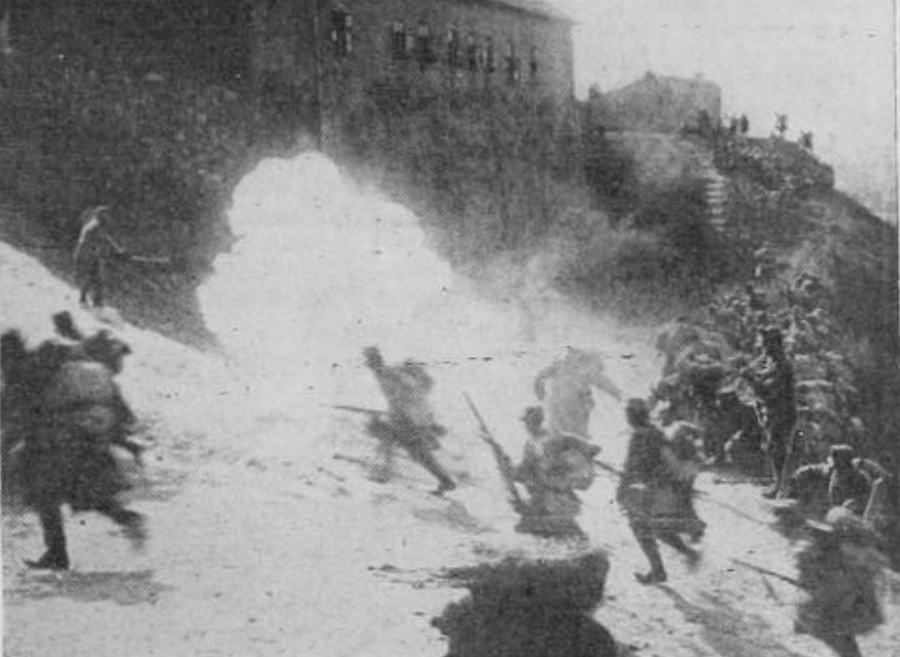
In the nascent, tumultuous years of the twentieth century, as the world teetered on the brink of unprecedented conflict, cinema found itself grappling with its burgeoning role as both an entertainer and a chronicler of history. Edward Lyell Fox’s *The Battle and Fall of Przemysl* emerges from this crucible, not merely as a film, but as a stark, unflinching testament to the brutal realities that defined the opening salvos of World War I. It’s a work that transcends simple narrative, offering instead a grim, expansive canvas upon which the early tremors of imperial collapse are vividly, often hauntingly, rendered. The film, in its very essence, becomes a historical document, capturing the agonizing process by which a supposedly impregnable fortress, a symbol of Austro-Hungarian might, slowly but inevitably succumbed to the relentless Russian onslaught. This is not a tale of heroic last stands in the traditional sense, but a more profound exploration of systemic failure, strategic myopia, and the sheer, overwhelming force of attrition warfare.
Przemysl, a name now echoing primarily in the annals of military history, was in 1914 a formidable bastion, a linchpin in the Austro-Hungarian defensive strategy against the Russian Empire. Its fall was not merely a tactical loss but a profound psychological wound, exposing deep-seated vulnerabilities within the Dual Monarchy’s military apparatus. Fox’s film, even without the benefit of elaborate special effects or sound, endeavors to convey the crushing weight of this siege. One can imagine the panoramic shots, perhaps utilizing matte paintings or clever staging, depicting the vastness of the fortifications, the endless lines of trenches, and the desolate, snow-swept landscapes that became the grave for countless soldiers. The narrative arc, driven by the historical events themselves, forces the viewer to confront the grim inevitability of the fortress’s demise. It’s a study in strategic erosion, where the initial bravado and defensive efforts slowly give way to the grim realities of dwindling supplies, mounting casualties, and the sheer, unyielding pressure of an enemy determined to break the will of its defenders. The film, therefore, acts as a cinematic autopsy, dissecting the moments and decisions that led to such a catastrophic unraveling.
Edward Lyell Fox, as the credited writer, was tasked with translating the sprawling, complex tragedy of Przemysl into a digestible, yet impactful, cinematic experience. In an era where visual storytelling was still in its infancy, the challenge of conveying the scale of a siege involving hundreds of thousands of men, the logistical nightmares, and the sheer brutality of early 20th-century warfare, would have been immense. Without a named cast, the film leans heavily on the collective experience, portraying the soldiers not as individual heroes or villains, but as cogs in a colossal, grinding machine of conflict. This approach, while perhaps born of necessity due to the constraints of early filmmaking, lends the narrative a stark, almost documentary-like authenticity. It shifts the focus from personal dramas to the broader, more encompassing tragedy of an empire’s military might being exposed as tragically insufficient. Fox’s contribution likely lay in structuring the historical events into a coherent, emotionally resonant arc, guiding the audience through the initial defenses, the tightening siege lines, the internal struggles, and the ultimate, poignant surrender.
While the film's synopsis highlights the strategic and military aspects, any depiction of such a prolonged siege, even in early cinema, would invariably touch upon the human cost. The relentless shelling, the scarcity of food and medical supplies, the biting cold of the Galician winter, and the psychological toll of constant bombardment would have been palpable. One can envision scenes, perhaps with a sparse but effective use of extras, illustrating the exhaustion on soldiers' faces, the quiet desperation of civilians trapped within the fortress walls, or the grim determination of officers wrestling with impossible decisions. The absence of a named cast ironically amplifies the sense of collective suffering, making the fall of Przemysl a universal tragedy rather than an individualized one. It forces the viewer to consider the sheer number of lives affected, the broken morale, and the profound sense of betrayal felt by those who had placed their faith in an unyielding defense. This collective narrative, rather than detracting from the emotional impact, imbues the film with a weighty, almost operatic sense of sorrow for a generation caught in the maelstrom of modern warfare.
The very existence of *The Battle and Fall of Przemysl* in 1914 speaks volumes about the early aspirations of cinema. Even as the medium was still defining its grammar, filmmakers were already attempting to tackle subjects of immense historical and societal significance. This wasn't merely about escapism, though that genre certainly thrived. It was about using the nascent power of moving images to capture, interpret, and disseminate recent history. The challenges were immense: limited budgets, rudimentary cameras, and the sheer difficulty of recreating large-scale military engagements. Yet, films like this demonstrate a clear intent to engage with the world’s unfolding drama, to make sense of the unprecedented violence that was consuming Europe. The film stands as a precursor to the great war epics and documentaries that would follow, laying foundational groundwork for how cinema would grapple with the complexities of conflict and its devastating aftermath. It's a bold artistic statement from a time when the medium was still finding its voice, choosing to speak not of fantasy, but of harrowing reality.
To truly appreciate Fox’s endeavor, it’s instructive to consider the cinematic landscape of 1914. While films like The Fatal Wedding explored personal dramas with often melodramatic flair, and The Pretty Sister of Jose offered romantic escapism, *Przemysl* veered sharply into the realm of stark realism. Films such as The Silence of Dean Maitland delved into moral complexities and forbidden secrets, while The Truth Wagon, presumably, tackled social issues with a more didactic approach. Even comedies like Tillie's Tomato Surprise provided light relief, a stark contrast to the grim subject matter of Fox’s film. Other contemporary releases, like The Hindu Nemesis, would have offered exotic adventure, a world away from the muddy trenches of Galicia. While Called Back explored mystery and psychological depth, and The Master Hand focused on intrigue and control, *Przemysl* stood apart in its ambition to capture a monumental, unfolding historical event. It’s a testament to the diverse range of storytelling already present in cinema, from literary adaptations like The Mill on the Floss, which delved into character studies, to action-oriented narratives like The Convict Hero, which focused on individual struggle. Fox's work, however, was in a league of its own for its immediate, large-scale historical focus, a stark reminder of humanity's destructive capabilities. It resonates with a sense of inescapable destiny, much like the thematic undertones found in Chained to the Past, but on an imperial scale.
The strategic implications of Przemysl’s fall were immense, revealing not just tactical missteps but fundamental structural weaknesses within the Austro-Hungarian military. The film, in its silent, visual language, effectively communicates this profound inadequacy. It portrays a military caught between the old ways of static fortifications and the brutal, dynamic realities of modern industrialized warfare. The narrative subtly, yet powerfully, underscores the logistical failures, the communication breakdowns, and the sheer unpreparedness that plagued the Habsburg forces. This wasn't merely a defeat; it was a prescient warning, a microcosm of the larger imperial unraveling that would culminate in the empire's ultimate dissolution. The film, therefore, serves as a poignant historical lesson, a visual essay on the perils of clinging to outdated strategies in the face of revolutionary military advancements. It’s a stark counterpoint to the more individualistic struggles seen in films like The Lure of New York, which focused on personal journeys within a rapidly modernizing urban landscape, or even the moralistic tales of Ten Nights in a Barroom. Here, the struggle is existential, for an entire nation.
The legacy of Przemysl, as captured by Fox’s film, is one of profound historical resonance. It’s a story of a great power's hubris and its subsequent, agonizing comeuppance. The film, even a century later, continues to serve as a powerful reminder of the human cost of strategic blunders and the fragility of even the most entrenched defenses. It asks us to reflect on the nature of warfare itself, and the often-overlooked logistical and command failures that can dictate the fate of nations. The fall of Przemysl was not merely a military defeat; it was a profound psychological blow, a harbinger of the dissolution that awaited the aging empire. While other historical or social dramas of the era, such as The Ragged Earl, might have explored themes of social injustice or individual struggle within a defined historical context, *Przemysl* tackles a canvas of national destiny. It stands in contrast to something like Cetatea Neamtului, which, if it also depicted a fortress, might have focused on different aspects of valor or resistance. Here, the focus is squarely on the erosion and ultimate collapse.
"The collapse of Przemysl was not merely a military defeat; it was a profound psychological blow, a harbinger of the dissolution that awaited the aging empire."
The film, through its visual storytelling, brings to life the stark reality of modern siege warfare, a grim dance between overwhelming firepower and human resilience. It underscores the ultimate futility of static defenses against a determined, well-equipped adversary. The imagery, however rudimentary by today's standards, would have been shocking and revelatory to contemporary audiences, offering an unprecedented glimpse into the horrors unfolding on the Eastern Front. It stands as an essential, albeit early, contribution to the canon of war cinema, a poignant and sobering account that transcends its technological limitations to deliver a powerful message about the human cost of conflict and the inexorable march of history.
Ultimately, *The Battle and Fall of Przemysl* is more than just a historical film; it’s a vital piece of cinematic archaeology. It allows us to understand how early filmmakers attempted to grapple with events of such monumental scale and tragedy. It speaks to the universal themes of conflict, loss, and the relentless march of time, themes that remain as relevant today as they were over a century ago. Edward Lyell Fox, in crafting this cinematic record, provided his contemporaries and future generations with a chilling, insightful look into one of the Great War's most significant early defeats. It’s a film that, despite its age and the silent nature of its presentation, continues to echo with the solemnity and gravity of its subject matter, reminding us of the fragility of empires and the enduring, devastating impact of warfare. Its place in film history is assured, not just as a curio from a bygone era, but as a serious, ambitious attempt to document and interpret a world in violent transition, setting a precedent for the war films that would follow in its wake.
IMDb —
1924
Community
Log in to comment.