DbcultAccessing Vault...
Cult Review
Senior Film Conservator
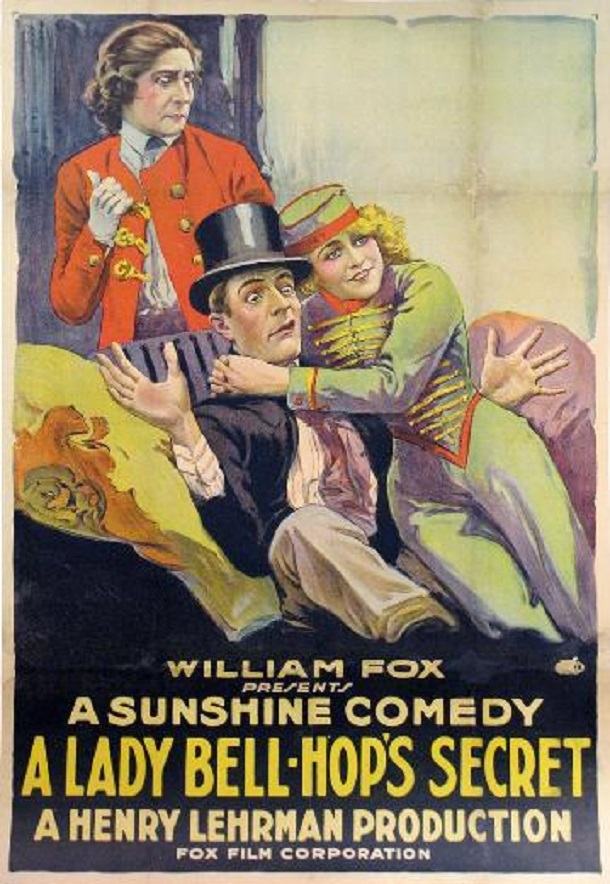
The flickering luminescence of the silent era often obscures the raw, unbridled anarchy that filmmakers like Henry Lehrman injected into the early cinematic bloodstream. In A Lady Bell Hop's Secret, we witness a frantic distillation of this energy—a piece of celluloid that functions as both a historical artifact and a masterclass in the geometry of the pratfall.
To understand the frantic pacing of this film, one must first acknowledge the pedigree of the L-KO (Lehrman Knock-Out) Kompany. Founded by Henry 'Pathé' Lehrman after his acrimonious departure from Mack Sennett’s Keystone, L-KO specialized in a brand of comedy that was faster, more violent, and arguably more surreal than its contemporaries. While films like The Blue Mouse leaned into more conventional farce, A Lady Bell Hop's Secret revels in the breakdown of the social machine. The hotel setting acts as a pressure cooker, a microcosm where the bourgeois guests are perpetually assaulted by the very staff meant to facilitate their comfort.
The film’s structure is built upon the 'gag-per-minute' ratio that would later influence the likes of Buster Keaton, yet here it remains unrefined, jagged, and delightfully mean-spirited. The 'Secret' alluded to in the title is almost secondary to the physical performance of the ensemble. It is a narrative hook designed to hang a series of increasingly improbable stunts. Unlike the more whimsical tone found in Susie Snowflake, this is a comedy of friction and impact.
The presence of Billie Ritchie is the film’s gravitational center. Often unfairly dismissed as a mere Chaplin imitator, Ritchie brought a distinct, almost predatory edge to his comedy. Where Chaplin’s Tramp was a poet of the gutters, Ritchie’s characters were often the instigators of their own misfortune, navigating the world with a frantic, bird-like intensity. In A Lady Bell Hop's Secret, his interactions with the guests are not merely clumsy; they are borderline transgressive. He occupies the screen with a spatial awareness that suggests he is constantly looking for the next object to break or person to topple.
Ritchie’s performance here highlights a forgotten branch of silent comedy evolution. If we look at the sophisticated dramatic irony in The Better Wife, we see cinema moving toward psychological realism. Ritchie, conversely, pulls the medium back toward the carnivalesque. His bellhop is a trickster figure, a chaotic neutral entity that exposes the fragility of the hotel’s high-society veneer. The way he manipulates luggage, elevators, and the very architecture of the set reflects a profound understanding of how the camera can distort physical reality.
The inclusion of Rosa Gore provides a necessary counterweight to the manic energy of the male leads. Gore, a veteran of the stage and early screen, possesses a facial vocabulary that could stop a locomotive. In this film, she represents the 'Establishment'—the rigid, unyielding force of social order that the bellhop must navigate. Her performance is a study in slow-burn frustration. Watching Gore react to the escalating insanity is often more rewarding than the gags themselves. She provides the 'straight' anchor that allows the slapstick to feel consequential.
In many ways, her role here serves as a precursor to the formidable women seen in later silent dramas like The Spotted Lily, though here her talents are bent toward the comedic. The chemistry between Gore and Ritchie is one of professional friction; they represent two different eras of performance clashing on the same stage. Gore’s theatricality is grounded, while Ritchie’s is purely cinematic, relying on the camera’s ability to capture the blur of a fall or the suddenness of a punch.
Technically, A Lady Bell Hop's Secret is a fascinating specimen of the late 1910s. The cinematography is functional but effective, utilizing deep-focus shots in the hotel corridors to allow for multi-layered gags. We see action occurring in the foreground, middle ground, and background simultaneously—a precursor to the complex staging that would become a hallmark of the 1920s. While it lacks the high-concept artistry of Il Fauno, its utilitarian aesthetic serves the comedy perfectly. Every frame is packed with potential energy.
The lighting, though primitive by modern standards, creates a stark, high-contrast world where the white of the bellhop’s gloves and the dark of the hotel’s mahogany furniture create a visual rhythm. This is a film that understands the importance of silhouette. In the absence of sound, the weight of a gesture and the speed of a movement are the only tools available, and the director utilizes them with surgical precision.
When placing this film alongside its contemporaries, its unique ferocity becomes even more apparent. While The Lightning Raider was pushing the boundaries of the action-serial, and The Mysterious Client was experimenting with the nascent tropes of the mystery genre, A Lady Bell Hop's Secret remained committed to the visceral impact of the 'Lehrman Knock-Out'. It shares a certain DNA with the absurdist humor of All That Glitters Is Not Goldfish, yet it feels more grounded in the physical realities of labor and service.
One might even draw a parallel to the social critiques found in König Nicolo, though where that film uses royalty to examine power, this film uses the service industry. The bellhop is the ultimate invisible man, the one who sees the secrets of the guests but is never seen himself—until he decides to disrupt the status quo. This disruption is not a political act, but a comedic necessity.
Why does a film like A Lady Bell Hop's Secret still resonate? It is because physical comedy is a universal language. The frustration of a stuck elevator or the indignity of a spilled tray are experiences that transcend the century between the film’s release and today. The 'Secret' within the plot might be dated, but the execution of the humor is timeless. It possesses a raw, unpolished quality that is often lost in the over-produced comedies of the modern era.
In the landscape of 1919, where audiences were reeling from the aftermath of the Great War, these films provided more than just escapism; they provided a cathartic release. Watching a bellhop dismantle the dignity of a pompous guest offered a momentary subversion of the rules that governed everyday life. It is the same impulse that drives the narrative in Never Say Quit, the dogged persistence of the underdog in a world that is inherently hostile.
As we look back at the filmography of Hugh Fay and Betty Carpenter, we see a group of performers who were the blue-collar workers of early Hollywood. They weren't making high art for the ages; they were making 'knock-outs' for the weekend crowds. Yet, in their dedication to the craft of the gag, they created something that endures. A Lady Bell Hop's Secret is a testament to the power of the short-form comedy—a burst of creative energy that refuses to be ignored.
Whether compared to the maritime grit of Les travailleurs de la mer or the frontier tension of The Place Beyond the Winds, this film holds its ground as a vital piece of the comedic puzzle. It reminds us that before cinema was a prestige medium, it was a fairground attraction—loud, boisterous, and brilliantly chaotic. To watch it today is to step into a time machine, to a world where a well-timed trip-up was the height of artistic expression.
Technical Note: For those interested in the restoration of L-KO titles, this film represents a significant challenge due to the nitrate degradation common in 1910s stock. However, the clarity of the existing prints allows for a deep appreciation of the stunt work and set design that often goes unremarked in silent film scholarship.
IMDb —
1922
Community
Log in to comment.