DbcultAccessing Vault...
Cult Review
Senior Film Conservator
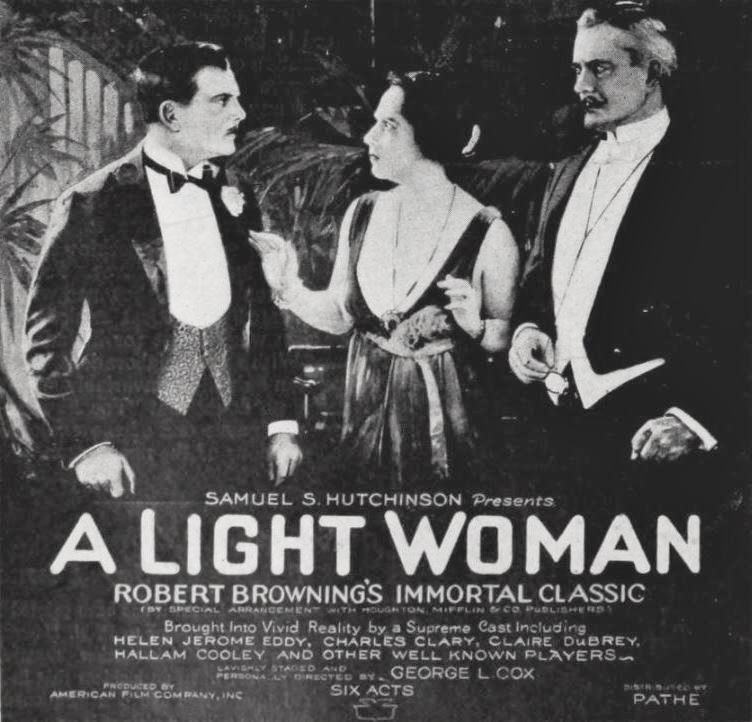
A Light Woman is less a love triangle than a love hexagon folded in on itself until the creases draw blood.
Frances Raymond’s Doris enters frame left like a Klimt portrait suddenly granted pulse—her pallor communicates the exact moment innocence recognizes its own obsolescence. The camera, still shy of the Expressionist acrobatics that would intoxicate German studios two years later, clings to her as though afraid she might dematerialize. Meanwhile Helen Jerome Eddy’s Jeanne DuPre arrives in iris-in, cigarette glowing like a fuse, stockings rolled below the knee, eyes promising catastrophes no title card could spell. The contrast is surgical: Doris embodies the pre-war ideal of the “light woman” as angelic, weightless; Jeanne redefines the term as morally photonegative, a black-hole siren whose lightness is the absence of ballast, not sin.
Director George L. Cox, saddled with a scenario adapted from Browning’s poem, jettisons the Victorian metaphysics and substitutes the ruthless economy of the nouveau riche. Paul’s father—Charles Clary in pince-nez severity—doesn’t merely disapprove; he weaponizes his own aging libido, turning seduction into hostile takeover. The scheme’s perversity feels startlingly modern: Dad courts the vamp with the same fiduciary coldness he once brought to railroad stocks, each bouquet a futures contract, each whispered endearment a short-sell on his son’s erotic naïveté. When Jeanne finally accepts the patriarch’s invitation to the country estate, the film stages a weekend-house symphony of glances: knives disguised as smiles, champagne flutes reflecting conspiracies, a single lace glove dropped on a bear-skin rug like a gauntlet thrown down by History itself.
The midpoint pivot arrives via a stolen letter—inked in Jeanne’s looping scrawl, addressed to a mysterious benefactor. Cox cross-cuts between three reading sites: Doris in the garden summerhouse, Paul in the smoking lounge, Father in the library. Each intertitle slices the text into staccato fragments—“…if the boy only knew…cash before kisses…tonight the boathouse…”—creating a proto-Pinteresque silence pregnant with menace. The montage accelerates until the camera itself seems to hyperventilate, finally landing on a submerged close-up: Jeanne’s face reflected in the lake, water rippling her features into a Cubist snarl. It’s the first time American silent cinema aestheticizes guilt as liquid instability, predating similar aqueous symbolism in Das rosa Pantöffelchen by at least three years.
Yet the film refuses villainy as simple binary. Jeanne’s backstory—delivered in a flashback that erupts without warning—reveals a girlhood spent sewing artificial roses for sweatshop wages, her fingers raw, her dreams leased to department-store catalogues. The sequence, tinted in sulphur amber, plays like a scar tissue origami: each fold of memory uncovers fresh hurt. We understand, if not forgive, her conviction that affection is merely another currency, less stable than the dollar but more negotiable than hope. Cox’s empathy feels radical when juxtaposed with contemporaneous vamps who exist solely as moral scarecrows (The White Pearl comes to mind).
The boathouse confrontation—lit by a swinging hurricane lamp that carves the screen into sliding panels of chiaroscuro—deserves canonical status in the history of cinematic staging. Paul, arriving first, discovers Jeanne already inside, her silhouette reclining against a canoe as though it were a fainting couch. She greets him with a line that, even without sound, vibrates with self-awareness: “So the lamb wanders into the abattoir to lecture the butcher on ethics?” Their exchange ricochets between seduction and confession, each close-up intercut with shots of water slapping against pylons, the sound implied by the rhythm of edits. When Father bursts in, the lamp crashes; the frame plunges into near-total darkness, faces emerging only as silvered negatives. The struggle is not for the gun that glints intermittently, but for narrative authority—who gets to author the story of what happened, who will be granted the privilege of victimhood.
Doris, meanwhile, undergoes her own metamorphosis. Abandoning the reactive posture of the wounded ingenue, she commandeers an automobile—an act coded as sexual initiation—and barrels through the night to the lake. Her road trip, intercut with registry-book sketches of speeding headlights, prefigures the liberating vehicular iconography later celebrated in The Daredevil. Upon arrival she does not collapse into Paul’s arms; instead she confronts Jeanne woman-to-woman, their faces framed in a two-shot so tight it compresses the universe into the space between pupils. The dialogue cards strip rhetoric to marrow: “You trade in illusions; I merely barter the memory of them.”
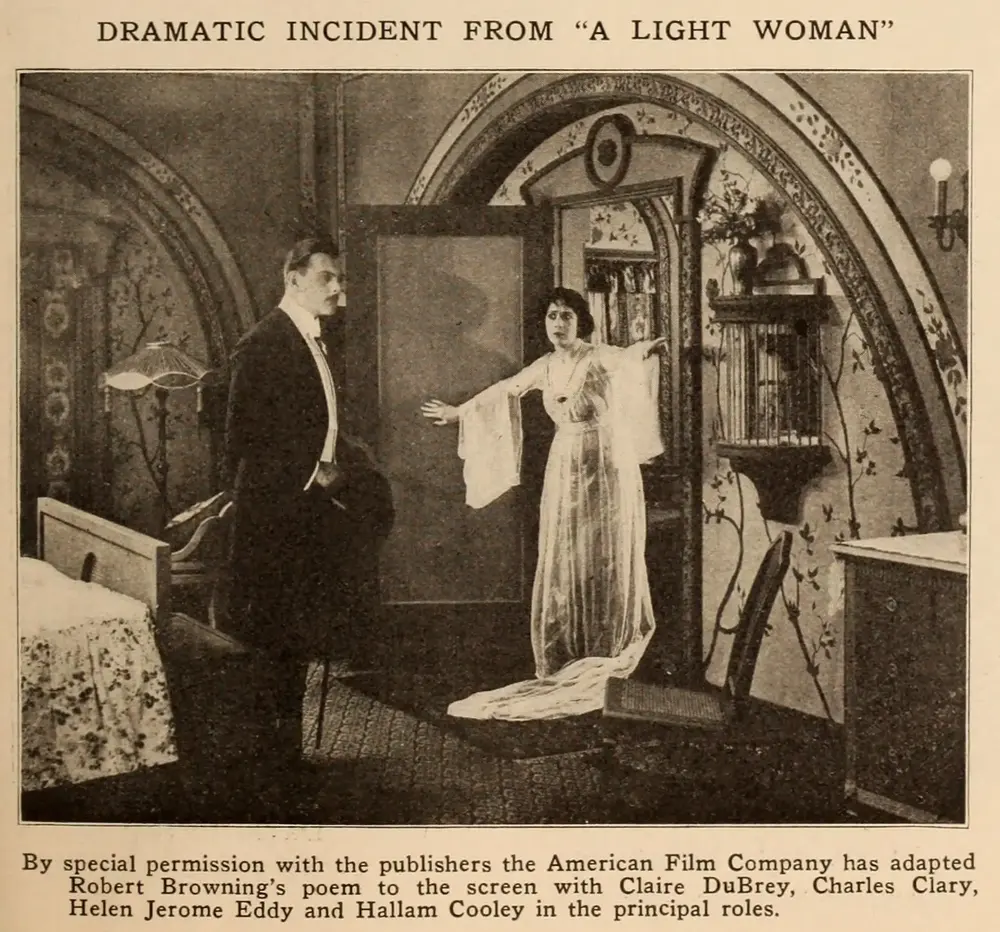
Resolution arrives not with death but with exile: Jeanne departs on the dawn steamer, wrapped in a fox stole that once belonged to Paul’s mother, her expression unreadable beneath the brim of a veiled hat. Father, defeated less by the vamp than by his son’s refusal to accept the moral ledger he offers, retreats into the shadowed corridor of the mansion. Paul and Doris remain on the pier, hands almost touching, the space between palms measuring the exact width of trust yet to be rebuilt. Cox holds the shot until a cloud eclipses the sun, plunging the couple into temporary silhouette—an elegy for every future that might have been, now rerouted by compromise.
Technically the film straddles two eras. The interiors still bear the stately proto-Wyeth tableaux of early Teens melodrama, but the location work—especially the lake sequences—embraces handheld dynamism, the camera bobbing slightly on a skiff to suggest subjectivity. The tinting strategy is sophisticated: magenta for salon duplicity, viridian for outdoor candor, sepia for the flashback sweatshop, culminating in a near-monochrome finale that whispers grayscale before Technicolor would render such subtlety commercially obsolete. Composer-writer Sidney Algier’s intertitles deserve praise; they eschew the floral bombast of Griffith for a terse, epigrammatic style that anticipates Hemingway’s newspaper cadences.
Acting kudos must spotlight Nancy Chase as the maid Lila, whose sly asides—delivered in single-reaction inserts—function as a Greek chorus, reminding us that upstairs heartbreak depends on downstairs complicity. Her micro-gesture when pocketing a dropped pearl earring speaks volumes about class tourism, a theme the film grazes but never sermonizes. Similarly, Guy Milham’s cinematographer cameo (he plays the chauffeur) grants the final reel a Brechtian wink: the artist as enabler of the very escape he documents.
Viewed today, A Light Woman reverberates as a cautionary tale about the commodification of intimacy, prefiguring the influencer economy where attention is mined like coltan. Jeanne’s vamp is the prototype for every brand that sells scarcity of affection; Father’s wallet the original subscription model. The film’s refusal to punish her with death—standard fate for The Spirit of the Poppy or My Husband’s Other Wife—feels almost subversive, granting her the existential shrug of a modern antihero.
Archival survival status: only two 35mm prints known, one at MoMA (missing reel 4) and a more complete but water-swollen nitrate at Cinémathèque de Toulouse, recently scanned at 4K. The restoration team opted to retain the French intertitles, translating back to English via Browning’s original stanzas, a choice that both estranges and elevates. The resulting hybrid text flickers between 1919 Atlantic City and Victorian London, producing temporal vertigo appropriate for a narrative about love’s untrustworthy memory.
Comparative contextualization: if Golfo rusticizes betrayal into shepherd ballets, and Surrogatet sci-fis it into android pathos, A Light Woman locates the fault line inside the bourgeois drawing room and dynamites the foundation. Its DNA reemerges in A Gamble in Souls and echoes even in 1950s noir like Sunset Blvd, yet its compassion for the vamp remains unmatched until Fassbinder’s Lola half a century later.
Verdict: mandatory viewing for anyone mapping the genealogy of toxic romance on screen. It will bruise optimists, thrill cynics, and leave cinephiles drunk on the perfume of a country that once believed desire could be regulated like Prohibition gin. Stream it if you can find it; if not, petition your local archive to coax the final reel from its vinegar-scented slumber. The woman is light, yes—but her footprint leaves a crater.
IMDb —
1925
Community
Log in to comment.