DbcultAccessing Vault...
Cult Review
Senior Film Conservator

Stepping back into the silent era is often an exercise in historical appreciation, but every so often, a film emerges from the archives that transcends its temporal boundaries, speaking to universal human experiences with surprising clarity and emotional potency. Such is the case with 'A Love Sublime,' a cinematic offering from a bygone age that, despite its melodramatic flourishes, delivers a narrative of unwavering devotion, cruel misunderstanding, and the serendipitous interventions of fate. Directed by Wilfred Lucas and Tod Browning, with a screenplay co-written by Lucas, Browning, and Samuel Hopkins Adams, this film is a testament to the storytelling prowess of its time, weaving a tale that, while simple in its core premise, becomes remarkably complex in its emotional execution and the unexpected turns it takes.
At its heart, 'A Love Sublime' is a grand romantic gesture, a testament to a love so profound it defies death itself. The narrative introduces us to Philip, portrayed with robust sincerity by Wilfred Lucas himself, a man whose physical strength is merely a superficial manifestation of his deep-seated emotional fortitude. His love for Toinette, a French girl played by Alice Wilson, is immediate and absolute, blooming from the unlikely soil of a devastating automobile accident. The initial scenes establish this bond quickly, relying on the visual language of silent cinema to convey burgeoning affection and immediate concern. Toinette’s injury and subsequent hospitalization set the stage for the central conflict, a misunderstanding so profound it threatens to shatter two lives.
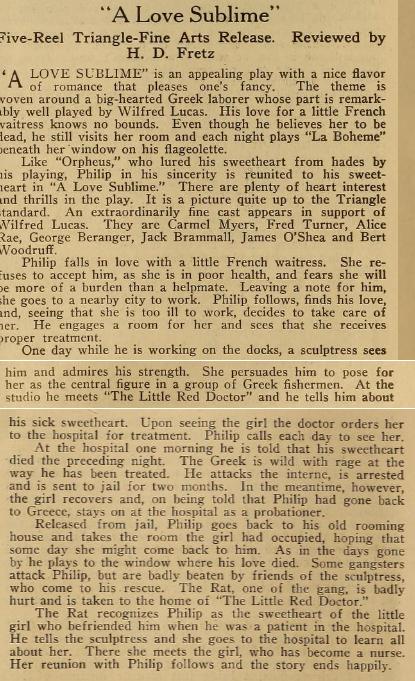
The pivotal moment of the film arrives with a shocking swiftness: a hospital attendant, through an act of either negligence or malice, informs Philip that Toinette has succumbed to her injuries. This misinformation is the narrative's fulcrum, catapulting Philip into a profound state of grief and unwavering resolve. Bound by a silent pledge, he embarks on a nightly vigil, singing beneath what he believes to be Toinette's former hospital room window, a haunting serenade intended for a spirit he believes departed. This image—a powerfully built man, alone in the urban night, pouring his heart out in song to an empty room—is both incredibly tragic and deeply romantic. It speaks to a purity of devotion that feels almost mythical, a love so absolute it transcends the physical presence of the beloved. In an era where melodrama reigned supreme, this particular plot device, while potentially straining credulity in a modern context, resonates with a powerful emotional truth about commitment and hope against despair.
What makes this segment particularly compelling is the stark contrast between Philip's public display of grief and Toinette's private recovery. While Philip mourns, Toinette slowly regains her strength, unaware of the profound depth of her lover's sorrow or the cruel deception that has separated them. The film deftly portrays these parallel realities, building a sense of dramatic irony that keeps the audience yearning for the truth to be revealed. This narrative technique, common in silent films, is executed here with a poignant sensitivity that ensures the audience feels the weight of both characters' isolated suffering. One might draw parallels to the emotional isolation explored in The Eternal Grind, where characters also faced immense personal struggles in solitude, though often stemming from societal pressures rather than direct misinformation.
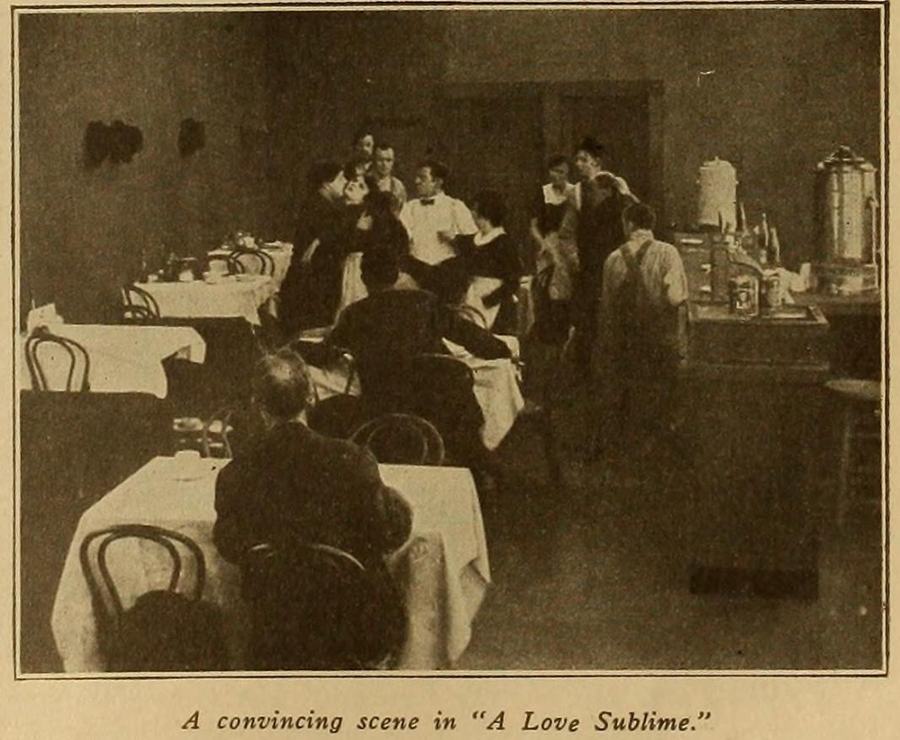
Just when the narrative seems firmly entrenched in the realm of tragic romance, it takes an unexpected detour into the grittier realities of urban life. A menacing gang, terrorizing a park adjacent to the hospital, introduces a layer of social commentary and gritty realism that broadens the film's scope. This subplot might initially seem disparate from the central love story, yet it serves as a brilliant narrative device to propel the plot forward in a wholly unforeseen manner. During a confrontation with the police, the gang leader sustains a stabbing injury and is, by a twist of fate, admitted to the very same hospital, under the care of the very same doctor who had arranged Toinette's admission. This convergence of seemingly unrelated storylines is a hallmark of early cinema's often intricate plotting, demonstrating a willingness to weave together disparate elements to create a cohesive, if occasionally convoluted, whole.
It is within this unlikely setting that the threads of fate begin to intertwine. The injured gangster recognizes Philip, not from his nightly vigils, but from an earlier, more mundane act of kindness: Philip had slipped him a pack of cigarettes during a previous hospitalization, coincidentally during Toinette's stay. This small, almost forgotten gesture of humanity becomes the catalyst for truth. It's a powerful reminder that compassion, even in its simplest forms, can have far-reaching and unforeseen consequences. The gangster, perhaps moved by Philip's unwavering devotion or a sense of karmic reciprocity, reveals the devastating truth: Toinette is alive and well. This revelation is a masterstroke of storytelling, transforming a seemingly peripheral character into an unexpected agent of resolution. It highlights the interconnectedness of urban lives, where paths cross in the most improbable ways, a theme also subtly explored in films like The Edge of the Abyss, which often depicted the harsh realities and chance encounters within cityscapes.
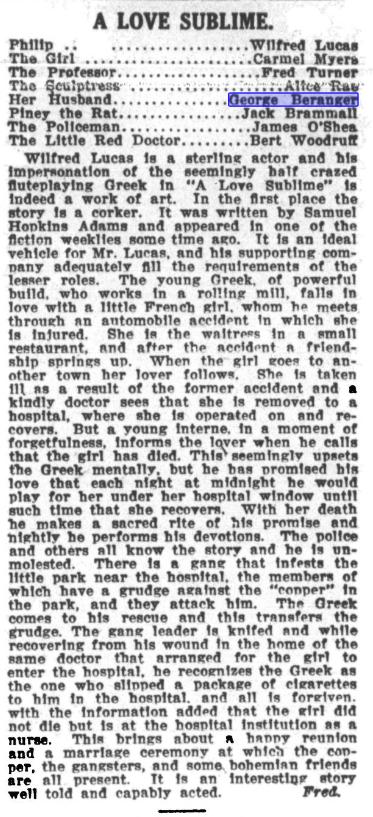
The success of 'A Love Sublime' rests heavily on the shoulders of its cast, particularly Wilfred Lucas as Philip and Alice Wilson as Toinette. Lucas, who also co-directed and co-wrote, brings a gravitas and earnestness to Philip that makes his unwavering devotion entirely believable. His physical presence conveys strength, but his expressive face communicates the depths of his sorrow and later, his joyous hope. Wilson, as Toinette, portrays a delicate resilience. Her character's journey from vulnerability to recovery, and her own quiet heartbreak at Philip's perceived abandonment, is conveyed with a nuanced performance that transcends the often-exaggerated gestures of silent film acting. The supporting cast, including James O'Shea, Bert Woodruff, George Beranger, Carmel Myers, Jack Brammall, Mildred Harris, and F.A. Turner, contribute to the film's atmosphere, particularly the menacing presence of the gang, which adds a crucial dimension to the urban landscape.
The directorial collaboration between Wilfred Lucas and Tod Browning is particularly intriguing. Browning, later to become a master of the macabre with films like 'Dracula' and 'Freaks,' demonstrates here an early aptitude for creating tension and extracting potent emotional performances. While 'A Love Sublime' lacks the overt gothic elements of his later work, there's a certain atmospheric quality to the night scenes and the portrayal of the urban underbelly that hints at his burgeoning style. Lucas, as both actor and director, likely brought a deep understanding of character motivation to the table, ensuring the emotional core of the film remained strong. The film's pacing is deliberate, allowing moments of emotional intensity to fully register, a characteristic of silent cinema that often feels more contemplative than modern filmmaking. The use of intertitles is effective, providing necessary exposition without detracting from the visual storytelling, which is, after all, the primary language of the silent screen.
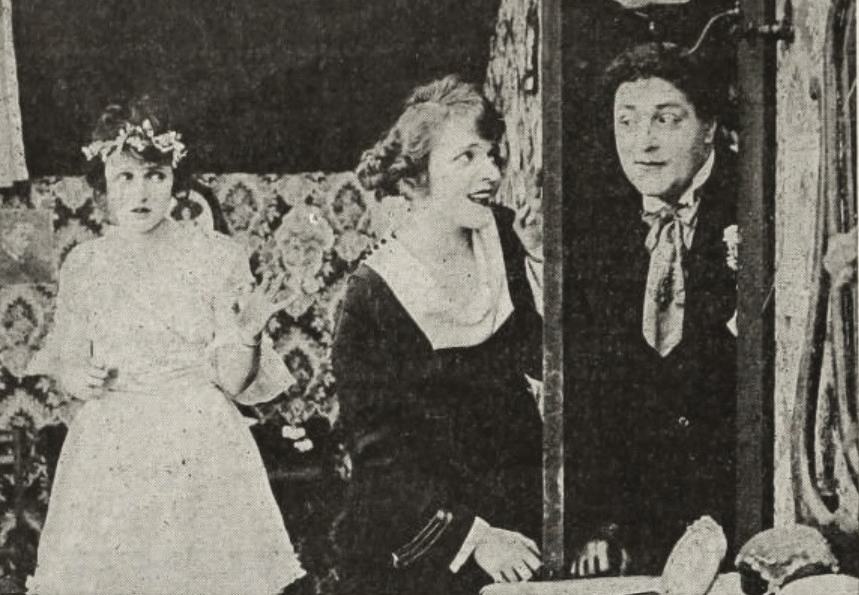
The screenplay, penned by Lucas, Browning, and Samuel Hopkins Adams, is a fascinating study in dramatic construction. It takes a relatively straightforward premise – lovers separated by misinformation – and enriches it with unexpected twists and turns. The introduction of the gangster subplot, in particular, is a stroke of genius, preventing the narrative from becoming overly saccharine or predictable. It injects a dose of realism and danger, contrasting sharply with the romantic ideal Philip embodies. This blend of romantic idealism with urban grit creates a unique texture, making the film feel more robust than a simple melodrama. Themes of enduring love, the power of hope, and the unexpected ways in which human connections can alter destinies are explored with a sincerity that resonates. It’s a narrative that champions the idea that true love can overcome even the most formidable obstacles, including the cruel hand of fate and human error.
The film also subtly touches upon themes of perception versus reality. Philip perceives Toinette as dead, while she perceives him as having abandoned her. The entire dramatic tension hinges on these false realities, and the eventual unveiling of the truth is immensely satisfying. This manipulation of perception is a powerful storytelling tool, forcing the audience to grapple with the emotional fallout of unverified information. In a broader sense, one could see this as an early cinematic exploration of how easily miscommunication can lead to profound despair, a concept that continues to be relevant in storytelling today. While not as overtly complex in its societal critique as something like Martha's Vindication, 'A Love Sublime' still manages to comment on human vulnerability to information and its profound impact on personal lives.
The climax of the film, the reunion of Philip and Toinette, is orchestrated with a heightened sense of emotional release. Philip, armed with the truth, rushes to Toinette, who, having been told he returned to Greece, has been quietly suffering her own form of abandonment. The moment of their reunion is the emotional payoff the film has meticulously built towards. It’s a scene designed to elicit tears and cheers, a cathartic release after prolonged tension and sorrow. The visual language of their embrace, their expressive faces conveying disbelief, relief, and overwhelming joy, is a powerful reminder of silent cinema's ability to communicate complex emotions without a single spoken word. This kind of raw, unadulterated emotional climax was a staple of the era, and 'A Love Sublime' delivers it with aplomb.
In conclusion, 'A Love Sublime' is more than just a historical artifact; it's a vibrant and emotionally resonant piece of early cinema that deserves to be rediscovered. It stands as a testament to the enduring power of love, the cruel caprices of fate, and the unexpected ways in which human connections can mend shattered lives. The film's blend of passionate romance, urban realism, and a surprisingly ingenious plot device makes it a compelling watch. For those interested in the foundational narratives of Hollywood or the early works of figures like Tod Browning and Wilfred Lucas, 'A Love Sublime' offers a rich and rewarding experience. It reminds us that even in an age without sound, cinematic stories could speak volumes, capturing the essence of human experience with a profound and lasting impact. It's a film that, like Philip's song, continues to echo through time, a beautiful testament to a love that truly was sublime.

IMDb —
1936
Community
Log in to comment.