DbcultAccessing Vault...
Cult Review
Senior Film Conservator
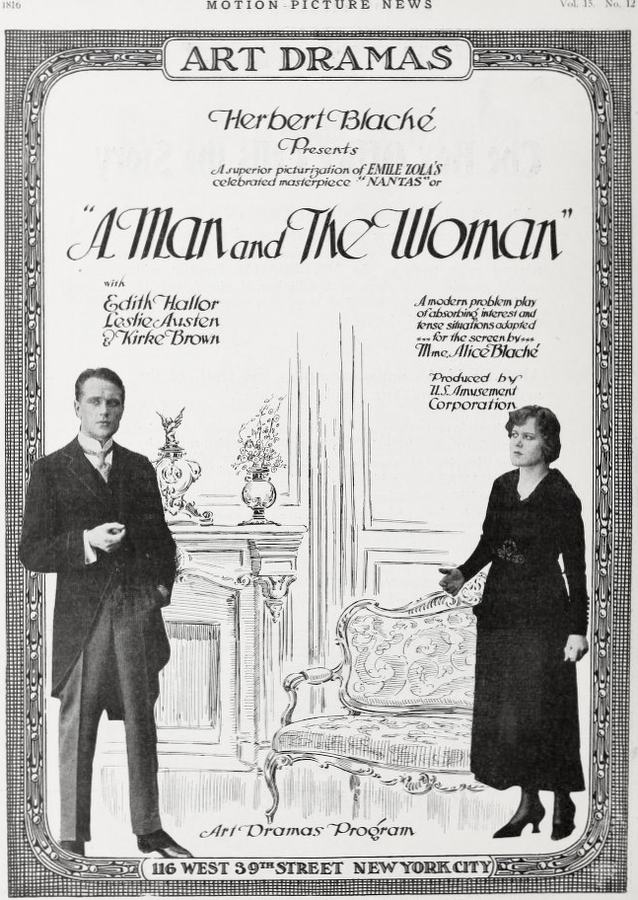
To witness A Man and the Woman is to step into a temporal rift where the burgeoning language of cinema collides with the unflinching naturalism of 19th-century literature. Directed by the legendary Alice Guy-Blaché, this 1917 production serves as a stark reminder that the early days of film were not merely occupied by slapstick and spectacle, but by a profound, often harrowing, exploration of the human condition. Based on Émile Zola’s L’Assommoir, the film strips away the romanticism often found in silent-era dramas, replacing it with a granular look at the destructive power of addiction and the inescapable gravity of poverty.
Alice Guy-Blaché, a pioneer whose contributions to the medium are only recently receiving their due, demonstrates an uncanny ability to translate Zola’s dense, deterministic prose into a visual lexicon of despair. Unlike the adventurous escapades seen in The Adventures of Kathlyn, which relied on exoticism and serial thrills, A Man and the Woman is rooted in the claustrophobia of the laundry and the tenement. The film doesn't just tell a story; it constructs an environment that feels lived-in, sweaty, and increasingly suffocating. The lexical diversity of the visual storytelling here is immense, utilizing shadows and cramped mise-en-scène to mirror the internal rot of its characters.
The narrative centers on Gervaise (Edith Hallor), a character whose very existence is an exercise in endurance. In a world that frequently marginalized female perspectives, Guy-Blaché places Gervaise at the emotional epicenter. We see her struggle to maintain a semblance of dignity against a backdrop of societal indifference. The arrival of Coupeau (Bradley Barker) initially offers a flicker of hope—a chance at a stable, domestic bliss that seems almost within reach. However, the film is a masterclass in the slow burn of tragedy. When Coupeau suffers a debilitating injury, the shift from a productive member of society to a victim of the 'green fairy' is handled with a terrifying, clinical precision.
Bradley Barker’s performance as Coupeau is nothing short of transformative. In an era where acting was often characterized by broad, theatrical gestures—a style evident in many films of the period like The Bushranger's Bride—Barker opts for a more internal, physicalized degeneration. His transition from a robust workman to a trembling, hollow shell of a man is visceral. It’s a performance that anticipates the gritty realism that would later define the American New Wave, yet it exists here, in the silent twilight of the 1910s. The chemistry between Barker and Hallor is palpable, making their eventual estrangement all the more agonizing to behold.
The supporting cast, including P.J. Rollow and Mrs. Willis Barker, provides a robust framework for this descent. Each character feels like a cog in a machine designed to grind down the individual. There is a sense of community, yes, but it is a community bound by shared suffering and the commonality of vice. This isn't the idealized poverty found in some Victorian melodramas; this is the raw, Zolaesque reality where the environment itself is a predator. For viewers familiar with the social critiques of The Italian, the themes of immigrant struggle and systemic failure will resonate deeply, though Guy-Blaché focuses more intently on the psychological and biological factors of the collapse.
Technically, A Man and the Woman is a testament to the sophistication of the Solax Company and the World Film Corporation. The cinematography captures the textures of the era—the steam of the laundry, the grime of the streets, and the sterile coldness of the hospital. Guy-Blaché’s use of deep focus and blocking creates a layered narrative where the background often comments on the foreground action. While it lacks the grand architectural scale of With Our King and Queen Through India, it possesses an intimacy that is far more impactful.
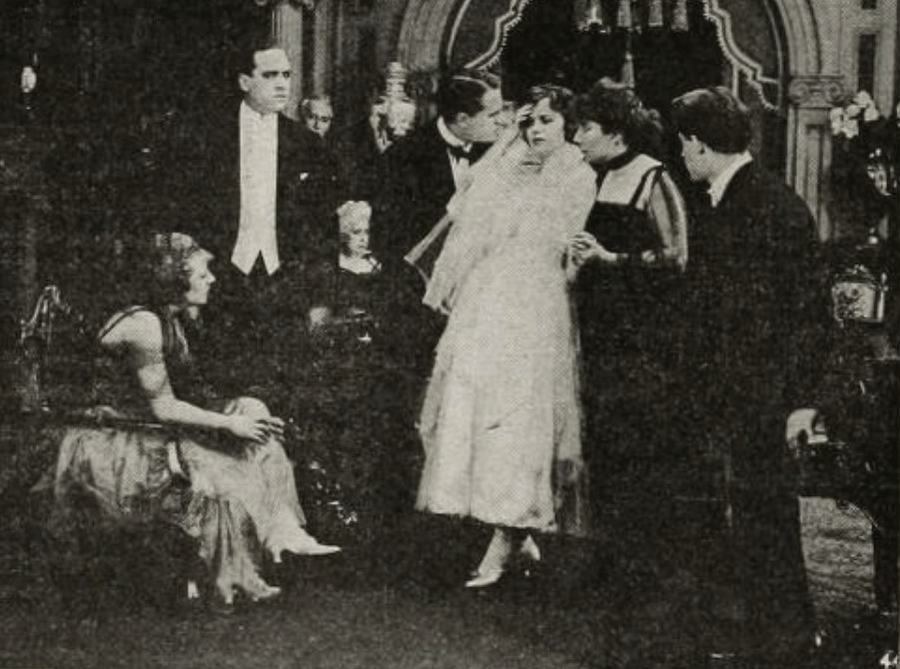
The film’s pacing is deliberate, reflecting the ineluctable nature of the characters' fate. There are no sudden rescues or convenient plot twists. Instead, we are treated to a steady accumulation of small failures that eventually culminate in a total systemic breakdown. This commitment to the source material’s bleakness is brave, especially for a time when audiences often craved happy endings or moralistic resolutions. Guy-Blaché refuses to offer easy comfort, much like the challenging narratives found in Nattens barn or the stark domestic questions raised in Should a Woman Divorce?.
One of the most striking sequences in the film involves the 'still'—the copper apparatus that produces the alcohol that becomes Coupeau’s master. Guy-Blaché films this machine as if it were a pagan deity, a gleaming, metallic beast that demands constant sacrifice. The symbolism is overt but effective. It represents the industrialization of vice, a product of the very society that fails to provide for its workers. The way the characters interact with the still—first with curiosity, then with a desperate, slavish devotion—is a haunting metaphor for the loss of agency.
This thematic weight elevates the film beyond a mere cautionary tale. It becomes an exploration of the 'beast within,' a central tenet of Zola’s philosophy. The characters aren't inherently evil; they are simply fragile, and the world they inhabit is designed to shatter that fragility. In comparing this to the high-stakes moral dilemmas of The Race or the primal urges explored in The Primal Lure, A Man and the Woman feels more grounded, more painfully relevant to the actual lived experience of the early 20th-century urbanite.
Reflecting on the film today, one is struck by its modernity. The issues it tackles—substance abuse, the cycle of poverty, the fragility of the working class—remain stubbornly persistent. Alice Guy-Blaché’s direction ensures that the film never feels like a dusty museum piece. There is a kinetic energy to the scenes of Gervaise at work, and a chilling stillness to the scenes of Coupeau’s delirium. It is a work of profound empathy, one that refuses to look away from the darker corners of human existence.
While many films of 1917 have faded into obscurity or are remembered only for their technical innovations, A Man and the Woman deserves a place in the pantheon of great social dramas. It stands alongside works like The Mystery of St. Martin's Bridge or Her Reckoning in its willingness to confront the complexities of morality and survival. It is a testament to the power of cinema to act as both a mirror and a magnifying glass, showing us the world as it is, in all its tragic, unvarnished glory.
Ultimately, the film is a triumph of directorial intent. Guy-Blaché’s insistence on 'natural' acting and realistic settings pays off in a film that feels remarkably authentic. The tragedy of Gervaise and Coupeau is not just their own; it is the tragedy of a society that allows such talent and such hope to be dissolved in a glass of cheap spirits. It is a harrowing journey, but an essential one for anyone interested in the roots of cinematic realism and the enduring power of Alice Guy-Blaché’s unique artistic voice. Whether compared to the satirical edge of A Spy for a Day or the sentimental weight of I'm Glad My Boy Grew Up to Be a Soldier, this film remains a singular, uncompromising achievement in early American cinema.
In the end, 'A Man and the Woman' is a haunting symphony of the streets, a film that captures the exact moment when the dream of a better life curdles into a nightmare of survival. It is essential viewing for the cinephile and the historian alike.

IMDb —
1917
Community
Log in to comment.