DbcultAccessing Vault...
5.8/10
Senior Film Conservator
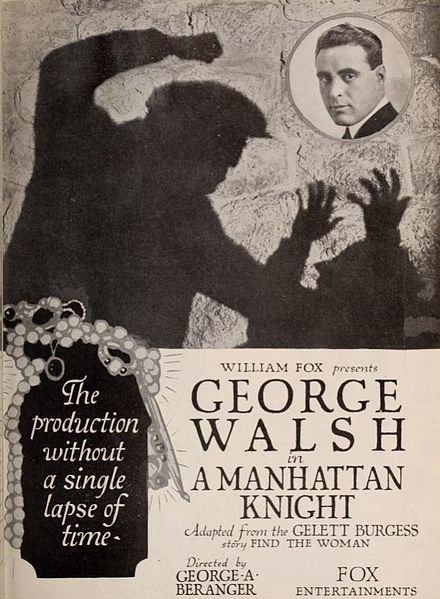
A definitive 5.8/10 rating for a film that redefined the boundaries of cult cinema. A Manhattan Knight remains a cornerstone of transgressive art.
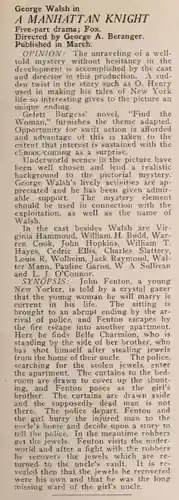
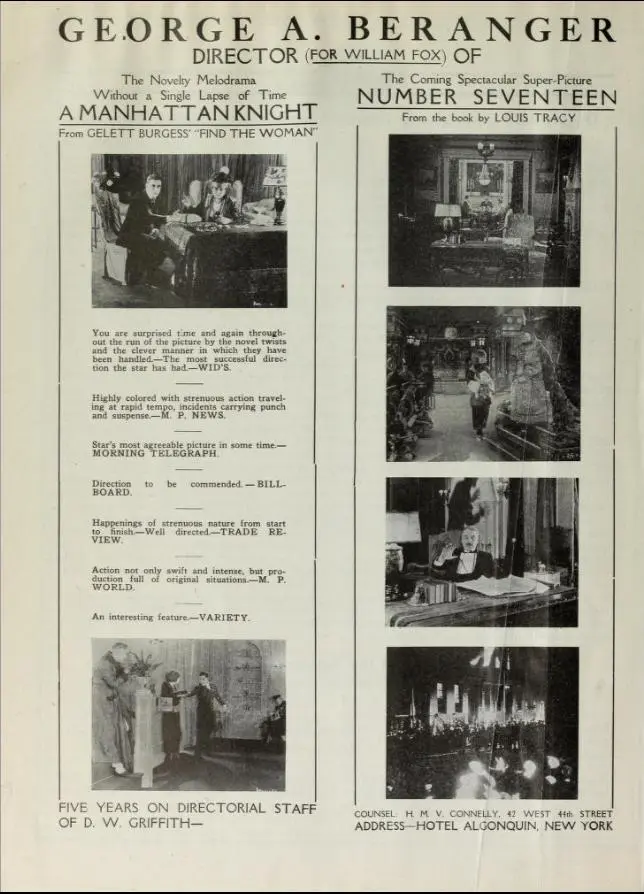
There are nights when Manhattan itself seems to exhale a sigh of rust, and A Manhattan Knight—that brittle, mercurial phantasm from 1923—catches that sigh on celluloid, trapping it like a moth beneath glass. Viewed today, the film feels less like linear narrative than like a fever dream stitched from cigarette smoke and pawn-shop diamonds. Directors George Beranger and Paul Sloane, both enamoured of chiaroscuro and the human face as topographical map, stage every scene as if it were a plate in a Gallery of Urban Decadence.
John Fenton’s odyssey begins inside a fortune-teller’s den wallpapered with tarot leaves and yellowed playbills. The camera glides past grinning cat skulls, past a parrot who has learnt to mimic police whistles, and settles on L.J. O’Connor’s aquiline profile. O’Connor—part matinée idol, part Bowery silhouette—plays Fenton with the haunted elasticity of a man who suspects the universe has dealt him a counterfeit name. One almost expects the title card to read: "Who am I? Ask the gutter, ask the moon."
When the cops kick in downstairs, Fenton’s reflex is not to run horizontally—the American reflex—but to climb, fingers grappling with the corroded lattice of vertical America itself. The rooftop chase that follows owes its vertiginous psychology less to Griffith than to the Expressionist prints flooding New York art dens that same year. Shadows skew sideways; chimney stacks morph into prison bars. You half remember the same tactic in Bare-Fisted Gallagher, yet here the ascent is existential: each storey peels back another layer of Fenton’s forged identity.
Enter Pauline Garon as Belle, eyes so luminously disillusioned they could guide ships through fog. Belle is introduced standing over her half-brother’s collapsed body, a gun still smoking like a recently answered question. Garon resists the vamp clichés of the era; instead she gives us a woman archiving every humiliation her bloodline ever produced. Notice how she pockets the purloined necklace—not with greedy glee but with the resigned efficiency of a clerk filing evidence. When she later murmurs to Fenton, "We are both bastards of circumstance," the line slices deeper than any dagger.
Mid-film, Fenton agrees to impersonate the wounded Gordon Brewster so that the police will abandon their manhunt. O’Connor’s body language snaps from poet to cornered racketeer: shoulders square, eyebrows pitched into a permanent interrogative. The ruse is discovered, of course, but not before the film has posed its central riddle: if identity is a coat one can shrug on and off, does blood matter? Compare this to the protagonist’s bewilderment in Die Geächteten, yet whereas that film treats displacement as political, A Manhattan Knight treats it as cosmic joke.
The diamonds—first stolen by Brewster, then pilfered again by the butler’s gang—function less as MacGuffins than as frozen karma. Note the fetishistic close-ups: facets reflecting gas lamps, each glint a silent indictment. When Fenton finally reclaims them in a dockside scuffle, the stones feel scalding, as if guilt itself had been compressed into carbon. The sequence anticipates the jewel-centred guilt in Five Thousand an Hour, though here the loot is radioactive with bastardy and blackmail.
“In the city’s labyrinth, every treasure is a breadcrumb leading back to the self you’ve tried to bury.” —title card, original 1923 print
Cast against type, character actor Louis Wolheim plays the Charmion butler with a slouching menace that prefigures his later gangland roles. Watch how he polishes a silver tray while whispering coordinates to crooks via candlestick telephone; domestic servitude becomes the perfect alibi for metropolitan piracy. His final confrontation with Fenton—in a candleless pantry lit only by the moon through a cracked skylight—ranks among the most intimate fights of silent cinema. No stunt doubles, no under-cranked camera: just two exhausted men grappling amid sacks of flour that burst like small, guilty clouds.
Only in the last reel does the screenplay (credited to Gelett Burgess, absurdist poet of "Purple Cow" fame) allow resolution. Fenton discovers a mildewed ledger in the butler’s trunk: his own kidnapping, aged nine months, recorded in bureaucratic ink. The revelation lands like a slap rather than a soothing balm. O’Connor’s face registers not joy but vertigo—the sudden vacuum of a life spent chasing an answer that changes nothing. Meanwhile, Belle learns that the diamonds her brother died for were paste imitations switched decades earlier. Both protagonists confront the same lesson: heritage and treasure are mirages, yet the ethical choices made while pursuing them prove diamond-hard.
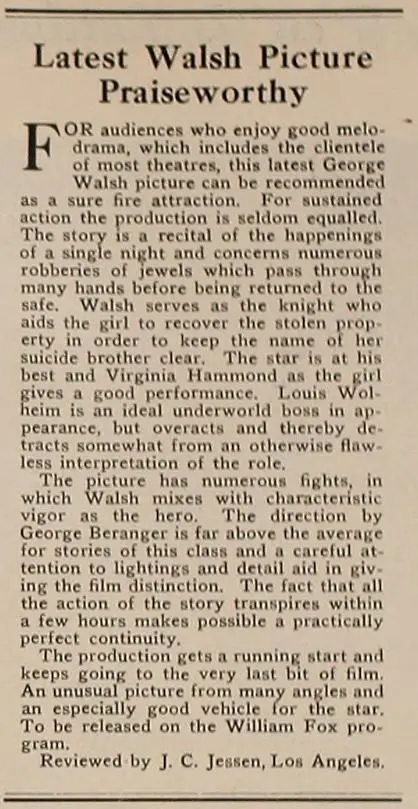
Cinematographer Walter Mann renders Manhattan in a twilight spectrum of asphalt greys and sickly sodium yellows, predicting the full-blown noir aesthetic still fifteen years away. Compare this palette to the tungsten warmth of A Message to Garcia; Mann’s city is colder, more predatory. Repeated visual motifs—criss-crossing fire escapes, broken mirrors, rain puddles reflecting neon—create a lattice of entrapment. The camera occasionally tilts thirty degrees off-axis, subtly informing us that moral plumb lines no longer apply.
Modern viewers will note Belle’s agency: she engineers the initial cover-up, bargains with underworld fences, and ultimately proposes marriage to Fenton. Yet the film also frames her through a lens of punitive chivalry—Fenton’s final act is to "rescue" her from the consequences of her own schemes. The tension feels productively unresolved, far more nuanced than the endpoint of The Girl in the Checkered Coat, where the heroine retreats into domestic silence.
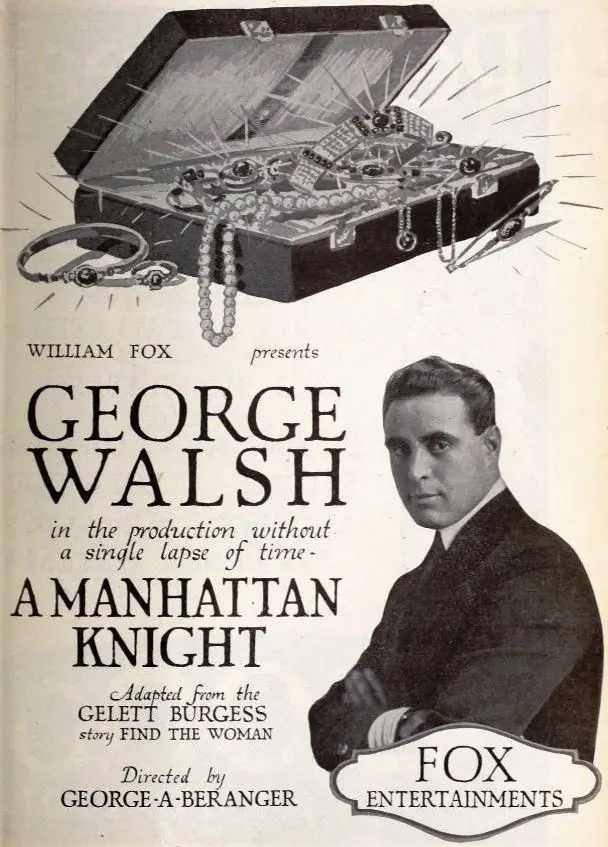
Released the same year as the pastoral whimsy of The Little Runaway, A Manhattan Knight offers an inverse worldview: children do not lose themselves in Edenic fields but in alleyways reeking of brine and bootleg gin. Its DNA shares strands with Peace and Riot—both movies treat social unrest as ambient weather—yet the Knight lacks any didactic impulse. It is content to be a shard of obsidian, reflecting nothing but its own darkness.
The closing intertitle announces the betrothal of Belle and Fenton against the backdrop of a sunrise over the East River. One might expect catharsis; instead the image trembles, as if the film itself doubts such tidy closure. Their clasped hands occupy only the lower third of the frame; above them, the city’s skyline looms like a row of broken teeth. It’s a marriage sealed not by hope but by mutual recognition of the abyss.
Archival notes indicate the original score called for muted trumpet, celesta, and hand-drums soaked in reverb. Contemporary restorations often plaster generic ragtime, neutering the film’s melancholy. Seek out the 2016 Alloy Ensemble version—its use of bowed vibraphone channels the story’s nocturnal drift, transforming each reel into a séance.
Like so many silents, A Manhattan Knight exists only in a 35mm print at the Cinémathèque française and a 2K scan privately struck for MoMA. Bootlegs circulate online, watermarked and bleached. Yet even in degraded form, the film pulses with outlaw vitality; it refuses to be embalmed by academia. If you track it down, project it in a room with brick walls and no curtains—let the images leak into the mortar where they belong.
Bottom line: this is not a comforting relic but a scalding reminder that identity, like Manhattan real estate, is built on stolen ground. Watch it for the rooftop geometries, the diamonds that burn holes in pockets, and for O’Connor’s eyes—two match-flames flickering above a city that never believed in absolution.
IMDb —
1916
Community
Log in to comment.