DbcultAccessing Vault...
Cult Review
Senior Film Conservator
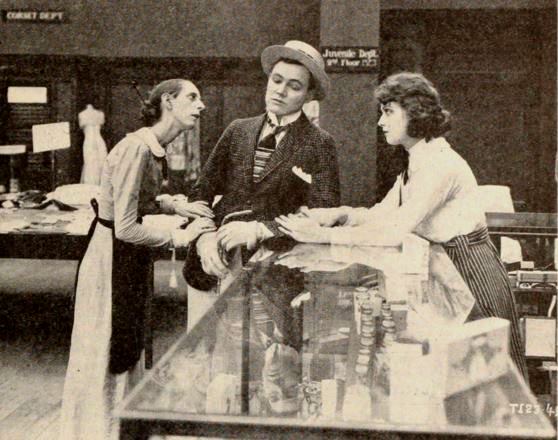
The film unspools like a tintype shaken awake: monochrome yet somehow iridescent, its rhythms dictated by a curfew bell that converts citizens into pumpkins long before midnight. Victor Schertzinger, composing silents as if scoring symphonies for ghosts, understands that quietude can be menace; the town’s gaslights hiss lullabies to complacency while a single woman’s heel-click on the boardwalk ricochets like a gunshot. This tension—between lull and lurid—is where A Nine O'Clock Town nests, incubating a fable about mercantile morality and the corsetry, literal and figurative, that keeps society from spilling its baser viscera.
Catherine Young’s vamp—listed only as "Vera Valmont" in studio notes but never named onscreen—enters in a traveling coat the color of bruised plums, cigarette glowing like a comet’s evil twin. Schertzinger introduces her via a dolly shot that creeps past pickle-barrels and nail-sacks, suggesting the camera itself is complicit in her hustle. Every eyelash is a baited hook; every syllable she purrs at David Clary (Melbourne MacDowell) feels extracted from a libretto written in smoke. The brilliance lies in how the director refuses to declare her guilt outright: we intuit it from the way she measures the store’s mahogany counter as though pricing a coffin.
David’s emporium is a diorama of American yearning: calico dreams, denim realities, a brass till that chimes like a tiny cathedral. MacDowell—often derided in fan-mags of the day as "the man who isn’t Lon Chaney"—gives a performance of tremulous reserve, shoulders forever halfway to a shrug, eyes pleading for invisibility. He embodies the national fantasy that goodness equals stasis, that if you sell yard-goods politely enough, entropy will overlook you. When Vera’s talons unsheathe, his terror feels cosmic; suddenly morality must be purchased retail, marked up, and displayed in the front window beside the gingham.
Enter Hazel Jennings, the corset model, essayed by Jane Novak with the stillness of a held breath. In a decade when flappers were beginning to scissor hems and prohibitions, Novak’s character weaponizes constriction itself. Watch her fingers while lacing a client: each tug is a stanza of control, every tightened knot a manifesto on the female body as contested territory. When she unmasks Vera’s forgery scheme—having recognized the city woman’s handwriting from a discarded perfume blotter—the victory is less Sherlockian sleuthing than textile insurgency. Her intellect is cut from the same tensile strength as the stays she sells.
Schertzinger lingers on close-ups of Hazel’s eyes, pools of sea-blue nitrate flickering with calculation. The film’s most erotic moment is not a kiss but a whispered measurement: "Twenty-two inches, madam," delivered with the solemnity of a priest administering last rites. In that instant the corset becomes chrysalis and armor, enabling flight while pretending to bind.
A tripartite motif structures the narrative: the bell that ends civic life at nine, the pocket-watch David perpetually consults as if time were a spreadsheet, and the cracked mirror in Vera’s rented room reflecting a fractured self. The editing rhymes these objects across cuts, so that when the bell tolls its final warning, the mirror shatters in implied simultaneity, shards glittering like verdicts. Silent cinema at its most poetic communicates causality through juxtaposition rather than dialogue; Schertzinger, also the film’s composer of intertitles, writes the bell’s toll as onomatopoeia—"CLANG-CLANG-CLANG"—superimposed over Vera’s startled face, marrying sound and image in the viewer’s cerebral cortex.
Where The Secret of the Storm Country sentimentalizes rural poverty and The Studio Girl frolics through back-lot whimsy, A Nine O'Clock Town exposes small-town claustrophobia as fertile ground for graft. Conversely, The Master Cracksman glamorizes criminality in urban labyrinths; Schertzinger relocates that menace to a place where sidewalks roll up at sunset, proving sin needs no skyscraper to thrive. Even On the Banks of Allan Water, with its pastoral tragedies, lacks the claustrophobic intimacy of a single counter separating decency from ruin.
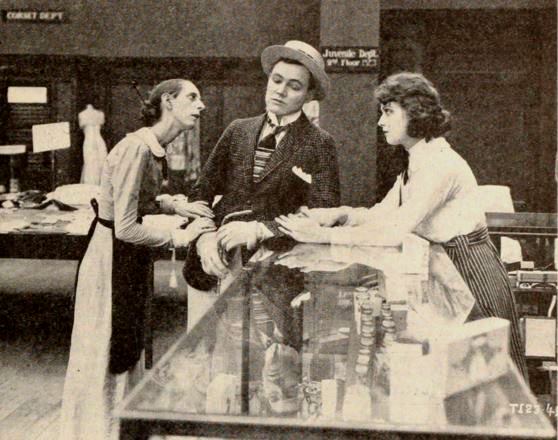
Melbourne MacDowell’s quivering stoicism is counter-weighted by Charles Ray’s turn as a garrulous delivery boy, all elbows and optimism—a living exclamation mark. Gertrude Claire, playing the town’s post-mistress, dispenses parcels and gossip with equal velocity, her spectacles perched like a judgmental crow. Otto Hoffman’s brief appearance as a traveling phrenologist provides comic relief, yet his pseudo-science also foreshadows the cerebral battle to come: skulls may be read, but motives remain encrypted.
The film dramatizes an economic system where women’s bodies circulate as promissory notes. Vera’s blackmail relies on photographs of an alleged tryst, the celluloid itself a currency more potent than the dollar. Hazel’s triumph is to re-appropriate that economy, using the tools of femininity—stitching, listening, archiving—to bankrupt the predator. Thus the corset becomes not a prison but a ledger where women write alternative contracts, inch by inch.
Only two 35mm prints are known to survive: one at UCLA’s Powell Library, another in a private Dutch collection. Neither has undergone full 4K restoration; the UCLA print—struck from a 1950s safety dupe—suffers from vinegar syndrome creeping along reel three, causing Vera’s crimson boa to flicker pink. Yet even in decay, the image breathes, thanks to sepia tinting that survived the photochemical gauntlet. Cinephiles petition archives for crowdfunding; as of this writing, €42,000 of the projected €80,000 required for photochemical stabilization has been pledged. Streamers beware: the YouTube rip circulating at 480p is from a 1990s VHS off-air, its intertitles smeared like wet ink.
While originally released with a compiled score of Sousa marches and parlour ditties, modern festivals often commission new accompaniment. At Pordenone 2019, Maud Nelissen performed a chamber suite that replaced brass bombast with accordion sighs, emphasizing the film’s continental undercurrent. The bell motif was literalized by struck anvils, sending seismic shivers through the Verdi Theatre. Viewers reported that when the final chord resolved, the auditorium’s own nine-o’clock bells—unplanned—echoed from the campanile, a serendipity worthy of Buñuel.
Early trade reviews were politely befuddled. Moving Picture World praised the "ingenious twist of virtue triumphant" yet dismissed the corset model as "a novelty to satisfy the fair sex." By the 1970s, feminist scholars reclaimed Hazel as a protofeminist saboteur. Today’s Letterboxd crowd hashtags it #SmallTownNoir, comparing its chiaroscuro to later rural noirs like Night of the Hunter. The film’s average rating sits at 3.7/5, impressive for a title viewable chiefly in archival basement caves.
Because America still tells itself that morality sleeps at nine, that Main Street is immune to the casino ethics of Wall boardrooms. Because women’s bodies remain battlegrounds where legislation, media, and capital stake claims. Because a silent artifact can speak louder than the algorithmic echo chamber currently dictating our cultural amnesia. A Nine O'Clock Town reminds us that every small store is a cosmos, every bell-curfew a potential gavel, every stitch in fabric a possible revolution.
Verdict: Imperfect, flecked with nitrate freckles, occasionally creaking under its own moral absolutism—yet these flaws feel human, the celluloid equivalent of laugh-lines. Seek it, should a festival curator risk the projector’s hum; cherish it, should a 4K restoration finally grant these shadows a second dawn.
IMDb 6.1
1936
Community
Log in to comment.