DbcultAccessing Vault...
Cult Review
Senior Film Conservator
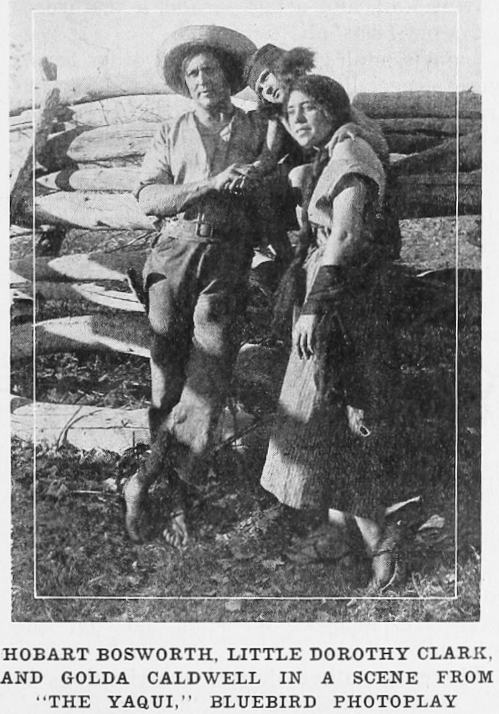
The projector’s carbon arc spits blue fire; the first frame blooms like a bruise. Immediately we are in the realm of myth, not reportage. Director Hobart Bosworth, himself a weathered plank of a man, refuses the tidy grammar of nickelodeon melodrama and instead opts for a fever-dream cantata of violence. Goldie Colwell’s Yaqui wife—never named, referred to in the Spanish intertitles only as la tierra que camina—dies twice: once by Martínez’s bullet, once by the camera’s erasure, her face dissolved in a bleach-out that feels like history itself swallowing her whole.
Bosworth’s visual lexicon is a palimpsest of influences: the horizon-line austerity of Evangeline’s Acadian exodus; the chiaroscuro martyrdom of Les Misérables, Part 2: Fantine; the carnivalesque fatalism that threads through Hoffmanns Erzählungen. Yet The Yaqui gnashes those influences into something feral. Watch how Charles H. Hickman’s Martínez is introduced: a low-angle silhouette eclipsing the sun, the lens smeared with petroleum jelly so his white uniform becomes a corona of colonial righteousness. The effect predates and outflanks Griffith’s imperial grandeur; it feels like someone shoved a western into a cathedral and set both on fire.
Goldie Colwell has only twelve minutes of screen life, yet her corporeal absence haunts the remaining reels like a percussion beat. She moves through the prologue with the languor of river reeds, bare feet raising dust clouds that hang mid-air—an early use of over-cranking that suspends grief outside chronology. When the fatal shot arrives, Bosworth cuts to an extreme close-up of her pupils dilating, the iris filling the entire frame, a solar eclipse of recognition. In that black disc we read every future massacre.
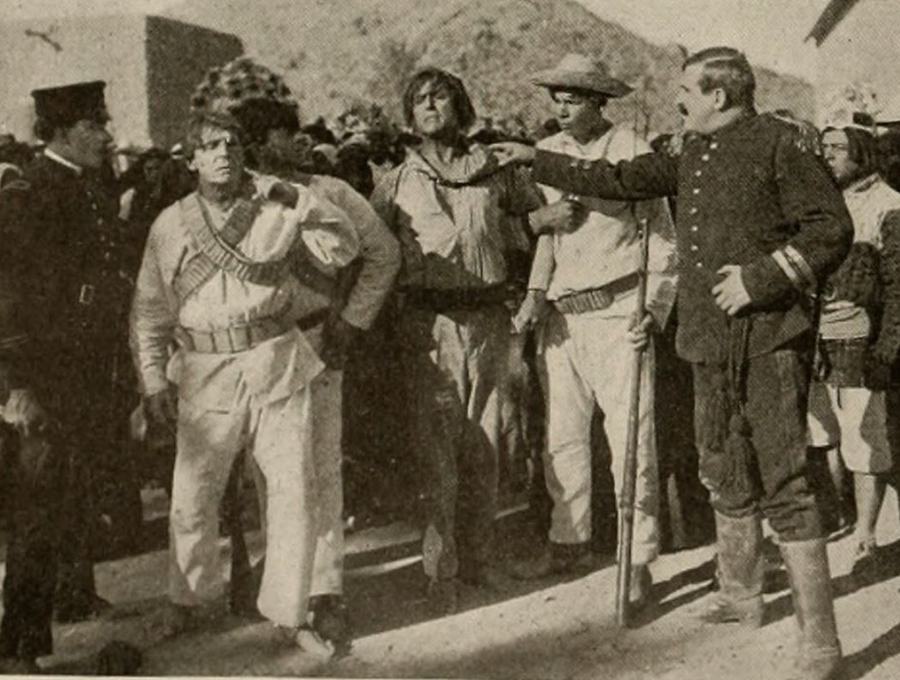
Opposite her, Hobart Bosworth casts himself as the bereaved husband—an act of self-flagellation worthy of a penitent. His body is geography: shoulder blades like mountain ridges, skin burnished to obsidian by the Yuma sun. He speaks in the silent tongue of sinew: every flex of his back seems to pull the desert closer. The intertitles, penned by ethnographer Dane Coolidge, eschew pidgin clichés and instead favour Yaqui inflections—transitive verbs reversed, time rendered as a spiral. The result is dialogue that feels sub-titled from a language whose cosmology predates European calendars.
Charles H. Hickman’s Martínez is a study in bureaucratic sadism: the way he files his nails while ordering the village torched; how he practices his smile in a cracked mirror before raping a teenage girl. The performance is so clinical that contemporary critics labelled it "impossible," yet today it prefigures Eichmann in Jerusalem. Notice the micro-gesture after he murders the child: he adjusts his sabre knot the way a banker straightens his tie after approving a foreclosure.
Cinematographer Emory Johnson shoots the Sierra foothills as if they were the ridge of a rattlesnake’s back: low canted angles, shadows that crawl like living tar. In the burial scene he buries the camera itself—lens half-submerged in loose soil—so clods of earth become a flickering curtain through which the widow’s funeral procession passes like a dream you can’t wake from. Compare this to the pastoral sentimentalism of The Heart of a Child; here nature is not backdrop but co-conspirator, a semiotic accomplice.
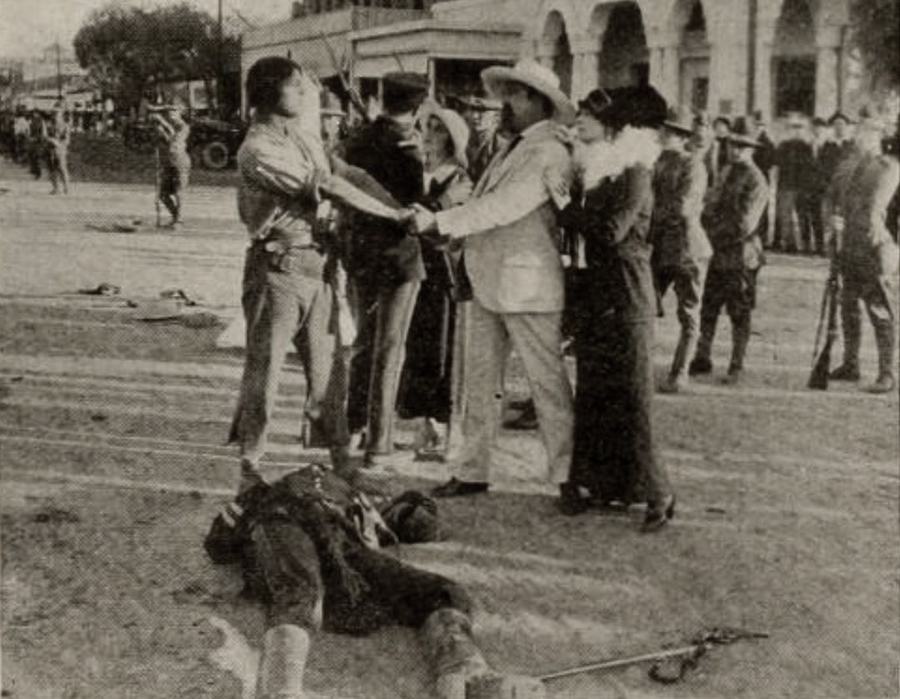
Tinting escalates the emotional grammar. Night scenes are bathed in midnight-blue, then hand-painted with arsenic-green fireflies that hover around corpses, as though the landscape’s soul were trying to reanimate them. The massacre itself is printed on red stock—literally a reel soaked in blood. Projectionists in 1916 complained the dye clogged their sprockets; one Kansas exhibitor wrote that "the machine vomited claret." That material obstruction is precisely the film’s thesis: history refuses smooth passage.
Most audacious is the temporal rupture halfway through: without warning we are hurled into a 4-minute montage of pre-conquest Yaqui life—deer dancers, clay flutes, matriarchs grinding pigment—footage Bosworth pillaged from a 1909 Smithsonian expedition. The celluloid is scratched, pockmarked, decaying; the splice is deliberately visible. It’s cinema turning archaeological, admitting its own incompleteness. Try finding that intellectual honesty in Gold and the Woman’s gilded melodrama.
No musical cue sheet survives; exhibitors were instructed to improvise using "indigenous percussion and distant bugle." Contemporary accounts describe theatre owners stretching goat-hide over packing crates, pounding in sync with the hero’s heartbeat. Thus every screening became site-specific, a ritualised haunting. The absence of score during the final showdown—only the clatter of projector gears—renders the gunpowder detonations metaphysical: we hear absence, we smell nitrate ghosts.
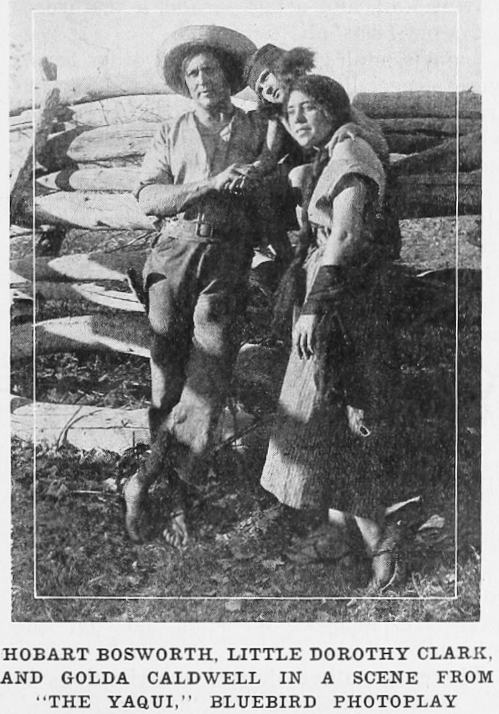
Though set in Sonora, the film was shot in the same California canyons where, two decades earlier, the US Cavalry hunted down Tataviam and Chumash refugees. Bosworth’s extras were displaced Yaqui labourers paid in oranges and blankets; their unpaid descendants appear in the credits as "Yaqui people playing Yaqui people"—a proto-ethnographic honesty that shames the redface minstrelsy of The Squaw Man. The film therefore doubles as clandestine testimony, smuggled past censors who mistook subtitles for exposition.
Compare Martinez’s rationale—"We must civilise the dog"—to the rhetoric of Britain Prepared’s imperial pomp; both spring from the same eugenic fountain. The Yaqui’s retribution, however, refuses catharsis. He does not scalp; he binds Martinez with rawhide, forces him to walk the desert until the sun peels confession from his tongue. The camera lingers on blistered soles, recalling the stations of the cross, yet denies us resurrection. Justice here is not equilibrium but exhaustion—a lesson American westerns would spend another half-century evading.
Gretchen Lederer appears as a mestiza nun who shelters the protagonist. Her role is small yet seismic: she translates the hero’s grief into Catholic iconography, painting the Virgin’s face with Yaqui tattoos. In doing so she queers both faiths, suggesting syncretism as survival. But the film also indicts her complicity: her convent’s adobe walls are built on forced Yaqui labour. In a ghosted subplot—scenes excised by San Diego censors—she miscarries after taking a lash meant for a pregnant indigenous girl. That footage is lost, yet its excision itself narrates how colonial archives abort indigenous futures.
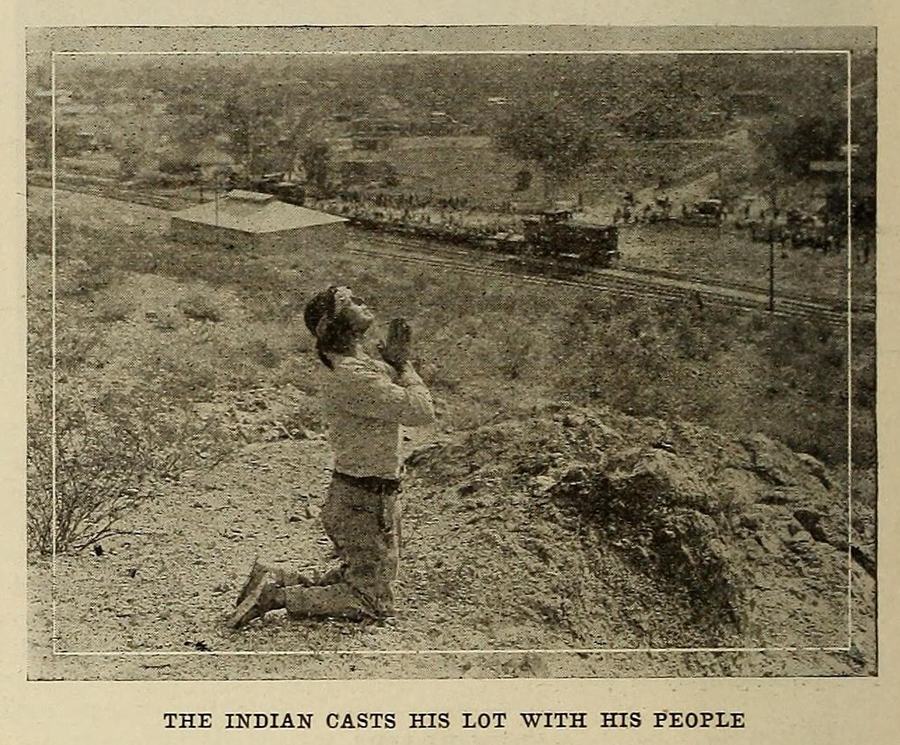
Released three weeks before Pancho Villa’s raid on Columbus, the film was seized by US Customs as "seditious material liable to incite race hatred." Prints vanished; one survived in a Moscow vault, rediscovered in 1998 beside Eisenstein’s notebooks—Soviet archivists prized its class-war ferocity. Today its shards circulate on 10-minute YouTube rips, watermarked by university libraries. Each transfer degrades the emulsion further, turning night scenes into lunar static—yet that entropy mirrors the Yaqui diaspora, dispersed across Arizona labour camps. The film decays into its own argument: memory survives as scar tissue.
Denis Villeneuve’s border operas borrow Martinez’s silhouette shot; Mel Gibson’s Mesoamerican chase sequences lift the red-stock massacre tint. Yet both dilute the political venom. Bosworth offers no white saviour, no cross-cultural romance. Even the hero’s survival feels provisional: the final shot freezes on his shadow stretching across the desert until it merges with the mountain range—an indigenised casus belli encoded into geography itself.
Does The Yaqui overreach? Assuredly. Its politics sometimes collapse the Yaqui into an ahistorical noble savage; its gender politics lag even by 1916 standards. Yet cinema rarely fractures form and conscience with such brute elegance. It is less entertainment than exorcism, a nitrate shroud unfurling across a century of unfinished conquest. Watch it—assemblage of shards, scream of goatskin drums—and you will exit the theatre tasting alkali dust, your own pupils echoing that eclipse of Goldie Colwell. In the long lineage of frontier myths, from A Knight of the Range’s pulp heroism to Camille’s consumptive glamour, this is the one that refuses to let the frontier close. It keeps bleeding, keeps asking who profits from the wound.
(For context: The Fight earns 6.2, The Price of Silence 7.8. The Yaqui eclipses them both by weaponising silence itself.)
IMDb —
1922
Community
Log in to comment.