DbcultAccessing Vault...
Cult Review
Senior Film Conservator
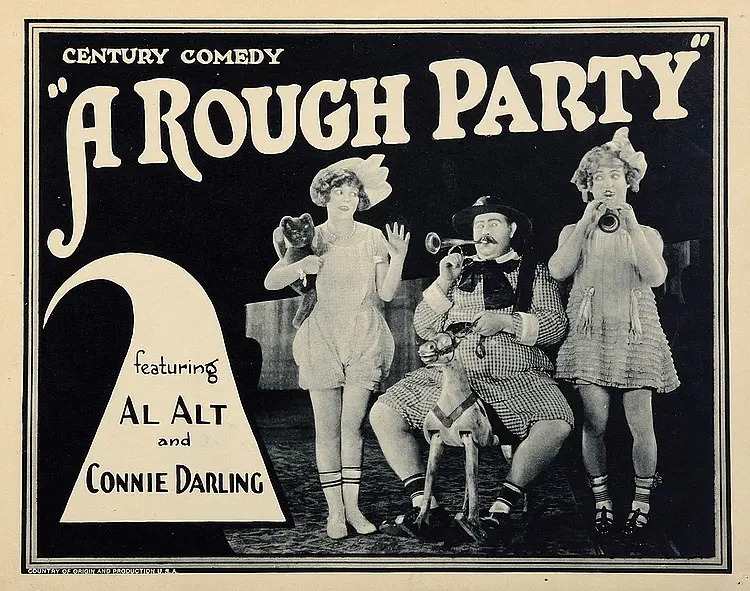
Is A Rough Party a forgotten classic of the silent era? Short answer: No, it is a bizarre relic that exists primarily as a historical footnote for those interested in the more eccentric corners of 1920s slapstick. It is a film that challenges modern sensibilities not through offensive content, but through a premise so fundamentally strange that it borders on the avant-garde. If you are looking for a sophisticated romantic comedy, look elsewhere. This is purely for those who find the visual of a grown man in a diaper inherently hilarious.
This film is for silent film historians and fans of 'Educational Pictures' shorts. It is absolutely not for anyone who finds the 'adult baby' trope unsettling or those who require a plot that makes logical sense. It is a product of a time when the rules of screen comedy were still being written in crayon.
1) This film works because of the sheer physical commitment of Hilliard Karr, whose large frame creates a genuine visual dissonance when stuffed into juvenile clothing.
2) This film fails because the central gag—adults acting like children—is stretched far beyond its natural breaking point, losing its comedic punch within the first five minutes.
3) You should watch it if you want to see the early, unrefined work of Charles Lamont before he became a staple director for Universal and Abbott and Costello.
The short answer is no, unless you are conducting a study on the evolution of American slapstick. While many films from 1923, such as A Man and His Money, attempted to blend social commentary with humor, A Rough Party leans entirely into the grotesque. It lacks the heart of a Chaplin short or the architectural brilliance of a Keaton set-piece. It is a one-note joke that rings hollow after the initial shock of the costume reveal.
The premise of A Rough Party is something that modern audiences might find in a dark indie horror film or a very specific niche of the internet. Two men, eager to impress a girl, find themselves at a party where the 'theme' is regression. The sight of Constance Darling in a pinafore, leading grown men around a nursery, is a visual that sticks with you, though perhaps for the wrong reasons.
The comedy relies heavily on the 'fish out of water' trope, but here, the water is a giant bathtub and the fish are wearing bibs. There is a specific scene where Al Alt attempts to maintain his dignity while clutching a giant rattle. It’s a moment that highlights the film’s only real strength: the actors' willingness to look absolutely ridiculous. However, the lack of a clever script means the actors are left to carry the entire weight of the production on their (bonnet-covered) shoulders.
Compared to other films of the period like Wild Women, which used absurdity to comment on gender roles, A Rough Party seems content to stay on the surface. It doesn't want to say anything about the infantile nature of the upper class or the absurdity of courtship. It just wants to show you a fat man in a high chair. It’s simple. It’s crude. It’s occasionally effective, but mostly it’s just exhausting.
Charles Lamont would eventually go on to direct some of the most successful comedies of the 1940s and 50s. In A Rough Party, we see a director who is still learning how to pace a gag. The camera work is static, even by 1923 standards. Unlike the dynamic framing found in '49-'17, Lamont keeps the action centered and flat. This gives the film a stage-bound feel that hampers the energy of the slapstick.
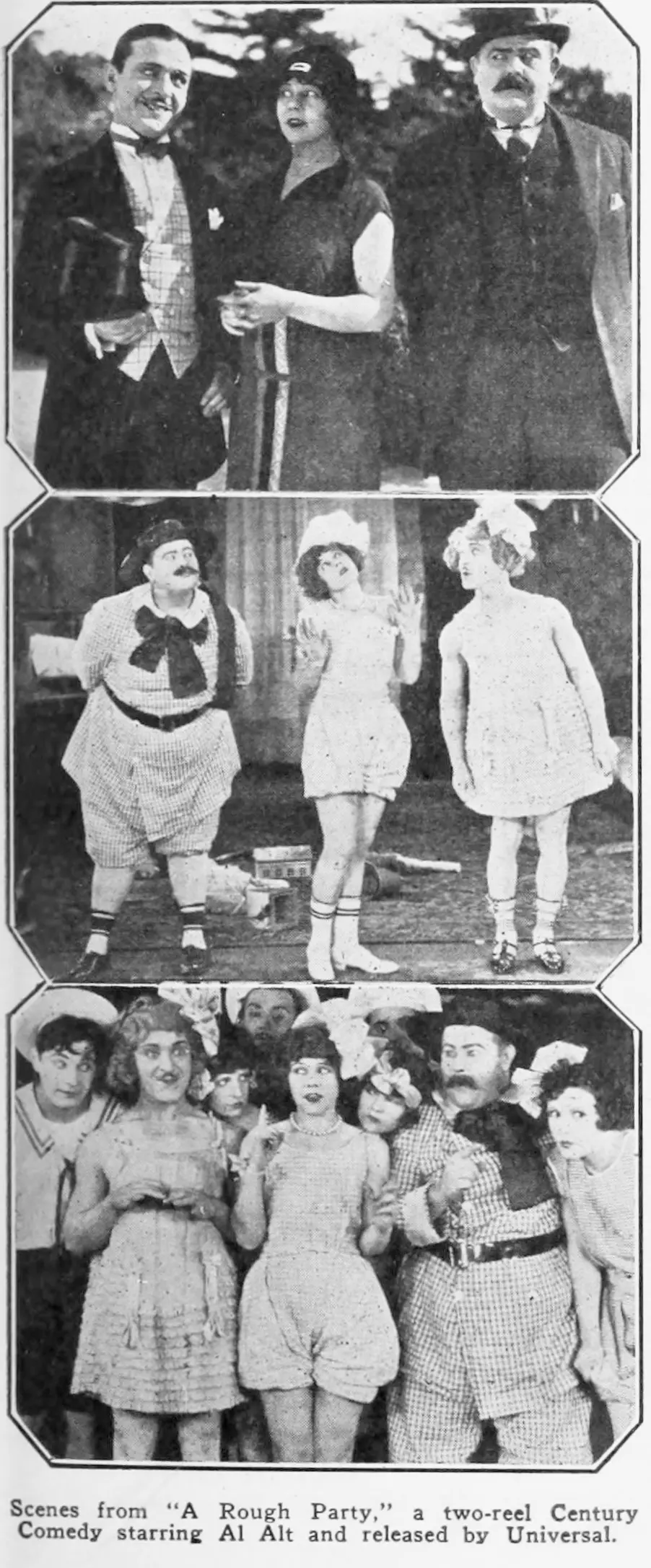
There is a missed opportunity here for some truly creative cinematography. Imagine the camera placed at a 'toddler’s eye view' to emphasize the scale of the props. Instead, we get wide shots that make the set look like exactly what it is: a cheaply built soundstage with oversized furniture. The lack of visual flair makes the repetitive nature of the gags more apparent.
"The film is a fascinating look at what passed for 'edgy' comedy in the early twenties, but it lacks the structural integrity to survive as anything more than a curiosity."
Hilliard Karr is the standout here. His performance is a masterclass in 'heavyweight' slapstick, a style that was popular during the silent era. He uses his size to great effect, particularly in a scene where he tries to navigate a set of giant building blocks. His frustration is palpable, and for a brief moment, the film touches on a genuine comedic truth: the indignity of the human body.
Al Alt plays the 'straight man' to Karr’s more boisterous energy. While Alt is competent, he doesn't have the same screen presence. He feels like a secondary thought in many of the scenes. Constance Darling, as the object of their affection, has very little to do other than look charming and occasionally scold the men for their 'childish' behavior. It’s a thankless role that was common in films like Miss Jackie of the Navy.
The chemistry between the two leads is functional but far from legendary. They lack the rhythmic timing of Laurel and Hardy or the chaotic energy of the Keystone Cops. They are two guys in a weird situation, and they play it as such. There is no deeper layer to their friendship or their rivalry. It works. But it’s flawed.
The pacing of A Rough Party is its biggest enemy. At a time when short films were becoming more sophisticated, this short feels like it belongs to an earlier decade. The gags are telegraphed miles in advance. When Karr sits on a giant cake, you aren't surprised; you’ve been waiting for it since the cake was first shown five minutes prior.
The editing is also quite jarring. There are several jumps that suggest footage may have been lost or that the assembly was rushed. This lack of polish makes it difficult to get into the 'flow' of the comedy. In contrast, a film like The City of Silent Men shows a much better understanding of narrative tension and visual storytelling.
Pros:
Cons:
A Rough Party is not a good movie in the traditional sense. It doesn't offer the emotional depth of Breaking Home Ties or the technical mastery of contemporary masterpieces. However, it is a fascinating artifact. It represents a specific type of 'low' comedy that was incredibly popular in the 1920s but has since been largely forgotten.
The film’s biggest crime isn't its weirdness, but its lack of ambition. It settles for the easiest laugh every single time. It’s a film that is content to be a footnote. If you find yourself watching it, you will likely spend more time wondering 'why?' than laughing. And perhaps that is its own kind of value.
In the end, A Rough Party is a reminder that the past is a foreign country where they do things differently—and sometimes, those things involve grown men in baby bonnets chasing each other with oversized lollipops. It is a rough watch, indeed.
IMDb —
1921
Community
Log in to comment.