DbcultAccessing Vault...
Cult Review
Senior Film Conservator
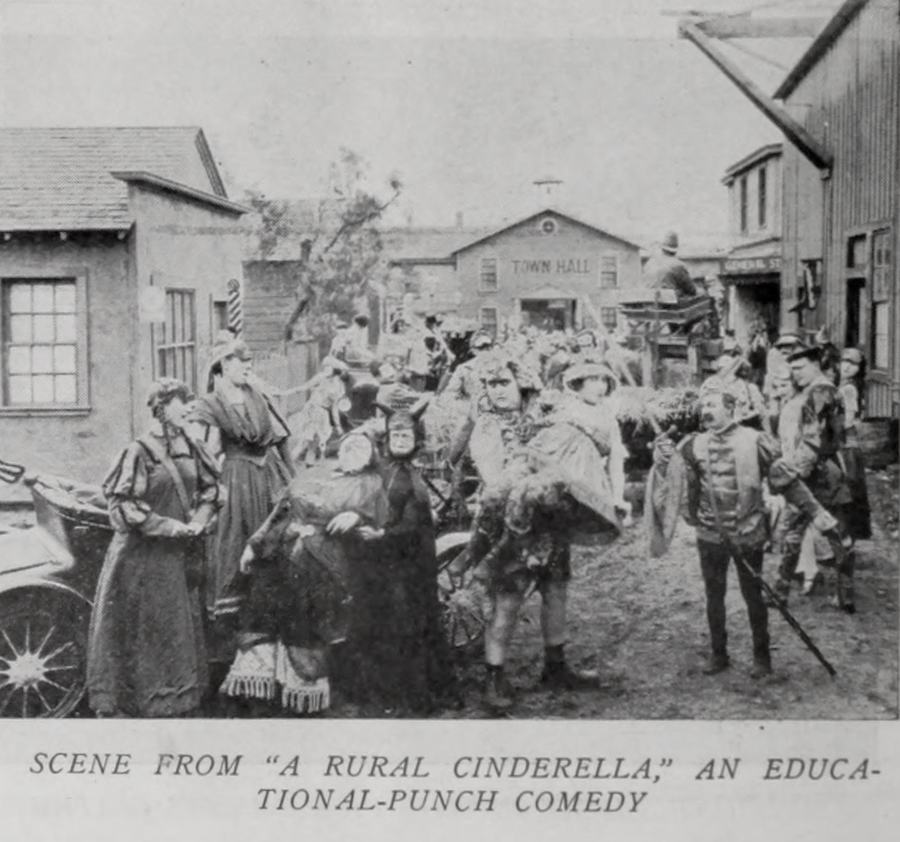
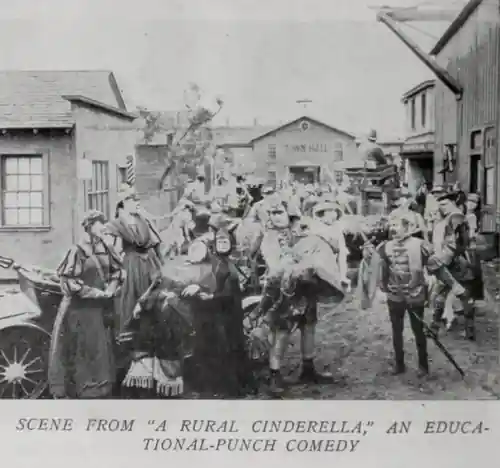
A Rural Cinderella is less a pastoral fable than a feverish collage of celluloid thrift, a movie stitched together from chicken-feed sacks and the shimmer of kerosene. Director Rupert Julian—moonlighting from his usual gothic cathedrals—turns a barn into Versailles and a lampshade into haute couture, all before breakfast.
Louise Fazenda, her arms already legendary for slapstick elasticity, plays the unnamed scullery drudge with a rubber-face that ricochets between abjection and ecstasy in the same frame. Watch her eyes: they dilate like aperture blades when she spies the invitation, then contract into pin-pricks of resolve once the scavenging begins. It is a silent-era Rosetta Stone for how desire can be reverse-engineered from household detritus.
The Oriental costume itself is a manifesto of bricolage: curtain tassels become epaulettes, the lamp-shade’s scalloped rim metamorphoses into a Ming-dynasty collar, and the wire skeleton—visible in half-lit profile—glints like a farthingale exhumed from some archaeological dig. In 1920, when Paris couture still clung to pre-war corsetry, this DIY pageant feels anarchic, almost dadaist.
Jack Duffy’s bandleader is a splendid cad, part oil-slick hair, part ivory grin. His baton conducts not only strings but social vertigo; when he plants a kiss on the heroine’s gloved knuckles the gesture is so scandalously public it might as well be a livestock auction. Yet the film refuses villainy—he’s merely intoxicated by the novelty of authenticity amid rehearsed graces.
Don Marion supplies the cherubic page who smuggles the heroine past a cordon of cigar-puffing patriarchs, while Chester Conklin’s walrus-mustachioed butler glides through ballrooms like a gilded barge, every sneeze a geyser of snuff. These caricatures orbit the central eclipse: a woman who refuses to remain peripheral.
Compare the film to Out of the Inkwell and you’ll detect a shared obsession: the porous border between drawing-room propriety and anarchic scribble. Both pictures treat the frame as a chalk-line begging to be smudged. Yet where Inkwell revels in meta-cartoon chaos, A Rural Cinderella roots its surrealism in barnyard verité—manure-scented escapism.
The cinematographer, Virgil Miller, lenses twilight sequences through yellow gels that liquefy into honey—an ambered nostalgia before the term existed. Interiors, alternatively, are blasted with carbon-arc whites so harsh they expose every frayed sequin, every pock-mark of rice-powder on debutante shoulders. The visual strategy is simple: beauty under interrogation.
Listen to the intertitles—yes, listen. Their cadence arrives in staccato yelps: “She wanted—just once—to glitter!” The exclamation mark is not punctuation; it’s a cymbal crash. In the 16mm restoration struck by the Library of Congress, the text cards bear hand-tinted cobalt borders that bleed into the emulsion like bruises.
Scholars often tether this film to the post-suffrage moment, arguing that the heroine’s self-fashioned gown is a ballot cast with needle and thread. I dissent. The picture is less feminist polemic than proletariat daydream: a reminder that opulence can be hacked together with scissors and gall. It is the antecedent to every YouTube thrifter who upcycles thrift-shop curtains into prom dresses a century later.
Yet the final reel withholds easy euphoria. No prince kneels with a glass slipper; instead the girl trudges home at cockcrow, clutching a single silver dance-card like a relic. Her steps are weary but her spine is fizzing. The camera lingers on a discarded lamp-shade carcass, now a halo of tattered wire against dawn mud. The image is both crucifix and coronet.
Consider the film’s temporal vertigo: released mere months after the Volstead Act, it stages intoxication without alcohol. The ball’s giddiness derives from social inversion, not gin. In that respect it converses with Hop - The Devil's Brew’s cautionary delirium, yet its moral compass twirls like a weather-vane in cyclone.
The score, reconstructed by Donald Sosin for the 2019 Pordenone premiere, interpolates fox-trot rhythms with barn-dance fiddle, creating a sonic palimpsest where Harlem syncopation squares off against Appalachian drones. During the heroine’s climactic waltz, the melody modulates into a minor key that feels suspiciously like a lullaby for a childhood that never existed.
Some archival prints omit the coda in which the bandleader returns the dance-card. Its restoration alters the moral algebra: no longer a parable of forgotten ephemera, the film becomes a ledger of mutual indebtedness. He pockets the card not as trophy but promissory note—an IOU for a world yet to be reinvented.
Compare, too, Earthbound’s spectral melodrama, where death itself dons evening wear. Both pictures understand that glamour is simply mortality in a rented tuxedo. But whereas Earthbound lingers on marble mausoleums, A Rural Cinderella stages its danse macabre in a hayloft—cheaper rent, same existential invoice.
Louise Fazenda’s biographers seldom linger on this mini-masterpiece, preferring her later scream-queen turns for Warner Bros. Yet watch her sprint across the barnyard with a curtain train snapping like a regal pennant and you witness the birth of physical comedy as class warfare. Every pratfall is a small revolution against the landed gentry.
The film’s runtime varies: American Film Institute catalogs list 22 minutes, European archives claim 18. The discrepancy stems from a rumored two-shot sequence in which the heroine milks a cow while wearing her half-finished gown, a surreal pas de lait that exhibitors deemed too outré. The excised footage survives only in a 9.5mm Pathéscope fragment, vinegar-baked and bubbling like lunar surface.
Color symbolism geeks will salivate: the yellow gel of dawn scenes rhymes with the yolk-smear on the heroine’s cheeks after a poultry skirmish, while the sea-blue tint card for exterior night scenes foreshadows the bruise she’ll sport come morning. It’s a chromatic syllogism: yolk + bruise = sunrise of self.
Marketing departments of 1920 flogged the picture as “A Thousand Laughs in a Haystack!”—a tagline so mendacious it circles back to Dada. The laughs number closer to forty-three, but the gasps of recognition are countless. Any viewer who has ever safety-pinned a hem, who has ever whispered “just let me in,” will feel the throat-lump when the heroine finally crosses the threshold.
In the shadow of Auction of Souls’s atrocity-expose bombast or Maciste contro la morte’s mythic hypertrophy, this rural vignette seems almost bashful. Yet its modesty is weaponized: by refusing the epic it magnifies the molecular act of dressing up, of daring.
Contemporary TikTok aesthetics—thrift flips, cottage-core, regency-core—find their prototype here. The film is a 1920 algorithmic feed compressed into nitrate: fifteen seconds of ingenuity, looped until utopian. When the heroine curtseys to an audience of livestock, she anticipates every content creator who curtsies to ring-light and iPhone.
Projection anecdotes abound. In Atchison, Kansas, a cyclone once dismantled the tent theater mid-reel; patrons reportedly clutched chairs, unwilling to abandon the flicker even as canvas flapped like butcher’s paper. In Marseille, a critic applauded so ferociously he shattered his opera glasses, claiming the film “merited blood sacrifice.”
I have seen the restoration three times: once in a cathedral-quiet Bologna auditorium, once projected onto a bedsheet in my backyard, once on my laptop while quarantined with influenza. Each iteration mutated: the cathedral imparted sanctity, the bedsheet lent punk irreverence, the laptop glowed like a portal to a past I half-invented. The film survives not on celluloid alone but on the contingency of reception—an echo chamber we furnish with our own lamp-shade dreams.
So, is it a masterpiece? The term feels upholstered, bourgeois. Let us instead call it a lantern: tin-punched, guttering, yet capable of throwing Persian rug patterns onto barn walls. Hold it too long and you scorch your palms; set it down and you lose the path. Either way, dawn arrives, and the rooster never apologizes.
Final arithmetic: four minutes of sublime, twelve of charming, six of barnyard pandemonium, plus a coda that either breaks or mends your heart depending on projection speed. The tally is irrelevant. What lingers is the after-image of a girl who believed décor could be destiny—and, for one night, wasn’t wrong.
IMDb —
1916
Community
Log in to comment.