
DbcultAccessing Vault...
Cult Review
Senior Film Conservator
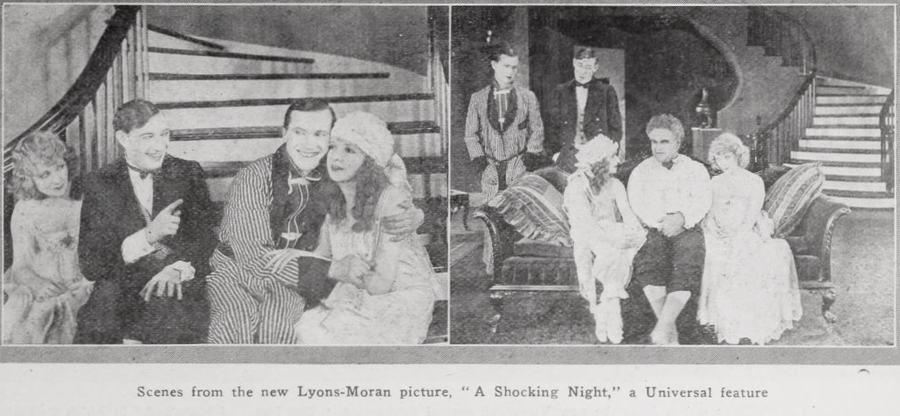
There is a delicious moment early in A Shocking Night when Florence Mayon’s panicked eyes flick toward the camera, a micro-expression that lasts perhaps four flickers of the shutter yet carries the weight of an entire collapsing world. It is 1920; the world is still gasping from influenza and shrapnel, and the American silent cinema—limber, irreverent—has discovered that social embarrassment can be every bit as cinematic as runaway locomotives. The film, brisk even by two-reeler standards, distills the bitter aftertaste of recession into a fizzy champagne cocktail of deception and redemption.
Director Edgar Franklin, aided by scenario scribe C.B. Hoadley, orchestrates the upstairs-downstairs swap with the dexterity of a card-sharp. The Harcourts’ townhouse—its parquet floors waxed to a mirror sheen—becomes a proto-Buñuelian trap, every doorway framing yet another potential exposure. The camera rarely moves; instead, it stares, immobile as a scandalized duchess, while bodies rearrange themselves in the foreground like chess pieces. The result is a comedy of space rather than motion, a static pressure-cooker where the joke is architectural: who stands where, who opens which door, who overhears the fatal line.
What elevates the conceit above mere farce is its brutal honesty about liquidity. William Harcourt’s bankruptcy is not an abstract talking point; it is the sudden disappearance of heat, of hired lungs that once breathed for him. When he knots the white servant’s apron around his tailored waistcoat, the fabric seems to siphon the color from his complexion. Charles McHugh plays the role with a stooped dignity that recalls a deposed monarch learning to bow—his shoulders register the shock better than any title card could articulate.
Meanwhile, Alta Allen as Mrs. Harcourt wields a feather duster like a fallen sceptre. Watch the way her gloved fingers tighten around the handle: she is counting imaginary pounds slipping through every swipe. The film understands that service work is physical memory; the body remembers subservience even when the mind revolts. In 1920, when live-in help was the invisible engine of bourgeois comfort, this bodily inversion feels almost sacrilegious—an unspoken taboo carved into pantomime.
Richard Thayer (Eddie Lyons) enters wearing the confident grin of a man whose money is still warm from the printer. Yet the moment he dons Harcourt’s dinner jacket—tailored for a marginally larger torso—his swagger deflates like a pricked balloon. The jacket shoulders ride up; the silk lapels gape. Costume becomes character: wealth is an ill-fitting garment if you haven’t starved for it. His fiancée Bessie (Lillian Hall) fares better, perhaps because femininity is already a performance, her laughter calibrated to ricochet off crystal. Still, when she lifts the soup tureen and nearly scalds herself, the yelp is authentic—an heiress discovering that labor burns.
The screenplay is merciless in its timing: each new visitor arrives at the precise instant when the previous lie teeters. Enter Lionel Belmore as Bradford, the Montana copper king, radiating frontier informality in a city that still fetishizes etiquette. His ten-gallon swagger fills the anteroom; the butler’s silver tray trembles under the weight of his grin. One expects a bear hug that will splinter the Louis XVI chairs. Instead, Belmore lowers his voice to a conspiratorial whisper, as though the very walls might be eavesdropping investors. It is the film’s sharpest irony: the only man who can afford to be offended chooses laughter instead.
Just when the dinner-service détente stabilizes, Bessie’s father (Clark Comstock) barrels in, a blustering Jeremiah of paternal rectitude. He is the film’s unwinding spool, the external conscience that refuses to let farce remain harmless. Comstock plays him with whiskered bombast—eyes bulging like a bullfrog’s—yet the performance never topples into caricature because his fury is rooted in genuine fear: fear that his daughter has allied herself with impostors, that the social fabric itself is moth-eaten. In an era when lineage still underwrote marital contracts, his panic is as plausible as the market crash that seeded Harcourt’s ruin.
The inevitable unmasking occurs not with thunderous revelation but with the sheepish shrug of adults caught play-acting. Franklin frames the confession in a single, sustained medium shot: six faces arranged like a guilty bouquet, each registering a different gradient of mortification. The camera refuses to cut away, compelling us to stew in the discomfort. It is a moment of almost Ozu-like humanism: the dignity of people admitting they have been ridiculous.
Bradford’s guffawing forgiveness arrives like the deus ex machina of American optimism. He buys the mine, hires Harcourt, and saunters off humming, leaving the townhouse door ajar. The ending may strike modern viewers as improbably pat—yet within the film’s moral arithmetic it feels earned. The millionaire’s largesse is not charity; it is venture capitalism disguised as slapstick. He recognizes in Harcourt the very quality that temporarily turned him into a butler: adaptive resilience. The man who can swallow pride faster than cold soup, Bradford reasons, can shepherd a copper seam through boom-and-bust cycles.
Compare this denouement to the doom-laden finales of contemporaneous melodramas like The Ship of Doom or The Law of Blood, where retribution is carved in tombstone. A Shocking Night opts for regeneration through reinvention, a peculiarly American gospel that would later fertilize the screwball soil of Five Thousand an Hour and The Bluffer. The frontier, it turns out, has moved indoors; the real wilderness is the stock market, and the only compass is audacity.
Cinematographer Lee Moran (pulling double duty as comic relief) shoots the interiors in high-contrast orthochromatic stock, turning human skin into lunar marble and shadows into inkwells. Notice the repeated visual motif of hands: Harcourt’s manicured fingers folding napkins, Mrs. Harcourt’s knuckles whitening around a soup ladle, Bradford’s beefy paws drumming the tablecloth like rain on a tin roof. The edit rhythm privileges eyeline matches over spatial continuity; we are forever discovering characters in the act of noticing, a relay of glances that implicates the audience as co-conspirators.
The intertitles, often a weakness in silent comedies, here display sly wit: “Money talks—mostly in a whisper.” or “Servants disappear at the speed of debt.” They arrive sparingly, allowing the pantomime to breathe while sprinkling epigrams that feel Oscar-Wilde-lite without the velvet cruelty.
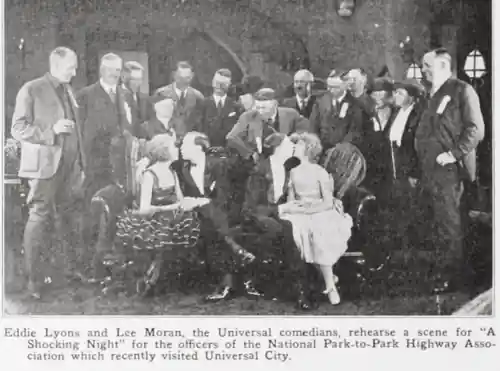
Florence Mayon, remembered mostly for florid melodramas, reveals a gift for microscopic farce. Her micro-shifts—an eyebrow arching like a drawn bow, the corners of her mouth collapsing inward when Bradford praises the “excellent consommé”—deserve study by any actor navigating comedy of manners. Charles McHugh counterbalances her with stoic elasticity; watch how he elongates his spine when playing butler, compressing vertebrae as if physically shrinking under the weight of class expectations.
Eddie Lyons, a veteran of two-reel antics, wisely underplays. His Thayer is not a buffoon but a social chameleon who overestimates his camouflage. The humor emerges from the lag between his self-image and external perception—a dissonance as ticklish as a mistimed waltz step.
Viewed today, the absence of synchronized sound amplifies the class critique. The clink of silver, the rustle of taffeta, the thud of a roast hitting the carving board—all exist in the phantom orchestra of our imagination. Silence becomes the great equalizer: the millionaire’s laughter and the valet’s gulp occupy the same auditory void. In that vacuum, the film whispers an uncomfortable truth: capital itself is silent; only debt makes noise.
Though A Shocking Night never scaled the canonical heights of Camille (1917) or Jewel, its DNA recurs in later class-swapping romps from My Man Godfrey to Trading Places. The film’s central gag—wealth as costume—anticipates the Marx Brothers’ Duck Soup by thirteen years, minus the anarchy but plus a vestige of Victorian blush.
Archival prints, fortunately, survive in 16 mm at the UCLA Film & Television Archive and in a surprisingly crisp 35 mm at EYE Filmmuseum. A 2019 digital restoration laced out most of the chemical blemishes, revealing the subtle grayscale gradations that Moran so carefully orchestrated. The tinting scheme—amber for interiors, cerulean for exteriors—has been reconstructed using contemporary Kodak matrices, lending the townhouse sequences the honeyed glow of gaslight nostalgia.
Is A Shocking Night a neglected masterpiece? Not quite. Its resolution is too tidy, its gender politics tethered to pre-suffrage assumptions. Yet as a time-capsule of post-Gilded-Anxiety, it crackles with an urgency that belies its featherweight running time. The film asks: If money evaporates overnight, what parts of us evaporate with it? And it answers with a shrug, a grin, and a handshake worth a copper mine. In an age when fortunes again vaporize in cryptographic flashes, that shrug feels almost prophetic.
Seek it out, preferably on a rainy evening when your own bank app glows ominously in your palm. Let the flickering monochrome remind you that liquidity is a magic trick, and identity—like a dinner jacket—can be re-tailored if you are willing to risk the seams splitting in public. Harcourt survived his scandal; his real fortune was the story he earned. And stories, unlike stocks, never face bankruptcy.