DbcultAccessing Vault...
5.2/10
Senior Film Conservator
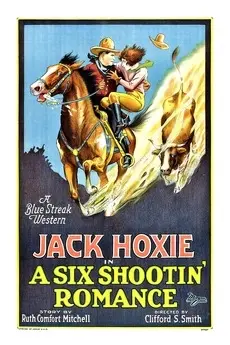
A definitive 5.2/10 rating for a film that redefined the boundaries of cult cinema. A Six Shootin' Romance remains a cornerstone of transgressive art.
Is A Six Shootin' Romance worth your time in the modern era? Short answer: yes, but only if you view it as a historical artifact of the transition between raw action and sophisticated melodrama. This film is specifically for silent cinema completists and those interested in the 'enemies-to-lovers' trope before it became a tired cliché. It is definitely not for anyone who requires fast-paced editing or a plot that avoids the standard damsel-in-distress formula.
Before we dive into the dusty trails of the 1920s, let's establish the ground rules for this viewing experience. This film operates on a logic that is nearly a century old, yet it possesses a certain grit that many of its contemporaries lacked.
If you are looking for a definitive answer, here it is: A Six Shootin' Romance is a serviceable B-Western that excels in its physical stunt work but stumbles in its narrative pacing. It is worth watching for the performance of Jack Hoxie, who was a legitimate rodeo star before he was a matinee idol. His comfort on a horse isn't an act; it's a reality that brings a level of authenticity to the screen that modern CGI-heavy Westerns simply cannot replicate. However, if you are not a fan of silent-era storytelling conventions—such as the heavy use of title cards to explain basic emotions—you might find yourself checking the runtime.
The 'Eastern Girl' arriving in the West was a staple of the 1920s. We see similar themes in films like The Yankee Girl, where the clash of cultures provides the primary engine for the plot. In A Six Shootin' Romance, Donaldeen Travis isn't just a character; she is a representative of a civilization that Jack's world hasn't quite reconciled with yet. The early scenes in the ranch house, where Donaldeen attempts to impose her social standards on the rough-and-tumble Jack, are played for laughs, but they underscore a deeper anxiety of the era: the closing of the frontier and the encroachment of 'polite' society.
Carmen Phillips plays the role with a stiff-necked pride that makes her eventual softening feel earned. When she finally admits her love for Jack during the rescue, it doesn't feel like a surrender to his masculinity, but rather an acknowledgment of his integrity. It's a subtle distinction, but one that makes the film slightly more progressive than its peers.
Jack Hoxie was never going to win awards for his range of facial expressions. He had about three: determined, angry, and slightly confused. But in the world of 1926, that was exactly what was needed. His physicality is the movie's greatest asset. Take, for example, the scene where he first confronts Currier King. There is no wasted movement. Hoxie moves like a man who has spent more time in a saddle than in a chair. It’s a performance of presence rather than prose.
Compare this to the more theatrical performances found in European films of the same year, such as Die Verführten. While the Europeans were experimenting with expressionism and psychological depth, the American Western was perfecting the art of the 'man of action.' Hoxie represents the pinnacle of this blue-collar acting style. He isn't trying to be a poet; he's trying to be a cowboy.
The character of Currier King is fascinatingly detestable. In many Westerns of this period, the villain wants the land or the gold. In A Six Shootin' Romance, King wants the girl, and the fact that he is already married adds a layer of moral filth to his character that would later be scrubbed away by the Hays Code. His abduction of Donaldeen isn't just a plot device to trigger a chase; it's a desperate act of an ego-bruised man. This makes the final confrontation feel more personal. It isn't just about justice; it's about clearing a stain on the community's honor.
"The silent Western didn't need complex dialogue because the landscape and the horse-chase told the story of the human soul better than words ever could."
The cinematography in this film is surprisingly expansive. The director, Alan James, utilizes the natural light of the California hills to create a sense of scale. The chase sequences are filmed with a kinetic energy that belies the primitive camera equipment of the time. You can almost feel the dust in your throat as the horses thunder across the screen. This isn't the sterilized West of the 1950s; it’s a place that looks hot, dry, and unforgiving.
The pacing, however, is where the film shows its age. The middle act, involving the legalities of the joint inheritance, feels like it belongs in a different movie. It slows the momentum to a crawl. We don't want to see Jack and Donaldeen arguing over paperwork; we want to see them navigating the dangers of the frontier. When the film finally remembers it's a Western in the final twenty minutes, it regains its footing, but the journey there is occasionally tedious.
Pros:
- Authentic 1920s Western atmosphere.
- A strong, if slightly stereotypical, female lead.
- The historical curiosity of seeing an early Gary Cooper.
- High-quality stunt work that holds up today.
Cons:
- Predictable plot beats.
- The villain is a bit of a caricature.
- Title cards are overly explanatory at times.
One of the most surprising elements of A Six Shootin' Romance is how it handles the concept of 'joint inheritance.' In an era where women were often depicted as having no agency, the film places Donaldeen Travis on an equal legal footing with Jack. While the film eventually settles into a traditional romantic ending, the premise itself acknowledges a shifting social landscape where women were entering the public and professional spheres, a theme echoed in films like The Lawful Cheater. It’s a small detail, but it prevents the film from feeling entirely like a relic.
A Six Shootin' Romance is not a masterpiece of world cinema. It is, however, a robust and entertaining example of the B-Western at its peak. It works. But it’s flawed. The film’s strength lies in its refusal to be anything other than what it is: a vehicle for a popular star to do what he does best. While it lacks the psychological depth of a film like The Outcast, it makes up for it with sheer, unadulterated energy. If you have seventy minutes to spare and an interest in the roots of American action cinema, you could do far worse than riding along with Lightning Jack.
IMDb —
1924
Community
Log in to comment.