DbcultAccessing Vault...
Cult Review
Senior Film Conservator
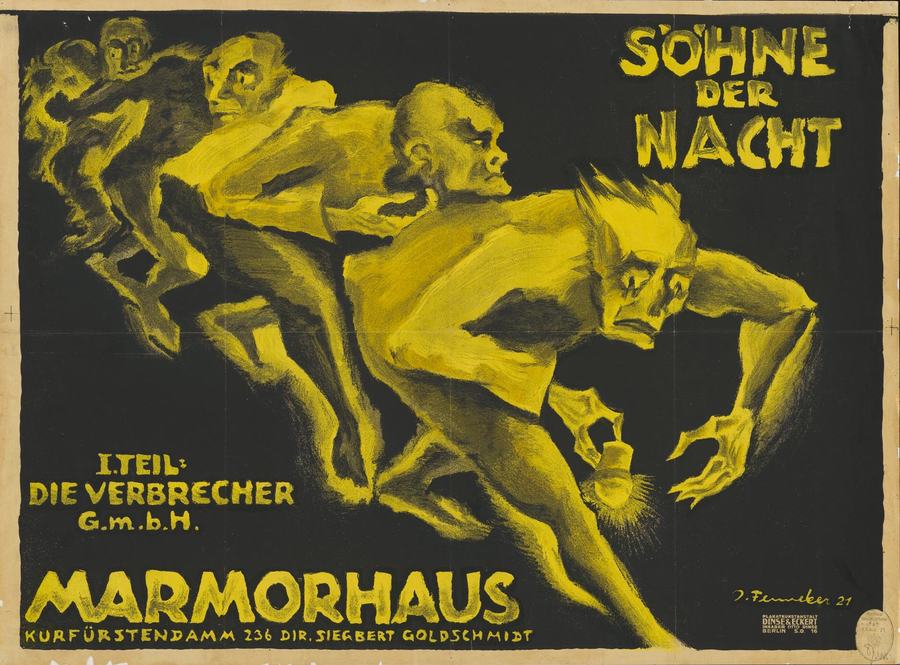
If you press your ear to the cobblestones of Söhne der Nacht, you will hear not horses but generators humming—an electrical promise that something modern and monstrous is being born. Margarete-Maria Langen’s scenario detonates the melodramatic fuse of earlier German crime serials; instead of mustache-twirling villains we get venture capitalists of violence, filing clerks who moonlight as garrotters. Director Ludwig Rex orchestrates this chaos with surgical detachment: every insert shot of a revolver cylinder or stock-market ticker is a reminder that capital and carnage share the same circulatory system.
What distinguishes the picture from contemporaneous pulp like Snap Judgment is its refusal to grant the audience moral buoyancy. There are no last-act confessions, no paternal cops tucking the city into bed. Even the camera seems implicated; it glides through smoke-choked basements like an accessory after the fact.
Rex and cinematographer Robert Scholz paint Berlin as a neural network where streetlamps synapse with knife-blades. Observe the early sequence inside the Moka Efti cabaret: gold leaf peels off Corinthian columns like diseased skin, while Tzwetta Tzatschewa’s dancer navigates the stage as though every high-kick might decapitate a spectator. The camera adopts her POV mid-spin, and suddenly the audience becomes a single gaping maw—Weimar’s collective id clamouring for the next thrill.
The palette is a self-negating triad: bruised oranges (#C2410C) of nightclub neon, sulfuric yellows (#EAB308) of foyer chandeliers, and the anaemic cyan (#0E7490) of dawn over the Spree. These hues don’t just decorate space; they arbitrate fate. When Harry Wills finally trades his tuxedo for a dockworker’s coat, the teal of the river seems to leach the copper from his complexion—an ontological downgrade from predator to prey.
Wolfgang von Schwindt has the bone structure of a matinee idol but the eyes of a man who has pawned his own reflection. Watch how he lights a cigarette: the match flares, he inhales, and for a nanosecond the flame reveals a tremor at the corner of his mouth—fear or remorse, impossible to parse yet exhilarating to witness. Compare this to Hans Albers, whose ‘Kohle’ Rudi enters each frame like a brass band on amphetamines. Albers weaponizes charisma; when he slaps a subordinate you sense the joy that radiates from his molars. The two men share a rooftop scene that plays like a seduction and a duel: backlit smoke, collar-buttons undone, their dialogue a duet of euphemisms for treason.
Esther Hagan’s Lola is the film’s wounded metronome. Her torch song Immer nur Mitternacht is performed in a single take, the camera creeping inward until her quivering iris fills the frame. You expect a cutaway—some visual escape—but Rex denies it, imprisoning us in her grief. The song becomes an aural brand; long after the credits you will find yourself humming it while reading headlines about inflation.
The eponymous “GmbH” is a shell company laundering narcotics through express mail. Langen modeled it on real conglomerates like IG Farben, whose boardrooms seated both chemists and counts. In the film’s centrepiece montage, invoices, shipping manifests, and death certificates are cross-cut like shuffled cards, implying that bureaucracy itself is the ultimate fence for stolen lives. This anticipates the corporate satire of later Weimar classics, though none would match the chill precision on display here.
There is also a queer subtext bubbling under the macho posturing. Harry’s bond with his lieutenant, played by Robert Scholz, carries an erotic charge that neither man can articulate. When they share a cramped jail cell, the camera lingers on their interlocked shadows—an intimacy more candid than any heterosexual clinch the Production Code would soon demand.
Langen fractures chronology so that past and present copulate violently. Flashbacks to trench warfare are not sepia-tinted nostalgia but phosphorous burns stitched into the celluloid. In one bravura match-cut, a bayonet thrust in 1918 becomes a champagne cork popping in 1929; history and hedonism share an arterial spurt. The editing rhythm—measured in heartbeats rather than seconds—foreshadows the temporal experiments of Parsifal, albeit in a grimy register closer to George Grosz than to Wagner.
Sound, though officially absent, is implied through visual sonification: the flicker of a neon sign syncs with intertitles that stutter like Morse code; a swinging lightbulb blurs into a sine wave. Viewers in 1929 reportedly gasped when a silent pistol “rang” louder than any on-screen gun because their minds filled the acoustic void with remembered artillery.
Female bodies in this universe are currency, battlefield, and archive. Yet Langen complicates the trope: Lola’s final act is not martyrdom but archival preservation—she photographs the ledger that incriminates the syndicate, trading her own erasure for evidentiary permanence. The film closes on her gaze fixed at us, a proto-feminist gauntlet thrown at the feet of a culture that commodifies her voice while ignoring its message.
Contrast this with The Easiest Way, where female agency dissolves into sacrificial melodrama. Here, survival is ugly, partial, yet self-authored.
American censors trimmed nearly 18 minutes for its 1931 U.S. release, retitling it Sons of the Night and reframing Harry as a federal agent—an intellectual lobotomy that excised the systemic critique. Even in truncated form, the film stalked the imagination of Hollywood émigrés: echoes appear in the venal cityscapes of The Dark Road and the bureaucratic nightmares of Lang & Wilder. The tracking shot through the postal depot, with parcels gliding like coffins on conveyor belts, directly inspired the factory sequence in Modern Times.
Today, when streaming algorithms parcel human attention into monetizable chunks, Söhne der Nacht feels prophetic. Its criminals don’t merely break laws; they gamify morality, turning civic institutions into slot machines. The film anticipates ransomware cartels, data-harvesting conglomerates, the whole twenty-first-century carnival of invisible theft.
A 4K restoration premiered at Bologna’s Il Cinema Ritrovato, scanned from a 35mm nitrate print discovered in São Paulo. Graffiti etched by cinema ushers on the margins—”Keine Moral!” inked beside a key intertitle—have been preserved, becoming part of the text’s palimpsest. If you watch it on Blu-ray, disable the contemporary score; instead cue up live improvisations by cellist Zoé Marie Rudloff, whose atonal drones reanimate the film’s circulatory tension without sentimental varnish.
Söhne der Nacht is not a relic pinned under museum glass; it is a live grenade rolled across a century. It indicts not merely its own fractured republic but any society that outsources cruelty to ledger columns and calls it progress. To witness it is to feel the first tremor of an historical earthquake whose aftershocks still rattle our digital balconies. Approach, then, with caution—and a willingness to emerge scorched, exhilarated, irreversibly haunted.
Community
Log in to comment.