DbcultAccessing Vault...
Cult Review
Senior Film Conservator
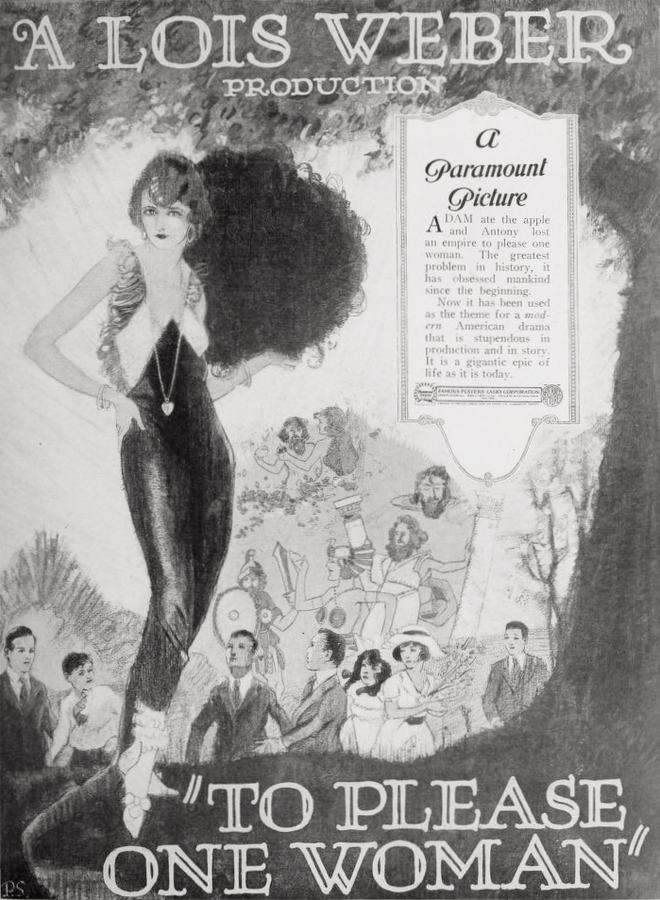
The first time I saw To Please One Woman—in a dripping Bologna archive, 35mm nitrate held together by archivist prayers and vinegar—I understood why entire city councils tried to jail Lois Weber. The print hissed like a skillet of serpents; the images arrived haloed in phosphor, as though the screen itself were blushing. Two reels in, a projectionist fainted. By the time Mona Lisa’s vamp sauntered into her final conflagration, half the audience had crossed legs or clutched crucifixes. No fangs, no cape, no Eastern-European castle—just a woman who knew that wanting is the sharpest incisor of all.
We open on a credit sequence superimposed over rippling satin: the fabric becomes a cityscape, then a courtroom, then a boudoir, all without a cut. Weber’s camera glides like a hand that refuses to ask permission. Enter Frank Coghlan Jr.—boyish but already sporting the wary eyes of someone who has balanced ledgers of sin. He plays Jimmy Haskins, junior teller at the Industrial Trust, engaged to Edith Kessler’s Miriam, a Sunday-school teacher who lectures on temperance while privately paging through lingerie catalogues with the reverence of Holy Writ. Their shared dream is a bungalow and a phonograph that never plays jazz. Into this porcelain existence swirls The Woman, unnamed onscreen, listed only as Her in the intertitles. She arrives at the bank to cash a check the size of a modest dowry, fixes Jimmy with a gaze that could unbuckle statute books, and asks—title card in Weber’s own handwriting—“Wouldn’t you rather be spent than saved?”
Because the print is hand-tinted, each frame flirts with synesthesia. Miriam’s world is daubed in icy cerulean; Her world pulses amber and arterial red. When Jimmy crosses the threshold of the vampire’s speakeasy, the tinting becomes fever-chart yellow, the same shade hospitals used to denote delirium tremens. Cinematographer Dal Clawson (borrowed from Universal’s East Lynne unit) layers scrims of cigarette smoke so that characters appear to dissolve mid-conversation. The effect is less atmospheric than forensic: every exhale erases a layer of soul.
Notice the blocking in the cabaret sequence: Mona Lisa occupies center frame, yet the camera is angled slightly from below, so her chin juts like a ship’s prow. Men orbit in Keplerian ellipses; women oscillate, pendulums measuring the gravity of her allure. George Hackathorne’s painter—modeled on real-life cocaine suicide Wallace Reid—sketches her on a napkin using his own blood from a pricked finger. The sketch is never shown; Weber cuts to his eyes, dilated as if staring down a locomotive. In that instant the film confesses its thesis: art cannot capture appetite, only the hemorrhage left behind.
What makes the picture transgressive even by 2020s yardsticks is its refusal to punish the woman. Every man engineers his own undoing. Lee Shumway’s attorney, a paragon of municipal repute, defends Her in court on a morals charge, wins, then immediately begs to become her next meal. She obliges—then discards him like a rinsed oyster shell. The intertitle reads: “He mistook the gavel for a heart, the verdict for a vow.” Weber, a former street-corner evangelist, here weaponizes scripture against patriarchy: the men are Pilate, washing their hands of agency while secretly thirsting for spittle-moistened robes.
Meanwhile Edith Kessler’s Miriam undergoes the inverse arc. Initially sketched as another shrinking violet, she stalks Her through rain-slick streets, barges into the cabaret, and—instead of pleading for Jimmy’s return—demands instruction. The vampire’s reply arrives as a single tintyped word: “Listen.” The next montage is a masterclass in erotic education: Miriam learns to roll stockings like a courtesan, to butter toast with the back of a spoon, to meet her own gaze in the mirror without blinking first. Kessler’s performance is calibrated to micro-tremors; when Miriam finally sports a sleeveless crimson dress, the actress lets her shoulders perform a tentative pirouette, as if testing whether the air itself might molest her. The moment is heart-splitting because it is not corruption—it is graduation.
Gordon Griffith, the original Jackie Coogan type, plays Pete the flower boy. Weber shoots him at child’s-eye level: adult torsos loom like Doric columns, skirt hems billow like galleon sails. Pete’s roses never find a buyer; instead they wilt into narrative mulch, petals ground beneath patent-leather heels. Yet the kid sees everything—Jimmy’s back-alley weeping, the minister’s furtive gin, the vampire’s dawn departure—without once judging. His function is Greek-chorus by way of newsboy: he hawks headlines no one will buy. In the penultimate reel he offers a rose to Mona Lisa; she kneels, accepts, then presses a coin into his palm so hard it leaves an imprint Weber shows in close-up. That imprint becomes stigmata; the rose, now blood-tipped, is tossed into the gutter where a street-cleaner’s broom bisects it. End of childhood, end of mercy.
Studio legend claims the original negative burned in 1923, the result of a carelessly flicked ash at Universal’s Fort Lee lab. Censors rejoiced; Weber, bankrupt, wept on the ferry to Catalina. Yet like any good succubus, the film refused to die. Duplicate fragments—about 42 minutes—surfaced in a Portuguese convent in 1978, then another reel in a disused Montana barn whose owner had used the canisters to steady a tractor. The restoration now touring cinematheques stitches those shards into something that breathes like a broken lung. The climax is cobbled from continuity stills: the vampire walks into what looks like a boiler room, silk gown brushing iron valves. Flames lick the hem; she never flinches. Over the blaze, Weber superimposes a title card—white letters on orange flicker—“She pleased none but herself, and thereby freed them all.”
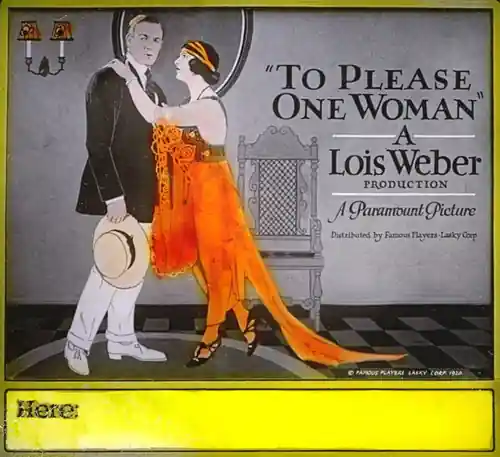
Because the footage is lost, historians debate whether the fire was accidental or a deliberate act of self-immolation by a director who understood her career was ash anyway. I favor the latter. The film’s surviving script directions read: “She burns not for sin but for silence—hers and ours.” That line, excised by the studio, feels more incendiary than any nitrate frame.
Modern screenings commission new scores; my favorite is by the Ukrainian quartet Dakh Daughters, who use bowed saw and typewriter percussion. When Mona Lisa first appears, they scrape the saw until it approximates a human wail; during the courtroom scene the typewriter clacks Morse code that spells “pleasewoman” ad infinitum. The effect is witch-craft: you swear Weber intended it, though she died decades before tape loops.
Place To Please One Woman beside The Cup of Life and you see Weber weaponizing the same chiaroscuro that made Pigs in Clover a slapstick hit, but here the shadows swallow punchlines whole. Against Peace and Riot, her film refuses the sentimental escape valve: no comic vicar, no last-minute dowry. Compared to Naar Hjertet sælges, Weber’s vampire is neither redeemed nor punished, whereas the Danish heroine finds salvation through self-sacrifice. Weber’s gospel is rougher: salvation arrives the moment you admit you don’t need saving.
Mona Lisa—billed only by her real name, an enigma even in casting bulletins—moves like smoke learning to waltz. Watch her fingers: she taps ash from a cigarette by rotating only the wrist, a motion so languid it feels like time itself is stretching. Edith Kessler counterbalances with staccato jitters, shoulders hitching as if her skeleton were trying to escape. In their shared close-up—an iris shot that narrows the world to two faces—you can measure the exact frame where fear transmutes into fascination; Kessler’s pupils dilate on the cut, not before. Frank Coghlan Jr., only nineteen, ages a decade across the narrative via posture alone: by the final reel his clavicle protrudes like a coat hanger from which ambition once hung.
Weber repeats a visual motif: water turned blood-red. A fountain in the bank’s lobby spews crimson when Jimmy cashes his first embezzled check; later, a baptismal font in the minister’s church overflows with the same tint the Sunday after he dreams of Her. The implication is alchemical: commerce, desire, and sacrament share one vascular system. Another refrain is the mirror. Characters confront their reflections in silver bowls, trolley windows, even a policeman’s helmet. Each time the reflection is cracked, fogged, or half-obscured by superimposed text. Weber insists self-knowledge is always mediated, always partial, always already written by someone else.
The New York Board of Review demanded 42 cuts. Weber attended every hearing, carrying a Bible and a copy of the Constitution like twin pistols. She lost. The excised footage—described in ledgers as “vampiric cohabitation,” “sapphic undertow,” and “mockery of clergy”—is presumed lost, though anecdote claims a projectionist named Sal saved a single trimmed frame in a locket. When he died in 1954, the locket was buried with him. Somewhere in Queens, a corpse wears Mona Lisa’s smile no larger than a postage stamp.
The 4K DCP tours festivals; it streams on Le Cinéma Club for one-night stands, then retreats to archival vaults like a coy mistress. A Blu-ray from Kino Lorber is promised for 2025, supplemented by a commentary track recorded at 3 a.m. in the same Ukrainian bomb shelter where the Daughters premiered their score. Pre-order is already back-ordered twice over. Bootlegs circulate on Telegram, watermarked by flickering cigarette burns that feel almost canonical.
Weber’s vampire is the prototype for every femme fatale that followed, yet she predates the Hays Code, predates vamp as slang, predates the modernist fascination with the anti-hero. She is not a cautionary device but a mirror hurled into the audience’s lap. We leave the theater—or the laptop tab—checking our own teeth for blood. The film’s final paradox: the more of it that disappears, the larger it looms in cultural memory. Like the vampire herself, it seduces not by fullness but by absence, not by speech but by the hush that follows. And in that hush you hear your own pulse, steady as a projector’s ticking, asking the question Weber embedded between every sprocket hole: whose appetite are you feeding tonight?
IMDb —
1921
Community
Log in to comment.