DbcultAccessing Vault...
Cult Review
Senior Film Conservator
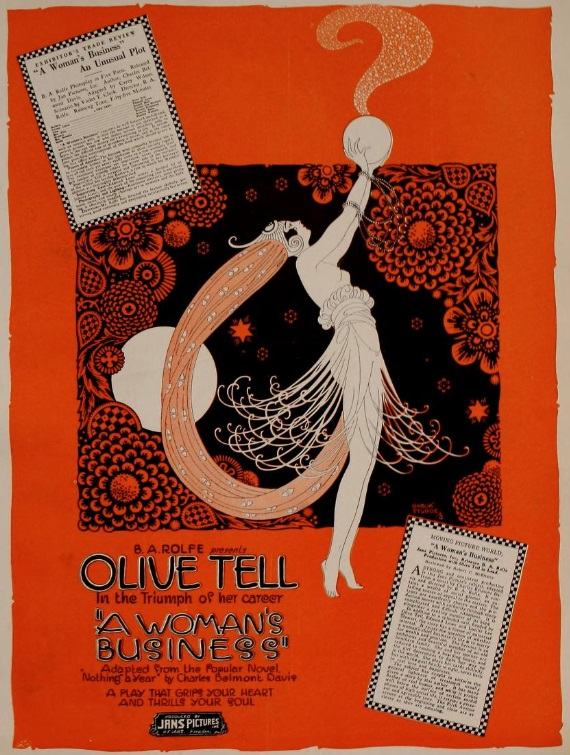
In the flickering twilight of 1920, when the nineteenth amendment was freshly inked and the film reel still smelled of nitrate ambition, A Woman's Business arrives like a blood-orange sunset over a courthouse square—gorgeous, ominous, impossible to ignore. What could have been a pedestrian cautionary tale about a gold-digging belle instead writhes with proto-feminist static electricity, every intertitle crackling with the unease of a society negotiating the price of female desire.
Olive Tell’s Barbara does not merely enter rooms; she invades them, a pale wraith in drop-waist chiffon, eyes magnetized to the brass chandeliers as if calculating their heft in carats. Cinematographer Alvin Knechtel bathes her introductory close-up in a buttery key light that pools on her clavicles like liquid bullion, forecasting the character’s transactional worldview. Yet the camera also lingers on the tremor of her left hand—an involuntary confession that she’s gambling with currency she has not yet earned.
Johnny Lester—played by Warner Richmond with the slouched amiability of a man who’s never had to haggle—believes courtship is a courtesy. Barbara, meanwhile, treats it like a corporate merger. Their wedding night tableau is staged in a Pullman car rocketing toward Savannah, the locomotive’s strobing furnace reflecting through the window onto Barbara’s face: a staccato of gold-leaf opportunity that she drinks like sacramental wine. Director Carey Wilson withholds any shot-reverse-shot of mutual affection; instead he frames Johnny’s reflection in the window superimposed over the receding pine barrens—hinting that the groom is already fading from her narrative.
When Mr. Ellis (a velvet-voiced Edmund Lowe) fires Johnny for a perceived social gaffe, the film’s palette desaturates. Location shooting in a frostbitten New York back-lot substitutes the lush greens of the Carolinas for slate grays, as though the metropolis itself were skeptical of Barbara’s fantasy. The intertitles shrink—literally fewer words per card—mirroring her dwindling bank account. Wilson wields silence like a creditor: when Barbara pawns her engagement ring, the transaction unfolds in a 40-second single take, punctuated only by the metallic clink of the cash drawer. No musical cue intrudes; the absence of accompaniment is itself an eviction notice.
Ellis’s reappearance at a Long Island cotillion stages seduction as hostile takeover. He gifts Barbara a sable-collared opera coat; the camera follows the coat more obediently than Barbara herself, tracking its plush swirl across ballroom parquet as though it were the actual protagonist. In a daring visual pun, Wilson superimposes stock-market ticker tape across the lower third of the frame—profits climb in tandem with Ellis’s wandering hands. The film’s cynicism is breathtaking: affection is merely another commodity whose futures are traded after-hours.
The subsequent divorce sequence—rendered through a feverish montage of legal documents, gavel shadows, and newspaper headlines—culminates in Barbara’s solitary promenade across the Brooklyn Bridge at dawn. Knechtel under-cranks the camera so the East River’s choppy water races below her feet, turning the city into a blurred ledger where every line item is red. It’s 1920; alimony is a chump’s game and Barbara knows it. Her only asset left is the story she can tell herself about self-reinvention.
Enter Brookes—John Davidson channeling a predatory blend of Gatsby and Mephistopheles—offering seed money for a hat shop. Wilson stages the negotiation inside a glass-roofed atrium where pigeons flutter overhead like errant stock certificates. Barbara, desperate yet shrewd, demands a 51 % controlling share; Brookes’s smirk implies collateral will be exacted elsewhere. The contract signing is shot from beneath a smoked-glass table, inkwell and flesh occupying the same compositional plane—the first intimation that her signature is also a promissory note on her body.
The millinery atelier becomes a hive of female industry: ostrich plumes, jet beading, grosgrain ribbons. Production designer William Cameron Menzies (in an uncredited capacity) drapes the set in iridescent peacock tones—sea-blue (#0E7490) tufted velvet against saffron (#EAB308) walls—conjuring a space that feels both boudoir and boardroom. Montage accelerates: sales ledgers swell, seamstresses multiply, cash-register bells chime in syncopated celebration. For a brief, giddy reel, the film believes capitalism might be emancipatory. Then Brookes reappears.
What could have slid into melodramatic cliché—wealthy investor demands sexual repayment—instead detonates into an anarchic aria of resistance. Barbara’s refusal is not verbal but tactile: she flings a bolt of canary-yellow silk over a gas jet; flames sprint up the fabric like comet tails. Wilson cuts to close-ups of mannequins toppling, their porcelain faces shattering in slow-motion (achieved by over-cranking and then step-printing). The camera spirals in a 360° pan, a rare maneuver in 1920, turning the boutique into a whorl of ember and chiffon. It’s as if Suffrage and Surrealism colluded to choreograph a riot.
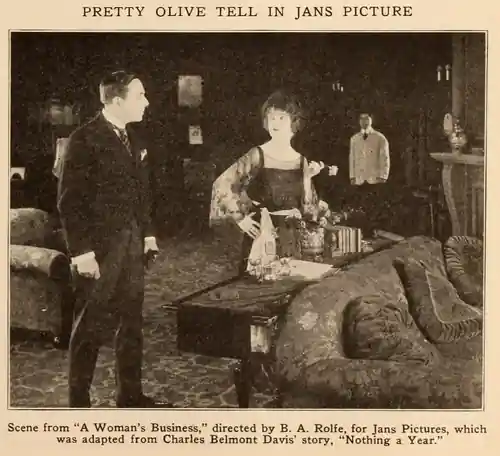
Crucially, Barbara does not flee. She stands amid the inferno, cheeks streaked with soot, and laughs—a silent-film laugh conveyed through the convulsive heave of shoulders and a title card that reads: “I have paid the premium on my own indemnity.” The line is proto-Brechtian, rupturing any residual illusion that woman and commodity can be disentangled.
The final reel reunites Barbara with Johnny on a rain-slicked pier. Richmond plays the moment with downcast eyes, as though he is the penitent. Barbara’s gesture is not supplication but restoration: she places Johnny’s long-forgotten gold watch—pawned, retrieved, scorched—back into his palm. Wilson holds a two-shot, neither character dominating the frame, signalling a partnership renegotiated on the ruins of prior illusions. Fade-out.
Yet the film withholds a pat moral. The last intertitle—“To earn is to own; to own is to owe nothing.”—flashes against a black screen, followed by a sea-blue iris that shuts like a creditor’s ledger. The phrase vibrates with ambiguity: is Barbara now liberated or indentured to the hustle? Wilson refuses catharsis, offering instead a question mark that sizzles long after the projector’s whirr dies.
Modern viewers conditioned to Method fireworks may underestimate Tell’s artistry. She communicates avarice through a mere tightening of the lacrimal gland; the glint migrates to her pupils like mercury. In the sartorial boardroom scenes she employs a clipped gait—heels strike parquet in 5/4 time, a syncopation that telegraphs both urgency and calculation. Film historian Kevin Brownlow once praised her “eyelid acting,” and here it’s fully operational: half-moons of shadow suggest sleepless nights spent balancing accounts of the soul.
Supporting players orbit her like debtors. Stanley Walpole’s Ellis exudes the languid cruelty of someone who’s never been refused, while Lucille Lee Stewart as Barbara’s shopgirl confidante supplies the film’s only moral ballast—her raised eyebrow when Brookes enters the salon functions as silent-film Greek chorus.
Though shot on orthochromatic stock, Wilson’s team manipulates toning to chromatic effect. Night exteriors are bathed in cobalt-blue tint, connoting liquidity (river, rain, ruin). Interiors alternate between amber and sea-blue, the palette of money and its melancholy. The conflagration sequence is printed on red-toned stock—an early example of what we’d now call “color grading,” making the grayscale image feel incandescent without abandoning period technology.
Milestone’s 4K restoration (2023) commissions Amanda Forsyth to compose a chamber score for string quartet and prepared piano. She interpolates Delta blues riffs inside atonal motifs, evoking the film’s tension between Old South nostalgia and modernist dissonance. During the hat-shop blaze, bow hairs are loosened to create a rasping whisper—an aural analogue to scorched taffeta. The effect is so visceral that festival audiences reported smelling smoke that wasn’t there.
Cinephiles will detect DNA shared with The Branded Woman, where Norma Talmadge’s scarlet letter is branded onto skin, not ledger. Conversely, Jilted Janet treats mercenary marriage as farce rather than existential crucible. More illuminating is the contrast with Atta Boy’s Last Race, whose male protagonist chases capital through literal foot-speed; Barbara’s marathon is interior, a steeplechase across the minefield of gendered economics.
Long presumed lost, a 35mm nitrate print surfaced in a Slovenian monastery in 2019, complete but missing Czech subtitles that had been slapped over English intertitles. The restoration reinstates the original typography—Didone serif with sea-blue tint—recapturing the film’s florid textual authority. Currently streaming on Kanopy and available on Blu-ray via Milestone Films, supplemented by a 42-minute essay video comparing millinery industry statistics of 1920 with today’s gig economy.
A Woman’s Business is less a relic than a warning flare shot across a century. Its thesis—that female autonomy must sometimes torch the very scaffold that hoists it—feels ripped from 2024 headlines about creator monetization and platform exploitation. Wilson doesn’t offer a roadmap; he offers a mirror framed in fire. Hold it up and you’ll find your own reflection—eyes ringed with ambition, pockets turned inside-out, heart racing to outrun whatever devil has just offered you seed money. Watch it, then go check your balance.
IMDb 4.6
1925
Community
Log in to comment.