DbcultAccessing Vault...
6.3/10
Senior Film Conservator
A definitive 6.3/10 rating for a film that redefined the boundaries of cult cinema. Pay Your Dues remains a cornerstone of transgressive art.
The year 1919 remains a watershed epoch for the American comedic short, a period where the primitive slapstick of the nickelodeon era began to synthesize with sophisticated character-driven narratives. In the center of this hurricane stood Harold Lloyd, an actor whose 'Glasses Character' was rapidly becoming the everyman icon for a modernizing nation. Pay Your Dues, directed by the stalwart Fred C. Newmeyer, is not merely a relic of this era but a vibrant, pulsating example of how physical comedy can serve as a profound critique of social structures.
The film opens with a sequence that is deceptively domestic. Lloyd’s character is engaged in a game of pin the tail on the donkey—a motif of blindness that Newmeyer uses to mirror the protagonist's general obliviousness to the dangers of the world. While contemporaries like those in The Hidden Pearls were exploring exotic locales and high-stakes drama, Lloyd found the sublime in the suburban. The blindfold isn't just a prop; it’s a thematic device. It represents the veil between the ordinary citizen and the subterranean worlds that exist just out of sight.
When our hero is mistaken for an escaped initiate of a 'kooky' fraternal order, the film shifts gears from domestic comedy to a frantic, almost Kafkaesque nightmare. The abduction is handled with a lightness of touch that belies its darker implications. In an era where films like Chained to the Past dealt with the weight of history, Pay Your Dues suggests that the present is equally capable of shackling the individual through sheer, random absurdity.
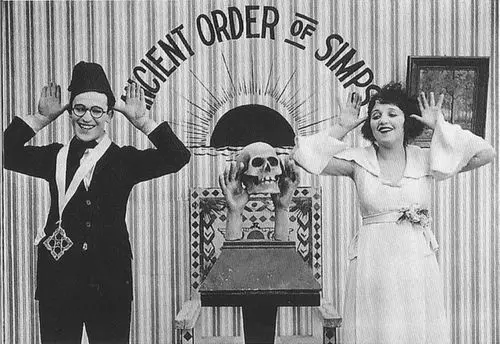
The secret society depicted in the film is a magnificent caricature of the various lodges and brotherhoods that permeated American life in the early 1900s. These organizations, with their arcane rituals and rigid hierarchies, are ripe for the picking by Newmeyer and writer H.M. Walker. Unlike the gritty realism found in Carmen of the Klondike, the 'danger' here is strictly performative, yet the indignities visited upon Lloyd are visceral and expertly choreographed.
The initiation process involves a series of 'tests' that range from the physically demanding to the psychologically bizarre. Lloyd’s athleticism is on full display here. Much like the desperate perseverance seen in Never Say Quit, Lloyd’s character doesn't just endure the indignities; he navigates them with a frantic grace. Whether he is being tossed about or forced into compromising positions, his facial expressions—conveyed through those iconic horn-rimmed glasses—communicate a profound sense of 'why me?' that resonates with any audience member who has ever felt like a cog in a nonsensical machine.
While Lloyd is the gravitational center of the film, the supporting cast provides the necessary friction to keep the engine running. Bebe Daniels, as she often did during this period, provides a counterpoint of charm and wit, though her role here is somewhat eclipsed by the madness of the fraternal order. The presence of 'Snub' Pollard and Noah Young adds a layer of seasoned slapstick expertise. These actors were the backbone of the Hal Roach studio, and their ability to execute complex physical gags with timing that rivals a Swiss watch is nothing short of miraculous.
Comparing this ensemble to the cast of The Bride or the dramatic weight of A Man and His Mate highlights the specific 'Roach' style: a focus on escalating chaos rather than melodrama. There is a clockwork precision to the way William Gillespie and Charles Stevenson inhabit their roles as the stern, unyielding members of the order. They are the 'straight men' in a world gone mad, providing the necessary resistance against which Lloyd’s frantic energy can push.
Fred C. Newmeyer’s direction in Pay Your Dues is remarkably economical. In an era where some films, like El block-house de alta luz, were experimenting with more static, theatrical presentations, Newmeyer understands the power of the frame. He uses the depth of the set to create a sense of entrapment. The lodge is not just a room; it’s a labyrinth of doors, shadows, and unexpected trapdoors. The cinematography captures the frantic movement without ever losing the clarity of the gag—a difficult feat in the days of hand-cranked cameras.
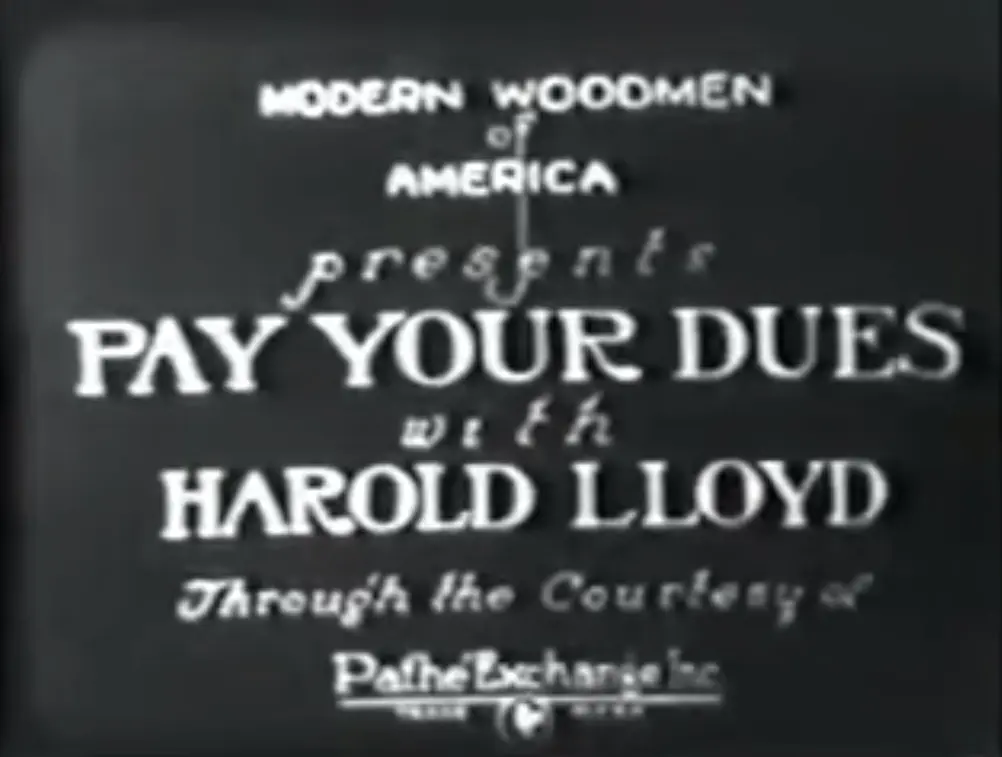
The pacing of the film is relentless. From the moment the blindfold is removed and the hero realizes he is not in a parlor but a den of ritualistic lunacy, the film never lets up. This is a stark contrast to the slower, more deliberate pacing of films like All for a Husband or the moralistic tone of Golden Rule Kate. Newmeyer isn't interested in preaching; he’s interested in the mechanics of the laugh.
Underneath the surface-level slapstick of Pay Your Dues lies a biting satire of institutionalization. The fraternal order represents any system that demands conformity through humiliation. While a film like Red, White and Blue Blood might look at class through a more traditional lens, Lloyd’s short looks at the sheer absurdity of social belonging. Why do we want to join these groups? Why do we endure the 'dues'?
The 'indignities' Lloyd suffers are a hyperbolic version of the small humiliations we all face when trying to fit into a group. In this sense, the film is more akin to the psychological tension of The Lure than a standard comedy. It captures the anxiety of being 'the new guy' and amplifies it to the point of hysteria. When Lloyd eventually finds a way to turn the tables on his captors, it’s not just a comedic payoff; it’s a cathartic victory for the individual over the collective.
To fully appreciate Pay Your Dues, one must consider the cinematic landscape of 1919. This was a time of transition. The epic scale of When Broadway Was a Trail showed what cinema could do with history, but Lloyd showed what cinema could do with the immediate present. While Her Hour or Coral might have focused on romantic or moral dilemmas, Lloyd’s work was about the physics of survival.
The film shares a certain DNA with The Man Who Could Not Lose, specifically in the way it handles a protagonist who is buffeted by fate. However, where that film might rely on narrative irony, Pay Your Dues relies on the kinetic response. Lloyd’s body is his primary tool for communication. His ability to convey shock, determination, and eventual triumph through physical movement alone is what elevates this short from a simple comedy to a work of art.
In the final analysis, Pay Your Dues is a quintessential Harold Lloyd vehicle. It contains all the elements that would eventually make his feature-length films legendary: the mistaken identity, the high-energy chases, and the ultimate triumph of the underdog. It lacks the death-defying stunts of his later work, but it makes up for it with a concentrated dose of character-driven humor.
The film reminds us that the greatest dues we pay are often to the expectations of others. By navigating the 'kooky' order and emerging with his dignity (mostly) intact, Lloyd’s character provides a blueprint for the modern survivor. It is a film that rewards multiple viewings, as the background gags and the subtle interplay between the cast members reveal new layers of comedic genius each time. For fans of silent cinema, or for those who simply appreciate the art of the well-timed fall, Pay Your Dues is an essential chapter in the history of the silver screen.
Rating: 4.5/5 - A masterclass in 1910s slapstick and social satire.
IMDb —
1923
Community
Log in to comment.