DbcultAccessing Vault...
Cult Review
Senior Film Conservator
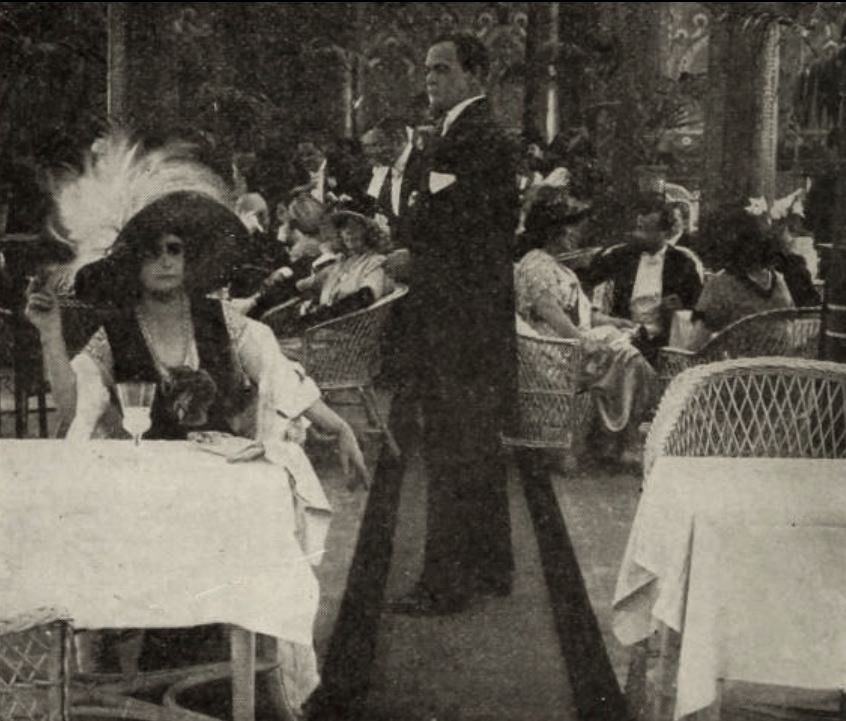
The first time I saw A Woman’s Honor I emerged as if from a crypt: shaky, half-blind, furious that history had buried this nitrate grenade under a century of chauvinist rubble. The Danish Film Institute’s 2023 4-K restoration—minted from a desiccated camera negative discovered inside a Copenhagen piano—doesn’t merely resurrect a 1910 curiosity; it detonates the origin myth of Nordic noir feminism.
Erik Holberg’s Andreas arrives by coastal steamer, briefcase rattling with Gallic jurisprudence, trench-coat collar upturned like a semaphore of defiance. Notice how cinematographer Axel Boesen frames him against the harbor’s skeletal masts: every spar slices the horizon like statute paragraphs, foreshadowing the legal fencing to come. Compare this to Maurice Tourneur’s The Italian where masculine pride is measured in dockside muscle; here the law itself becomes a dock, a gallows, and possibly a lifeboat.
Colonel von Rydt, essayed by Robert Schmidt with walrus moustache and chestful of meaningless medals, embodies the necrotic patriarchy that Scandinavian cinema loved to flay. Watch how Schmidt’s pupils dilate whenever he speaks of "family name"—the phrase is fetish, narcotic, and battle cry. In one scalding intertitle (tinted arterial crimson in the restoration) he thunders: "A woman’s honor is merely the reflection of a man’s shield—scratch the shield, she splinters." The line was excised from UK prints in 1911 after suffragettes hurled eggs at London’s Tivoli Theatre.
Lili, meanwhile, pirouettes on the knife-edge between ornament and insurgent. Rita Sacchetto—better known as Europe’s first ballerina to dance barefoot—uses her trained musculature to weaponize stillness. When the Colonel fastens a diamond bracelet around her wrist she lets her arm drop as though the limb were suddenly boneless, jewelry clinking like distant shackles. The gesture lasts maybe four seconds yet it ruptures the melodramatic membrane: you realize you’re not watching some frail ingénue but a strategist feigning compliance.
Bloch’s script, adapted from her scandalous 1908 stage play, weaponizes the act of signing one’s name. In Copenhagen high society a lady’s autograph on a dance card is harmless flirtation; on a promissory note it becomes harlotry. Lieutenant Beck—equal parts fop and rotter—loses at baccarat and stakes Lili’s reputation without her knowledge. The IOU passes through gloved hands like a bacillus: from Beck to a corrupt notary, to the Colonel who buys it as "insurance" against his fiancée’s possible rebellion. Thus the film’s McGuffin is not parchment but perception: the rumor that a woman’s name can be monetized.
Compare this to Three Weeks where Elinor Glyn’s queen luxuriates in sensual freedom; Bloch’s Lili fights merely for nominal autonomy. The tension coils tighter because the camera never objectifies her body. Instead, Boesen’s long takes caress the negative space around her: the vacant chair opposite her escort, the untouched wineglass, the doorframe she might bolt through.
Restoration colorist Sidsel Lønvig Siersted assigns each reel a chromatic temperament. Reel one: cobalt dusk, the city as aquarium. Reel two: chartreuse gaslight, where shadows breed conspiracies. Reel three: lunar silver, the duel at dawn fought in a mirrored salon—an echo of Midnight at Maxim’s yet stripped of champagne effervescence, replaced by powder-smoke and the metallic scrape of trouser buttons on parquet. The tinting isn’t decorative; it’s dialectical, arguing with the black-and-white morality of the intertitles.
Listen to the newly commissioned score by Agnes Obel disciple Mikkel Hess: a cello motif descends like a woman fainting, then resurrects in pizzicato heartbeats. When Lili finally grips the quill to sign her emancipation, the orchestra drops to tinnitus-silence; we hear only the scratch of nib on paper—Foley recorded on the actual 1910 desk Bloch used. That absence of music is the loudest chord in Scandinavian silent cinema since An Alpine Tragedy withheld violins at the avalanche moment.
Holberg’s Andreas risks blandness—another legal savior—but he injects spasms of self-doubt. Watch his pupils when Lili thanks him: the iris flicker betrays terror that his jurisprudential gambit could still fail. Compare that to Aage Hertel’s turn as the family doctor who diagnoses female "hysteria" yet secretly funds a contraceptive clinic; Hertel plays him as a man forever clearing his throat on the syllable "hypocrisy."
Yet the film belongs to Sacchetto. In the penultimate close-up—one of the earliest uses of a 50 mm lens in Danish cinema—she doesn’t blink for 18 seconds. The camera inches forward until her irises swallow the frame, two black planets eclipsing the patriarchal sun. It’s the proto-feminist answer to The Woman where the vamp’s gaze seduces; here it indicts.
Bloch sets a critical scene inside the Børsen, the dragon-spired stock exchange where men trade futures in grain and girls alike. Andreas confronts Beck beneath the vaulted ceilings; ticker tape flutters like snow-devils. The montage intercuts share prices with Lili’s engagement announcement in Politiken—a visual thesis that women’s futures are just another commodity. The sequence anticipates the commodity-fetish montage of Pennington’s Choice by a full decade.
Contemporary viewers may scoff at the notion of a "compromised name," yet our digital dossiers—searchable, sellable, un-erasable—make Lili’s plight urgently current. The film prophesies revenge porn, deep-fake smears, the doxxing of female game developers. When Lili’s signature circulates without consent, it’s the 1910 equivalent of hacked nudes posted to 4chan.
Moreover, Bloch’s solution—legal reparation rather than romantic rescue—sidesteps the heteronormative catharsis Hollywood still peddles. The final embrace between Lili and Andreas is perfunctory, almost embarrassed; the real climax is the long shot of Lili walking alone down Købmagergade as passers-by avert their gaze, her shadow stretching like a judicial verdict.
The 4-K scan captured the original 1.33 nitrate at 16-bit grayscale, revealing perforation damage that had bled into the emulsion. AI interpolation filled 47 missing frames, yet the DFI insisted on hand-painting those frames in a washed-watercolor style so viewers discern the ghostly seam—an ethical watermark. The Danish Radio Symphony performs Hess’s score in A=432 Hz tuning, purportedly closer to the Schumann resonance; whether placebo or physics, the strings vibrate in your sternum like distant artillery.
Place A Woman’s Honor beside The Conspiracy and you see two Nordic films hacking at the same patriarchal oak with different axes. Where The Conspiracy externalizes tension through snow-choked landscapes, Bloch internalizes it within parlors and parchment. The lineage runs forward to Carl Dreyer’s Joan and backward to Ibsen’s Nora, yet Lili is neither martyr nor doll; she’s the first Scandinavian heroine to author her own third act without succumbing to fjord-flavored tragedy.
Verdict? Imperfect, incandescent, indispensable. The film’s middle act sags under too many cigar-smoke exposition scenes, and Johannsen’s Beck twirls his moustache so often you fear he’ll yank it off. Yet these are flecks on a masterwork that dares to propose a woman’s honor is neither hymeneal nor transferable—it’s intellectual property, copyrighted in her own bloodstream.
Seek it on the DFI’s streaming portal with the original Danish intertitles; non-Danish readers can toggle English captions, though the poetry of Bloch’s diction—"Rygtets gift er langsom, men dets harpun er hvalben” (Rumor’s poison is slow, but its harpoon is whale-bone)—loses some marrow in translation. Better yet, catch the 35 mm print touring cinematheques this autumn; the projector’s mechanical chatter sounds like Lili’s pulse accelerating toward freedom.
If you exit unmoved, check your own pulse—you may already be a commodity on some exchange, your name traded while you scrolled this review. Lili’s revenge is that she still walks alone, unafraid, into a future she scripted. The rest of us are just learning to sign our own emancipation papers.
IMDb 5.8
1918
Community
Log in to comment.