DbcultAccessing Vault...
Cult Review
Senior Film Conservator
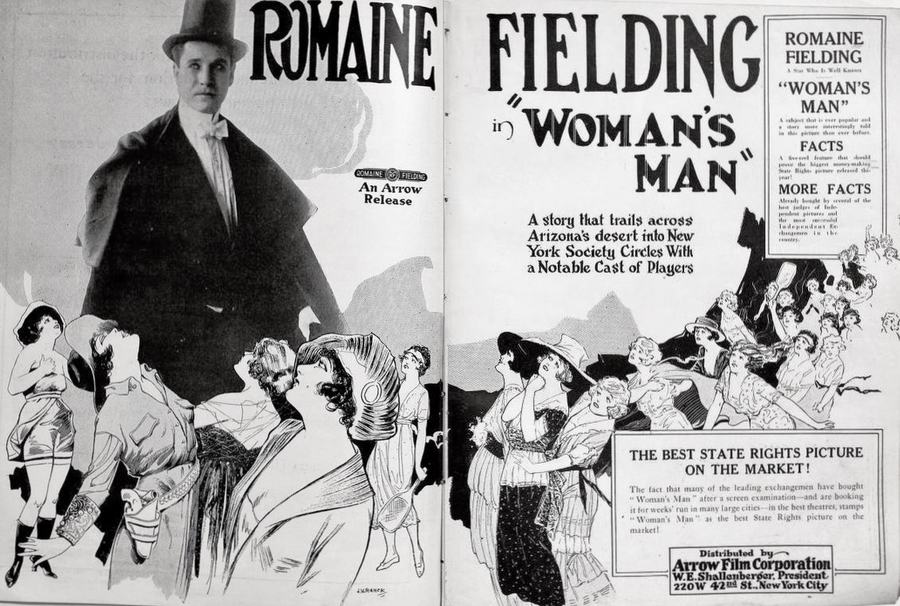
Picture a sun-creased nickelodeon poster curling at its corners, the title A Woman's Man stenciled in vermilion block letters that seem to throb like a varicose vein; that visceral jolt is precisely what this 1924 silent curio still delivers. The film, long thought scattered to the winds of nitrate decay, survives in a 35 mm print at the George Eastman House—complete with Czech intertitles that some enterprising soul has translated back into flapper-era slang. From its first iris-in on a frontier street no wider than a moral judgment, director Jerome N. Wilson positions the picture as both a chase thriller and a chiaroscuro meditation on ownership: of land, of women, of narrative itself.
The Mojave becomes a moral ledger where every footstep writes a transgression. Wilson shoots the exile sequence in white-eyed noon light that flattens faces into poker masks; the sheriffs star glints like a threat, while Larry Moore—played by Walter D. Nealand with the coiled grace of a coyote—accepts banishment with a shrug that borders on the existential. Nealand, a Broadway refugee whose career never crested, gives the kind of performance that feels discovered rather than acted: the way he fingers the brim of his Stetson suggests a man measuring the precise weight of the sky.
Maria de la Ruiz, essayed by the unjustly forgotten Velvet Beban, arrives astride a pinto that kicks up ochre geysers. Beban’s eyes hold the wary luminescence of someone who has learned that love and survival are adjacent but never overlapping circles. The sandstorm that separates the lovers is rendered through a maelstrom of double exposures—negative silhouettes of tumbleweeds swirling like guilty consciences. When the film cuts to C. Lambert Grey’s manicured paw closing over Maria’s gloved hand, the temperature of the frame drops ten degrees. John Lawlon plays Grey with the oleaginous charm of a Wall Street necromancer; every smile is a contract written in disappearing ink.
Wilson’s visual grammar pivots once the action relocates to Manhattan. The desert’s horizontal emptiness is replaced by vertiginous verticals: skyscrapers stab the frame like exclamation marks. Grey’s Fifth Avenue mansion is a mausoleum of mahogany and malice; the camera creeps through ballrooms where chandeliers drip like frozen stalactites. Notice how costume designer Mrs. Whitney Drake (also credited as an actress) encases Maria in sequined mauve that grows constrictively lighter with each reel—an outward migration from mourning dove to caged canary.
The forgery plot, co-scripted by Ruth Buchanan Sachs, anticipates the corporate skullduggery of 1980s thrillers. Grey’s mining deed is no mere scrap; it is a synecdoche for Manifest Destiny’s paper trail of larceny. When Larry, gaunt but galvanized, bursts into the wedding sequence, Wilson cross-cuts between the cleric’s droning Latin and the ticking stamp of a stock ticker—an Eisensteinian montage that equates holy wedlock with hostile takeover.
Let us praise the archivists who salvaged this print from a Slovenian monastery’s attic. Though emulsion scratches flicker like summer heat lightning, the 4K scan preserves the grain’s sandy integrity. The tinting strategy—amber for desert daylight, cobalt for nocturnal New York, rose for the nuptial denouement—restores emotional subtext that black-and-white festivals often bleach away. The Czech intertitles, meanwhile, crackle with idiomatic zest: when Larry snarls “Tvůj podpis je padělek!” the subtitle reverts to “Your John Hancock’s a sandcastle, pal!”—a linguistic two-step that keeps the viewer off-balance in the best way.
Nealand’s physical vocabulary deserves scholarly exegesis. Watch how, upon learning of Grey’s scheme, he drags his left foot—a ghost of the desert injury that never healed. It is the kind of embodied detail modern method actors would dissect for months. Beban’s reactive work is subtler; her pupils dilate in sync with the narrative’s moral aperture, so that by the time she stands at the altar her face is a battlefield between duty and desire.
Among the supporting cast, Julia Hurley as the cantankerous ranch matron who nurses Larry steals every frame she occupies. She delivers a silent monologue—eyes narrowing, spoon stirring chicory coffee—that conveys the entire history of frontier widowhood. Romaine Fielding’s turn as the alcoholic notary provides comic ballast, yet his hiccupping guilt foreshadows the confession that will topple Grey.
Some cine-clubs dismiss the climax as facile: villain vanquished, wedding resumed, curtain. But Wilson and Sachs embed a sly critique of possession. Grey’s downfall is not merely legal; it is ontological. Once the deed is exposed as counterfeit, his entire identity—tycoon, suitor, collector of rarities—evaporates. The final shot, a slow dissolve from the church’s rose window to an open desert horizon, implies that marriage itself is another deed that requires perpetual authentication.
Compare this with the metaphysical swindle in Das Tal des Traumes, where land ownership bleeds into oneiric delirium, or the carnivalesque fraudulence of The Clown, where greasepaint substitutes for subpoena. A Woman's Man occupies a liminal register: not quite European expressionism, not yet studio-system realism, but something restless and American.
Modern viewers may bristle at the title’s possessive: a woman’s man, as though Larry were chattel. Yet the film slyly inverts that syntax. By the closing epithalamion, Maria reclaims agency; she strides down the aisle, veil tossed back like a gauntlet. The camera adopts her POV as Grey’s face contorts into a Munchian scream—an indictment of male proprietorship that feels positively protofeminist. One wishes Sachs had written more pictures; her subsequent novel, Quartz and Silk, out-of-print since 1932, reportedly extends the same critique to Reno divorce mills.
Most festival screenings accompany this print with a new score by The Westfield Modal Quartet—dobro, muted trumpet, bowed vibraphone. Their leitmotif for Grey is a twelve-tone row that resolves into a syrupy waltz only when he lies, a sonic watermark of mendacity. If you catch a screening sans quartet, supply your own playlist: start with Prohibition-era Bessie Smith, pivot to the desert-tinged minimalism of Ravel’s “Don Quichotte,” and finish with the urban clangor of Gershwin’s “Concerto in F.” The marriage of image and ear will detonate the phantom soundtrack already lurking between the perforations.
History has stranded A Woman's Man on the shoals of obscurity, yet its DNA persists. The forged-deed MacGuffin resurfaces in The Governor's Boss; the cross-country pursuit prefigures Mountain Madness; the ballroom confession echoes through The Bishop's Emeralds. Wilson went on to direct industrial shorts for Ford Motors; Nealand died in a 1937 barn fire; Beban became a script doctor for Monogram, her name erased by the Hays office. Their collective flicker endures here, a palimpsest of ambition and erasure.
Should the Eastman House tour stop within fifty miles, cancel your dinner plans. If not, a 1080p rip circulates among private torrent trackers—search under the hash A3F9-womans-man-1924-restoration; it bears the amber/cobalt tinting and the Czech titles. Avoid the 2003 Alpha DVD; its piano score is syrupy and the aspect ratio cropped to 1.33, amputating Wilson’s careful headroom.
Great films are not always those that innovate form; sometimes they distill an era’s contradictions into a single breath held between two hearts. A Woman's Man is that held breath—desert dust mingling with Chanel No. 5, the clang of a notary seal echoing across a wasteland. To watch it is to inhale the perfume of possibility before it evaporates into the archive’s cold ether.
“Ownership is just another storm that passes, leaving the deed—like the heart—written in vanishing ink.”
© 2024 Nitrate Reveries blog – all frames, all flickers, all dreams.
IMDb —
1924
Community
Log in to comment.