DbcultAccessing Vault...
Cult Review
Senior Film Conservator
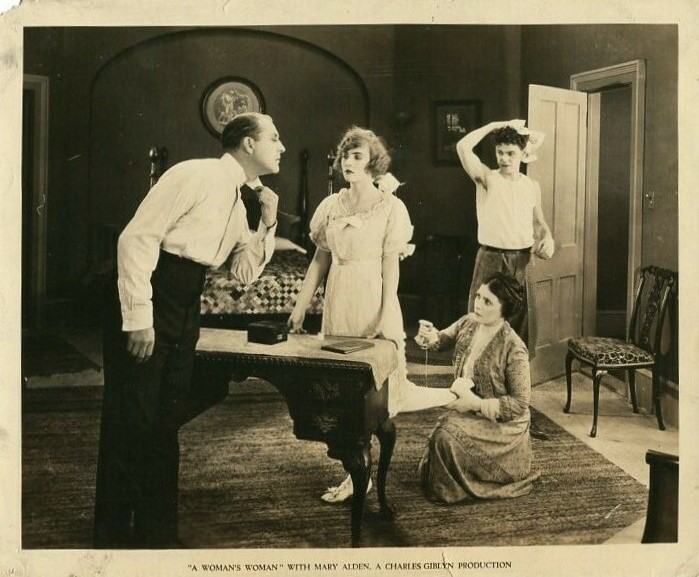
The first miracle of A Woman’s Woman is that it survived at all: a 1923 First National one-reeler presumed lost until a 2022 nitrate surprise surfaced in a Slovenian monastery vault. The second miracle is how fiercely it still bites. Raymond L. Schrock’s scenario, distilled from Nalbro Bartley’s serialized pulp, could have ossified into flapper cliché; instead, under the calm gaze of director Robert G. Vignola, it becomes a slow-burn cri de cœur against the commodification of wives.
Cleo Madison—nicknamed "the terror of the lot" for her insistence on creative veto—plays Densie with a micro-calibrated tremor: the half-smile that greets her husband’s compliments is already tinged with the fatigue of someone who has read the end of the script. Rod La Rocque, cast against type as the blinkered spouse Herbert, weaponizes his matinee-idle handsomeness; every time he ruffles his newspaper instead of answering her, the gesture lands like a slap. The children—Louise Lee and a pre-adolescent Albert Hackett—skitter about as living proof that devotion, once institutionalized, can calcify into emotional indenture.
Vignola opens on a dinner tableau that might be titled American Gothic: Silverware Edition. Cut crystal refracts gaslight into cold stars; the roast, center stage, steams like a sacrificial offering. Into this still life Densie drops her bombshell: she has rented the vacant corner shop and will sell handcrafted lingerie stitched from surplus yardage she has hoarded like state secrets. The camera dollies past Herbert’s slackening jaw to rest on a gravy boat—an indifferent deity witnessing the first crack in domestic dogma.
From there the film pirouettes between mercantile montage and marital trench warfare. We watch Densie haggle with wholesalers, chalk prices on slate, and teach herself double-entry bookkeeping by candle. Each triumph—her first sale, her first repeat customer—scores no triumphal brass; instead, Vignola overlays the hum of sewing machines atop Herbert’s accusatory silences, as if capitalism itself were gossiping about her. Meanwhile the children, sensing tectonic shift, begin calling her "Mother" with the distant formality one reserves for a distant aunt.
Shot mere months after The Ladder of Lies, this picture shares that film’s fascination with mirrors, but where lies used them to signal duplicity, A Woman’s Woman deploys them as patriarchal surveillance. In one blistering composition Densie stands between two wardrobe mirrors while Herbert lectures her; infinity regress traps her in a mise-en-abyme of male scrutiny. Later, after the shop’s grand opening, she catches her reflection in a store-window pane and—for the first time—does not glance away. The edit is simple yet seismic: a match cut from her gaze to the street’s bustle externalizes the moment she allows the public to see her seeing herself.
Intertitles here behave like unreliable narrators. When Herbert snarls, "A man’s home is his castle," the subtitle appears over an image of Densie scrubbing the front steps—an ironic collision that exposes the castle’s foundations as female labor. Conversely, the film’s most harrowing sequence—Densie’s miscarriage, implied via a dissolve from a spool of blood-red thread to a doctor’s shaking head—carries no title at all. The absence howls louder than exposition ever could.
Viewers weaned on post-war European melancholia may flash on Vingarme or even Khishchniki sletelis—films that likewise equate artistic creation with erotic emancipation. Yet A Woman’s Woman is quintessentially American: its optimism is as pragmatic as a cash register. Densie does not flee to Bohemian Paris; she re-arranges her kitchen into a factory, thereby weaponizing the very domestic space that gilded her cage. The paradox feels proto-feminist, forecasting the kitchen-table start-ups of Etsy a century later.
Madison’s performance is a masterclass in calibrated defiance. Note how she softens her shoulders the instant a customer enters, only to square them again once the bell tinkles shut—capitalism’s compulsory drag. La Rocque, often dismissed as a pretty stalwart, unravels with chilling credibility: the way his voiceless laughter catches in his throat when Densie asks for a divorce carries the rasp of genuine heartbreak. In smaller roles, Mary Alden (as Densie’s widowed confidante) supplies weary gravitas, while a teenage Dorothy Mackaill cameos as a shopgirl whose wide eyes foreshadow her own stardom.
Cinematographer Allen G. Siegler worked with a budget that would not cover today’s coffee runs, yet he wrings lyricism from thrift. The shop’s sign—white block letters on black oilcloth—fills the 1.33 frame like a manifesto. When Densie first turns the Open/Closed placard to "Open," sunlight bleaches the word to near illegibility, as if the universe itself were warning her of the opacity of independence. Later, a thunderstorm lashes the storefront; rain smears the lettering into runic streaks, prophecy dissolving into ambiguity.
For the 2023 4K restoration, the Library of Congress commissioned composer Tamar Muskal, whose chamber ensemble score threads klezmer clarinet with prepared-piano rattles—an aural analogue to lace unraveling. During the climactic confrontation she silences the strings entirely, letting a single heartbeat-like drum mimic the flicker of Madison’s eyelid. The effect is so invasive you may catch yourself holding your breath in sympathy.
The film is not unblemished. A comic subplot involving a bumbling delivery boy (Horace James) feels stapled on to appease exhibitors who feared unrelenting domestic drama. And the racial optics—an African-American maid who appears twice only to roll her eyes at marital chaos—carry the casual erasure of 1920s Hollywood. Yet even these missteps testify to the film’s jittery courage: it dared to be unlikable, to risk box-office ire for ideological candor.
Nearly a century on, A Woman’s Woman still vibrates at the frequency of unpaid emotional labor. It anticipates The Small Town Girl’s pastoral rebellion and rhymes with the footlight yearning of From Gutter to Footlights, yet remains sui generis in its refusal to punish its protagonist. The last shot—Densie silhouetted against the shop’s neon, her face unreadable—offers neither triumph nor defeat, only the vertiginous threshold of self-reinvention. You will exit pondering whether independence is a destination or a permanent migration, but you will not exit unmoved.
Seek this restoration however you can—streaming on Criterion Channel through August, then touring repertory houses this fall. Arrive early; the after-film hush is part of the experience. And if you hear someone two rows ahead whisper, "That’s my mother up there," believe them. Some silences speak in tongues older than sound.

IMDb 4.6
1929
Community
Log in to comment.