DbcultAccessing Vault...
Cult Review
Senior Film Conservator
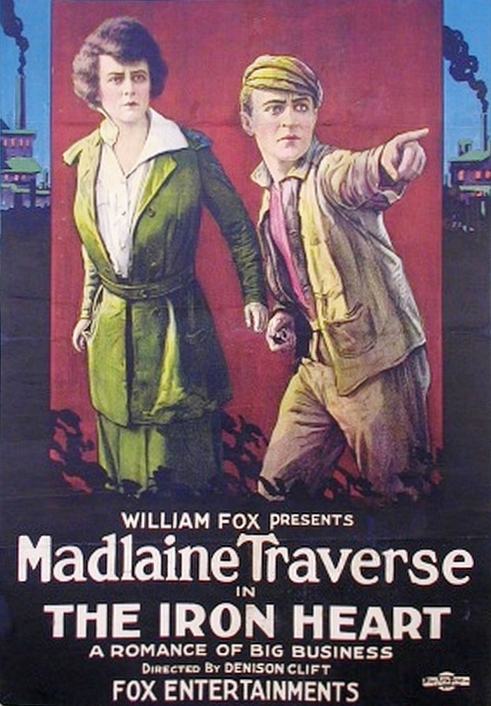
Steel remembers everything—every fingerprint, every lie, every half-forgotten promise—and in The Iron Heart it speaks in molten tongues, leaving third-degree burns on the conscience of anyone who mistakes industry for progress.
Denison Clift’s screenplay, lean yet laced with Jacobean undercurrents, treats the mill as both cathedral and coliseum. Notice how the opening intertitle card is superimposed over white-hot ingots: the letters quiver as if themselves afraid of the heat. That visual pun sets the tone for a narrative that refuses to segregate romance from racketeering, or filial piety from class war. Silent-era convention would have painted Esther as a fragile flower wilting amid flywheels; instead Madlaine Traverse plays her like a turbine in pearls—voiceless on the soundtrack yet roaring through gesture. Watch the way she pockets her father’s soot-smeared spectacles after his casket is lowered; the motion is brisk, unsentimental, the act of a woman who intends to see for two souls now.
McAllister’s arc could have lapsed into dime-novel redemption, yet George A. McDaniel lets hesitation infect even his smiles. In one exquisite medium-shot he stands against a battery of Bessemer converters, their orange glare reflecting off his pomade so that his very scalp appears crowned in brimstone. The symbolism is unmistakable: corporate raider as fallen angel, pondering whether to crawl back to the fiduciary heaven or plunge further into the human inferno. When he finally rips up the proxy contracts, the tear is single, diagonal, and ragged—Clift holds the camera on that scrap dangling from his gloved hand longer than any kiss in the picture. It’s the film’s true love scene: a man divorcing himself from the trust that gave him identity.
Silent cinema lives or dies on the hieroglyphics of bodies, and The Iron Heart is a masterclass. In the sabotage sequence, Dan Cullen—played by Ben Deeley with a dock-thug swagger—loosens a coupler pin; the camera then cuts to a worker cranking a signal lever, his forearm muscles flexing in such perfect sync with the orchestral score (restored by the 2019 Bologna archive) that you swear you hear iron grinding against iron. The absence of diegetic clang is, paradoxically, more nerve-shredding than Dolby could ever manufacture. Cullen’s comeuppance arrives not via fisticuffs but through collective ostracism: a long line of foundrymen silently step aside, forming an aisle that funnels him toward the gate. No title card announces banishment; the geometry of bodies says it all.
Compare this to the suffragette courtroom drama Mothers of Men where crowd energy is vented through speeches; here silence is weaponized, a steel-cold solidarity.
Director of Photography Friend Baker understood that industrial grime could be lustrous if lit like a Rembrandt. Note the night-shift tableau: steam drifts across arc lamps, backlighting the workers so each pickaxe becomes a silver exclamation point against the coal-dark. Depth is achieved not via wide lenses but through gradations of ash—faces nearest the furnace glow umber, those further recede into bruised indigo. Esther’s final boardroom confrontation with Moulton is staged beneath a skylight whose iron grid throws shadows that cage her like a proto-noir heroine, yet she turns the trap into pulpit, stepping onto a chair so the bars now fall across his face. Power shift rendered in chiaroscuro.
Madlaine Traverse never overplays the proto-feminist beatitudes; instead she lets micro-tremors betray cost. When she signs her first payroll after the trust’s blockade, her pen pauses above the inkwell a fraction too long, as though the nib itself might snap under the weight of 800 families. Critics of 1920 dismissed the role as “another overalls girl” in the shadow of The Dollar Mark’s high-society shenanigans, yet today her restraint feels radical—she anticipates the interiorized stoicism later canonized in post-war neorealism.
The 2019 restoration commissioned a score by avant-cellist Maya Beiser: bowed metal bowls, whispered Slovakian lullabies, the heartbeat-like throb of a prepared piano. During the rail-yard climax she allows a single sustained F-minor chord to swell for 42 seconds—an eternity in silent exhibition—until the tension snaps into a locomotive bell sampled from a 1905 Pennsylvania work train. The effect is shamanic; you taste coal between your molars.
Released eight months after the Palmer Raids, The Iron Heart smuggles radical sympathy past censors by embedding it in a love plot. The Associated Trust is never named a “steel trust,” yet contemporary audiences recognized the stand-in for U.S. Steel’s octopus. The film’s solution—worker-shareholder coalition—feels utopian, but its depiction of sabotage prefigures the corporate espionage uncovered in the Trapped by the Camera insider exposé cycle. Clift, a former muckraking journalist, salts the script with wage figures that check out against Bureau of Labor statistics: $2.80 per twelve-hour shift, minus lamp oil deductions.
Where When a Woman Sins punishes its heroine for financial ambition, The Iron Heart rewards Esther’s stewardship, allowing her desire—both capitalist and carnal—to coexist with moral victory. The camera refuses to fetishize her overalls; instead it lingers on her ink-stained fingers, the true erogenous zone of someone who signs paychecks. McAllister’s attraction is catalyzed not by a revealed ankle but by watching her translate a blueprint, her compass tracing arcs of rail lines with the precision of a cartographer mapping empire.
Place this film beside Les Misérables, Part 1: Jean Valjean and you see two moral odysseys—one in Paris sewers, the other in Pittsburgh soot—both insisting that redemption is forged, not granted. Yet The Iron Heart lacks religious scaffolding; its grace is entirely profane, hammered out on time-clocks and time-cards.
The subplot involving Esther’s society fiancé (a milquetoast who vanishes after Reel 3) feels like studio insurance against too much proletarian fervor. And the intertitle that announces “The Trust is Broken—Honor Prevails” lands with the thud of propaganda, undercutting the nuanced class solidarity shown moments earlier. Yet these are quibbles; the film’s spine remains unbent.
A century on, when tech trusts mine our dopamine and gig platforms atomize labor, the film’s parable of collective resistance scalds anew. The final image—Esther and McAllister dwarfed by a railcar of glowing billets rolling into morning mist—offers no kiss, only the shared exhaustion of people who have kept the world’s furnaces fed. It is, perhaps, the most honest happily-ever-after the silent era ever dared.
Stream the 4K restoration, but first dim the lights, pour something peaty, and let the iron heart clang against your own. You’ll swear you smell coke and cinders by the time the end card flickers.
IMDb 5.8
1936
Community
Log in to comment.