DbcultAccessing Vault...
Cult Review
Senior Film Conservator
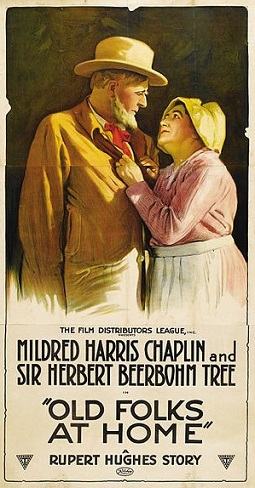
Picture a nation still nursing the bruises of the Gilded Age, its newspapers drunk on muckraking, its nickelodeons flickering like votive candles for the dispossessed. Into that chiaroscuro strides The Old Folks at Home, a 1916 one-reel powder-keg directed by the prolific Chester Withey and scripted by Rupert Hughes—yes, the same Hughes who would later skewer Hollywood in The Carpet from Bagdad. The film is a seditious little sermon on how dynasty, not democracy, writes the final verdict.
Elmer Clifton’s Steve Coburn arrives onscreen with the louche elegance of a champagne flute balanced on a tombstone: hair slicked to patent-leather brilliance, eyes ringed by the insomnia of all-night poker dens. He is the inverted Horatio Alger—fortune squandered, future mortgaged, yet still coddled by senatorial linen. The murder itself is staged in a curt, almost off-hand manner: a dissolve, a struggle silhouetted against French windows, a mute scream swallowed by velvet drapes. In 1916, such ellipses were both censor-evasion and moral Rorschach; we supply the arterial spray ourselves.
Compare the economy of violence here with the baroque shoot-outs in The Boer War or the pastoral innocence of The Book of Nature. Withey refuses spectacle; he peddles contamination. Steve’s crime is less a rupture than a logical runoff from the moral sewage that funded his cufflinks.
Herbert Beerbohm Tree—imported from the London stage to lend Shakespearean gravitas—plays Senator Coburn with a walrus mustache that seems to sniff its own entitlement. Tree’s gestures are grandiloquent even by silent-film standards: palms turned skyward in courtroom piety, shoulders canted like a man Atlas-loading the republic. Yet watch the micro-tremor when the jury files back in; the mask slips, revealing not statesmanship but brand-management. The performance is a master-class in how power pretends to be grief.
Josephine Crowell, as Eleanor, commands the film’s moral vertigo. In medium close-up, her eyes swell like tide-pools of unshed rain; when she stands to speak, the camera dollies-in—a rare maneuver for 1916—until her face becomes a silver-plated icon. No intertitle can carry the freight of her silence before she finally signs, “I have already buried my heart; do not bury my son.” The line, ghost-written by Hughes, is pure melodrama, yet Crowell’s tremulous soprano turns it into a secular prayer.
The jury’s deliberation occurs off-screen, a budgetary necessity that becomes existential coup: we never witness the alchemy of empathy overriding evidence. Instead, Withey cuts to the foreman’s trembling lips, the collective gulp of twelve men swallowing their civic oath like castor oil. When “Not guilty” lands, the courtroom does not erupt; it exhales, a collective sigh of guilty relief. The old folks—those titular guardians of hearth and law—have bent justice into a boomerang.
Technically, the print surviving at Library of Congress is a 16mm reduction struck in the 1930s, its emulsion cracked like drought-riverbed. Yet even through the nitrate acne, one perceives Alfred Paget’s luminous cinematography: chiaroscuro worthy of Rembrandt, with prison-bar shadows striping Steve’s face during the paternal visit scene. The tinting—amber for interiors, cyan for exteriors—follows the melodramatic grammar of the day, but Withey subverts it: the final courtroom tableau is tinted rose, as if the film itself were blushing at its own ethical sleight-of-hand.
Censorship boards in Chicago and Pennsylvania excised the murder, turning the narrative into a courtroom abstraction; exhibitors in Georgia trimmed the mother’s plea, fearing its “seditious maternalism.” Thus the film survived in shards, each projection a Rorschach of regional anxiety. Compare that fragmentation with the global completeness of The Story of the Kelly Gang or the slapstick wholeness of Right Off the Bat. Old Folks exists as a palimpsest of prudery.
Hughes’ script, adapted from his own Saturday Evening Post novella, is a trenchant pre-code satire on the elasticity of jurisprudence under class privilege. Read alongside his later Other People’s Money, you perceive an author obsessed with how capital colonizes conscience. Yet unlike the 1920s Wall Street swagger, here the currency is maternal affect, tender yet totalitarian.
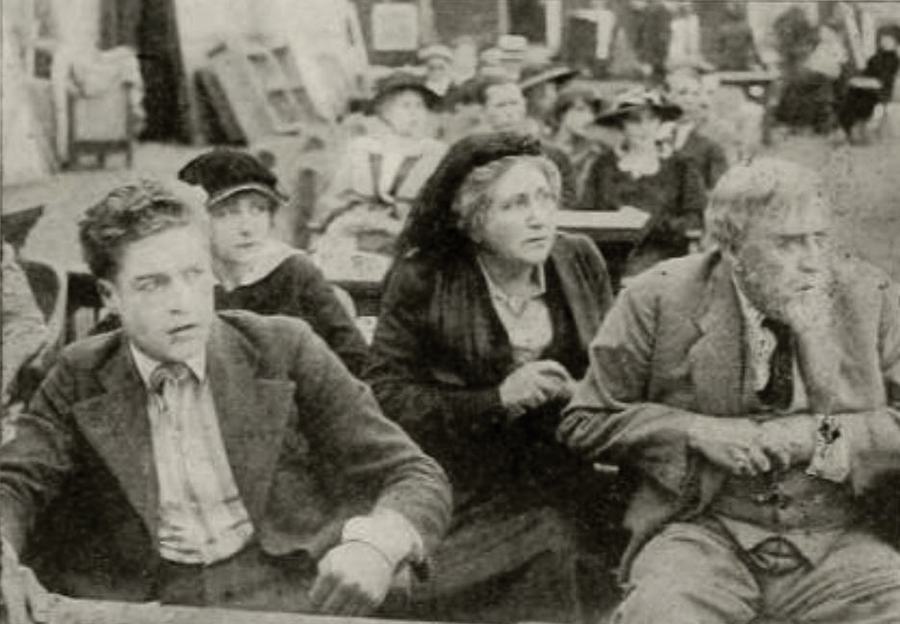
The film’s reception was bifurcated: Variety praised its “emotional dynamite,” while The Moving Picture World fretted that it “undermines respect for the ballot box and the jury box alike.” One Ohio exhibitor reported that a patron fainted during Eleanor’s plea, hitting the nickelodeon’s sawdust floor like a sack of moral potatoes. Such anecdotes stitch the movie into the folklore of early cinema as a contagion of nerves.
Modern viewers, armored by a century of noir cynicism, may smirk at the jury’s volte-face. Yet consider our own celebrity acquittals, the helicopter-parent legal funds, the Instagram apologies that trump DNA. The film’s final iris-in on Steve’s smirk—half relief, half repressed triumph—feels prophetic. We have never left the courtroom; we merely upgraded the chandeliers.
Performances aside, the film’s DNA coils around the maternal sublime. Eleanor’s grief is not rhetorical ornament; it is the last jurisdiction beyond senate committees and stock portfolios. When she collapses back into her mahogany pew, the camera lingers on her glove—kid leather soaked through with sweat—an unspoken stigmata. Crowell based the gesture on a real-life trial she attended where a socialite mother tore her own pearl necklace, letting beads skitter across the marble like guilty hailstones.
Spottiswoode Aitken, as the defense attorney, delivers a closing argument entirely through gesture: palms pressed together as if in prayer, then flung apart to release invisible doves of reasonable doubt. Intertitles are sparing; the film trusts physiognomy. That minimalism anticipates the later laconic trials in Divorced and the moral quicksand of Gambling Inside and Out.
Scholars of silent-era gender politics often pit Old Folks against Hoodoo Ann’s plucky orphan feminism or the anarchic tomboy in The Marriage of Molly-O. But Eleanor Coburn is no progressive icon; she is a relic of matriarchal absolutism, wielding domestic sentiment as deftly as any senator wields a filibuster. Her triumph is reactionary, yet the film refuses to condemn her. We are left in ethical vertigo, our own moral gyroscope spinning.
The score, lost to time, was originally a live cue-sheet blending Stephen Foster’s titular parlour tune with somber organ chords that resolved into a triumphal major key at the acquittal. Imagine that tonal whiplash: the same melody that once serenaded plantation nostalgia now baptizes a patricidal acquittal. Foster’s ghost must have winced.
In the wake of the trial, the Coburns exit the courthouse into a fog that swallows their carriage whole—an effect achieved by double-exposing the negative with smoke from a locomotive engine. The visual metaphor is blunt yet haunting: privilege dissolving into abstraction, crime without consequence evaporating into the American mist. One thinks of the final ghostly ride in Marta of the Lowlands, only here the phantom is systemic impunity.
Restoration efforts remain piecemeal; a 4K scan of the 16mm print is rumored at UCLA but awaits funding. Should it surface, anticipate Twitter hot-takes decrying “jury nullification propaganda.” Yet to reduce the film to jurisprudential footnote is to miss its bruised heart: the terror that love, once weaponized, can outgun truth.
So, a century on, The Old Folks at Home still squats in the attic of American conscience, a tintype of our original sin: that justice is negotiable if the lullaby is sweet enough. Watch it—if you can find it—and feel the floor of certainty sag beneath your feet. Then ask yourself, in the hush after credits: would my own mother stand? And would the jury clap?”
IMDb 4.8
1935
Community
Log in to comment.