DbcultAccessing Vault...
4.7/10
Senior Film Conservator
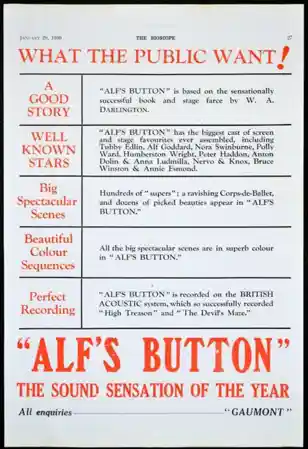
A definitive 4.7/10 rating for a film that redefined the boundaries of cult cinema. Alf's Button remains a cornerstone of transgressive art.
Okay, so "Alf's Button" from way back in 1930. Is it worth tracking down today? Look, if you’re a serious silent-to-early-talkie enthusiast, someone who digs seeing how movies *changed* right in front of the camera, then absolutely, give it a shot. You'll find some curious charm here. If you're just looking for a fun, fast-paced comedy, you might bounce off this pretty hard. It’s got a specific kind of old-timey rhythm that’s definitely not for everyone.
The film’s an early talkie, right? You can *really* tell. The sound, for one, it’s often a bit crackly. Sometimes characters turn away from the microphone, and their lines just sort of vanish. You gotta lean in sometimes. 👂
Then there's the acting style. It’s got that broad, almost stage-play feel that was common back then. People tend to *announce* their feelings rather than just show them. Peter Haddon as Alf, he’s a bit of a standout, mostly for how genuinely bewildered he looks half the time.
The film's title, "Alf's Button," it just sounds so wonderfully simple, doesn't it? And the movie itself, it delivers on that kind of straightforward charm. You don't get a lot of deep introspection here.
So, Alf finds this button, right? And it’s from Aladdin's lamp. Suddenly, there’s a genie. And let me tell you, this genie… not what you might expect. Bruce Winston plays him, and he’s less mystical being, more like a slightly annoyed butler in a turban. It’s pretty funny, honestly.
The humor, it's mostly situational. Alf, he's just this ordinary guy, a bit bumbling. He doesn't really get how serious this magic stuff is. So when the genie pops up, he's more annoyed than amazed, like "Oh, *another* thing to deal with." That dynamic really carries a lot of the laughs.
The wishes themselves are where the real comedy should come from. Alf, being a soldier, he wishes for things like extra rations, or maybe a promotion. Simple stuff, but they get complicated fast. There’s a scene where he wishes for some money, and it just *appears*. Not gracefully, mind you, but like it was dropped from the ceiling. 💸
And the consequences of his wishes? They're never quite what he expects. He might wish for a quiet afternoon, and suddenly the whole barracks is in a noisy, chaotic mess. It's that classic "monkey's paw" thing, but played for laughs.
One bit I remember, Alf accidentally wishes for a huge parade, and suddenly the streets are just *packed*. The crowd scenes here, they’re actually pretty decent for the era, not just a handful of extras. You can almost feel the chaos spill off the screen.
There’s this odd moment, very brief, where one of the other soldiers just stares blankly at the genie. No reaction, just a wide-eyed look. It felt a little like the actor forgot his line, but it adds to the quirky charm.
The pacing, it's definitely *old school*. Things take their time. A modern audience might find it a bit slow, especially in the first twenty minutes before the magic really kicks in. But once it gets going, the situations Alf creates with his wishes are genuinely inventive for 1930.
Annie Esmond as Alf’s wife, she’s great. She brings a real grounding to all the nonsense. You can see her trying to make sense of her husband’s suddenly bizarre life, and her exasperation is pretty relatable. It makes you wonder what *she* would wish for.
The supporting cast, they mostly serve as reactions to Alf's antics. Nora Swinburne, she’s good as one of the women who gets caught up in the magic. Her disbelief feels pretty genuine, which is important when everything else is so over-the-top.
The sets, they look like sets. Very much studio bound. But there’s a certain charm to that. It feels like you're watching a play sometimes, which makes sense given the time. The special effects are… well, they’re 1930s special effects. Expect quick cuts and maybe some clever camera tricks rather than anything fancy.
There's a scene with a military band that plays a tune that keeps getting interrupted by Alf’s wishes. The way the sound cuts in and out, it's a small detail but it really highlights the early sound tech. It’s a *wobbly* kind of magic.
I appreciate how much of the film relies on simple visual gags. A disappearing object, a sudden costume change. Nothing too complicated, but effective for the time. It’s not trying to be flashy, just fun.
Oh, and a quick one: Merle Oberon, she's in this! Blink and you'll miss her, but it’s a tiny early appearance. She’s just one of the background folks. Pretty cool to spot someone who'd become such a big star later on. ✨
This isn't a film you put on for edge-of-your-seat thrills. It’s more of a historical curiosity, a snapshot of British comedy and filmmaking finding its feet. It’s got a genuine heart to it, even if some of the jokes don't quite land the same way today. The movie really gets its stride when Alf realizes the *trouble* wishes can cause, and then he's trying to undo things. That’s where the fun really is.
The end, it wraps things up pretty neatly, but not without one last little magical twist that Alf, of course, misunderstands. It leaves you with a smile, which is what these old comedies were really aiming for, I think.
It’s an interesting watch if you're into that sort of thing. It feels like a precursor to so many other "be careful what you wish for" stories. A bit rough around the edges, sure, but that’s part of its charm.
IMDb —
1920
Community
Log in to comment.