DbcultAccessing Vault...
7.4/10
Senior Film Conservator
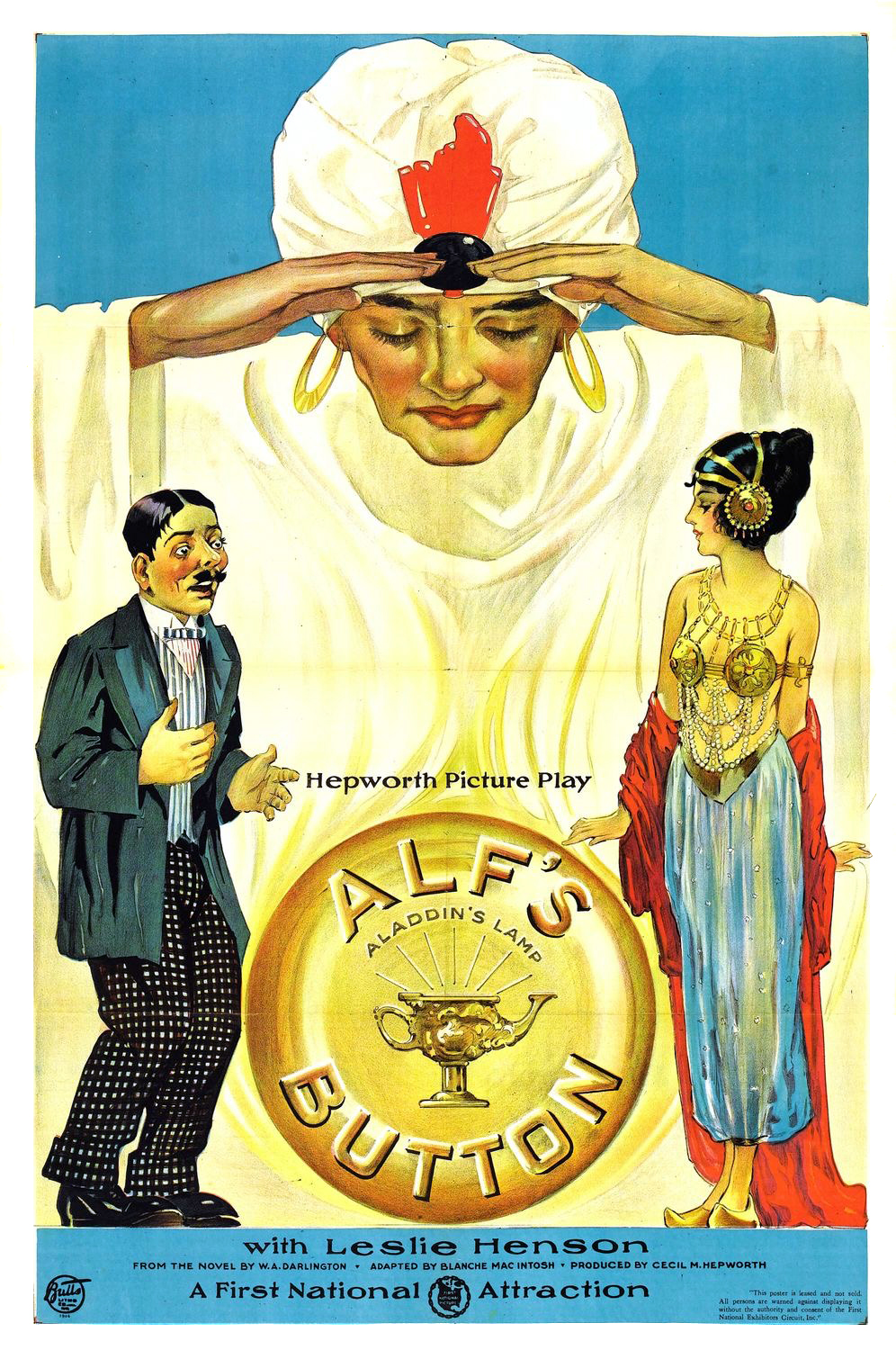
A definitive 7.4/10 rating for a film that redefined the boundaries of cult cinema. Alf's Button remains a cornerstone of transgressive art.
The reel unspools like a fever dream stitched inside a khaki greatcoat: a lowly Tommy discovers his regulation button is in fact a sliver of Aladdin’s lamp, hammered into military uniformity by some cosmic prank. Suddenly the Western Front becomes a playground where reality kneels to appetite. Director W.P. Kellino, armed with a scrappy budget and a hallucinatory streak, turns the trenches into Expressionist corridors—mud walls tilt at impossible angles, barbed wire coils like black rosary beads against a sulfur sky. The camera lingers on the button’s dull sheen until the brass seems to breathe, exhaling curls of ochre smoke that reek of cordite and frankincense.
John MacAndrews plays Alf Higgins with the stunned eyes of a man who has seen the world’s scaffolding exposed. When he first rubs the button, the wish is pint-sized: a steaming plate of steak-and-kidney pie. The pie arrives, but so does a telegram announcing his mother’s death—time has been mortgaged elsewhere. MacAndrews lets his face crumple in increments, a paper sculpture left in rain, and the scene lands harder than any battlefield casualty. The film’s genius lies in such equations: every desire balanced by a debit demanded from the cosmic ledger.
As the Salvation Army lass who trudges through shell craters with a portable organ, Herbert radiates a brittle compassion. Her voice—half cracked bell, half lullaby—serves as the film’s moral tuning fork. When she sings “Abide with Me” over a dying German prisoner, the button pulses malevolently in Alf’s pocket, as though offended by selflessness. The juxtaposition is scalding: while Alf conjures ballroom gowns and champagne fountains, she dispenses cocoa and scripture, a counter-magic that needs no djinn. Cinematographer René Guissart frames her in chiaroscuro halos, backlit by flare guns, so she appears perpetually on the verge of combustion.
Unlike the Orientalist pageants of Cleopatra (1917) or the louche sand-and-sandal reveries of Therese, Alf’s Button weaponizes Arabian folklore for British propaganda yet can’t quite muffle its own guilt. The djinn—rendered as a 40-foot plume of electric-blue smoke with a Cheshire grin—speaks in clipped officer-class diction, a colonial bureaucrat dispensing miracles stamped “For King George.” The irony is savage: the Empire that plundered spices and saints now repurposes a mythic slave-spirit to prolong its continental slaughter.
Art director C. Wilfred Arnold scrounged army surplus to build sets: surplus parachutes became Persian silk, dented mess-tins morphed into harem serving trays, and salvaged stained glass from a bombed-out chapel reincarnates as the djinn’s kaleidoscopic eyes. The thrift-shop surrealism predates the found-object chic of later cult oddities like The Lone Wolf’s Daughter. In one delirious montage, Alf wishes for a night in Paris; the Eiffel Tower sprouts from a shell crater like a metallic orchid while Edith Piaf phonographs spin in foxholes. The image lasts three seconds yet singes the retina.
Alf’s third wish conjures “the most beautiful woman in the world,” and the film veers into pre-Code libertinage. Eileen Dennes appears as Saida, a vamp draped in cobra-laced chiffon, hips swaying like a metronome set to forbidden time. Her introductory close-up—lips parted, eyes half-lidded—was reportedly clipped by censors in several counties, yet the uncut print pulses with subterranean desire. Notice how she strokes the brass button nestled against Alf’s sternum, a proxy seduction that bypassed the Hays office entirely.
Leslie Henson, Britain’s music-hall dynamo, cameos as a drunken quartermaster who accidentally wishes himself into a harem. His pratfall into a pool of liquid gold is played for laughs, yet the subsequent shot—his bloated corpse floating beneath a lattice of female silhouettes—detonates the gag into horror. The tonal whiplash is quintessential to a nation that joked its way through Verdun and came out giggling through broken teeth.
Where Please Get Married domesticates magic into drawing-room farce and Binnaz injects Turkish erotica with folkloric slapstick, Alf’s Button hybridizes battlefield realism with hallucinogenic Orientalia. Its closest cousin might be Hilde Warren und der Tod, where Death stalks a cabaret stage; both films understand that war and vaudeville share greasepaint and gunpowder.
Cornered by mutinous soldiers who crave their own miracles, Alf wishes the button had never existed. The djinn, now shrunk to a smoldering ember, grants it with a sneer. Cue reverse montage: opulent salons peel into mud, champagne reverts to stagnant water, and the dead comrades reappear—still doomed, yet restored to the historical record. The film ends on Alf’s face, eyes wide as trench periscopes, staring at an ordinary buttonhole that now contains only thread. The silence is cavernous; no orchestral swell, no moral placard—just the wind scraping across a cemetery that will soon be renamed “development land.”
John MacAndrews never starred in another feature, making his turn here feel like a ghost performance—a life caught on celluloid then evaporated. Gwynne Herbert, by contrast, went on to matronly character roles, yet her lamplight close-ups in this film remain a masterclass in restrained hysteria. James Carew’s colonel, all walrus mustache and predatory bonhomie, anticipates the rot-of-empire archetypes later perfected in Station Content.
Released in the twilight of silents, Alf’s Button sports a synchronized score cobbled from Debussy gramophones and artillery field recordings. Listen for the moment the djinn materializes: kettle drums mimic distant howitzers while a solo violin slides quarter-tones, evoking gas seeping into lungs. The effect predates the musique-concrète experiments of postwar Europe by two decades.
For decades the negative languished in a Kent barn, nibbled by goats and nostalgia. A 2018 4K scan by the BFI reveals textures previously smothered: the button’s etched runes now legible as bastardized Arabic, the djinn’s iris flecked with miniature biplanes. Streaming on niche platforms, the film has accrued a coven of cine-geeks who dissect its politics in Reddit threads that read like trench dispatches from the culture wars.
I first saw Alf’s Button on a mildewed 16 mm print in a Glasgow basement, the projector clacking like a Maxim gun. Halfway through, the bulb exploded, leaving only the sound of wind and violin. In that darkness I realized the film had already granted my unspoken wish: to witness cinema as both séance and scar tissue. When the emergency lights flicked on, the audience—strangers all—sat in communal silence, as though mourning a country that had never quite existed.
Verdict: A volatile curio that fuses imperial guilt with proto-surrealist spectacle, Alf’s Button deserves shelf space between The Evil Eye and The Midnight Man—a lamp you can’t rub without scorching your fingerprints.
IMDb —
1932
Community
Log in to comment.