DbcultAccessing Vault...
Cult Review
Senior Film Conservator
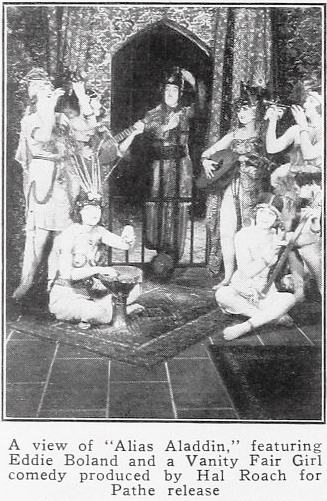
The first thing that hits you is the glare—an avalanche of diamonds, platinum, and rhinestones that Hal Roach’s cinematographer turns into a blizzard of starlight. Eddie Boland’s Eddie, a salaryman in celluloid collar, wanders through this glacier of opulence with the slump of a man whose marriage has calcified into Sunday roasts and antimacassars. Enter Dolores Johnson’s clerk: eyes like fresh ink, voice preserved only in intertitles that flutter like moth wings. She produces the lamp—tarnished, squat, unremarkable—yet the way she cradles its belly suggests she’s holding a grenade of myth. One swipe of Eddie’s palm and the jewelry store’s geometry liquefies; the Travelling Matte does its voodoo, frames stutter, and we’re suctioned into a cobalt dream where the nickelodeon becomes a diwan of flickering concupiscence.
Roach, ever the budgetary Houdini, shot the harem sequences on leftover sets from The Yellow Menace, repainted saffron and pink, then gilded them with cigarette smoke to mask the cardboard seams. The effect is delirious: a hothouse Orient stitched from paper-mâché and desire, a place where every archway frames a new fetish—nautch girls twirling veils like tethered moons, eunuchs whose waxed mustaches curl into question marks, and Caroline Rankin’s prima odalisque who lounges as though she’s been lacquered onto the set. The camera glides, ogles, retreats, then ogles again, adopting Eddie’s own rhythm of disbelief and appetite. You half-expect the film to combust from sheer voyeuristic static.
But the real sleight-of-hand is tonal. Roach refuses to play the harem as pure burlesque; instead he lets erotic danger seep in. When Eddie, drunk on rose petal wine, stumbles upon a dagger pressed against his throat, the moment lingers longer than comedy allows. The blade gleams with studio mercury, its reflection superimposing Eddie’s pupils—two black suns eclipsed by the recognition that fantasy exacts tariffs in flesh. This is 1920, mind you, when most slapstick still treated the subconscious like a whoopee cushion. Roach, sketching on a shoestring, anticipates the surreal menace of The Scarlet Road and the erotic catacombs later mined by Acquitted.
Eddie Boland, rubber-limbed and popeyed, was Roach’s utility everyman—neither Keaton’s stoic sphinx nor Lloyd’s go-getter, but a daydreamer whose libido arrives in polite knock-knock jokes. Watch how his gait changes post-lamp: spine erect, hips swiveling like a metronome, face cycling through arousal, terror, and slapstick befuddlement without ever settling. It’s a silent-era Rosetta Stone of male wish-fulfillment, the template later Xeroxed by Trouble Makers and even, in darker hues, by Virtuous Sinners.
The Vanity Fair Girls, credited as a collective odalisque chorus, move like synchronized mercury. Roach shoots them through gauze, turning skin into burnished parchment, then cuts to a tight close-up of anklets—those tiny bells jingling in asynchronous rhythm with the projector’s clatter. The eroticism is never nude; it’s all inference, the curve of a calf dissolving into shadow, the way a veil adheres to perspiration. Censors of the time, distracted by bathtub gin and Fitzgerald’s flappers, barely noticed the film’s stealth sophistication. Yet watch the scene where Eddie hides inside a giant urn while two courtesans disrobe behind screens: the silhouette play, the flicker of fabric, the strategic eclipse of nipples by tassels—it’s a striptease choreographed by suggestion, hotter than any Instagram thirst trap a century later.
Soundless cinema lives or dies on its musical marriage, and here Roach’s regular accompanist, Ernie Morrison Sr., allegedly improvised a ragtime-odyssey hybrid—clarinet lines slithering around oud arpeggios, snare drums mimicking hoofbeats across Anatolian steppes. Most prints screened today are mute, but even in that hush the editing sings. Notice the eyeline match when Eddie first glimpses the harem’s central fountain: a jet of water arcs upward, cut to a champagne bottle uncorked back in the jewelry store, bridging dream and reality in a splash of white foam. It’s a visual pun worthy of Lubitsch, delivered on a budget that wouldn’t cover the corsage bill in Bismarck.
Critics nostalgic for narrative cohesion will gripe that the film evaporates once Eddie wakes; the final ninety seconds reek of contractual obligation—wife, moral, exit cue. Yet that abrupt shrug is the point. The dream does not resolve; it simply ends, like a telegram from the unconscious that self-immolates upon reading. The lamp returns to shelf, price tag fluttering, and Eddie’s marriage resumes its monochrome trundle toward joint tax returns. The cruelty is exquisite: paradise tasted, then repoed. Compare this with the redemptive arc of Just a Song at Twilight, where illusion reconciles with reality, and you’ll see how Roach opts for the existential raspberry.
Restoration-wise, the lone surviving 35 mm nitrate was salvaged from a Montana barn in 1987, reeking of raccoon urine and sporting French intertitles that some scholar misattributed to a Pathé export. After a 4K photochemical romance at UCLA, the amber tinting re-emerged—those saffron skies over Istanbul now glow like hot ambers against cobalt shadows. The grain structure, left intact, crackles like a campfire, each fleck a pixel of history. Stream it on a 4-foot phone and you’ll miss the point; projected on even a bedsheet with a cheap LED, the imagery regains its original halo.
So why should a 12-minute trifle matter in an era of multiverse sagas? Because Alias Aladdin is a stealth manifesto on how desire is commodified, repackaged, and sold back to us as trinkets. The jewelry store isn’t merely a setting; it’s late-capitalism’s cathedral, every gem a compressed millennium of slave labor and marketing alchemy. The dream-harem is the ad campaign, promising transcendence in exchange for a rub—of lamp, of credit card, of touchscreen. Roach, hustling laughs in 1920, accidentally sketched the blueprint for every Instagram paradise influencer who flogs boutique tea cleanses against Maldives sunsets.
And there’s gender politics to untangle. The film’s women oscillate between frump and fantasy, with no middle register. Eddie’s unnamed wife—played by Ethel Broadhurst in a fat suit and scowl—embodies domestic dread, while the harem sirens incarnate unfettered lust. Yet watch Caroline Rankin’s lead odalisque: she controls the frame’s temperature, her languid blink commanding Eddie’s heartbeat. For a hot second the power dynamic inverts; the male gaze becomes a beggar at her gate. Then the alarm clock of narrative reasserts patriarchy, but that tremor of matriarchal authority lingers, a ghost in the celluloid.
Film students chasing Easter eggs should freeze-frame when Eddie first rubs the lamp: etched into the brass is a tiny inscription, “Made in South Bend.” It’s a gag, sure, but also a wink at the industrial Midwest mass-producing Oriental mystique. Another blink-and-miss-it: the ledger book on the jeweler’s counter lists yesterday’s customer as “Mr. A. Einstein”—a nod to relativity published five years prior, time being the film’s true antagonist.
In the Roach cosmology, Alias Aladdin nestles between the anarchic shorts of Harold Lloyd and the ethnographic spoofing of The Apaches of Paris. Its DNA reappears in the wish-fulfillment hi-jinks of To-Day and the masquerade delusions in The Remittance Man. Yet none of its descendants capture the same perfume of danger and cheap perfume, the sense that the dream might slit your throat once it’s finished kissing it.
Bottom line: seek it, screen it, let its 12 minutes detonate inside you. The lamp won’t grant three wishes, but it will remind you that cinema’s earliest magic was never the trick itself—it was the gasp between tricks, the instant where possibility hangs, shimmering, before the projector’s clatter drags you back to the jewelry store of adult obligation. Eddie Boland’s eyes, wide as pennies, still glint in the dark, asking the only question that matters: if you could rub your way out of your life, how hard would you scrub before you drew blood?
IMDb —
1932
Community
Log in to comment.