Summary
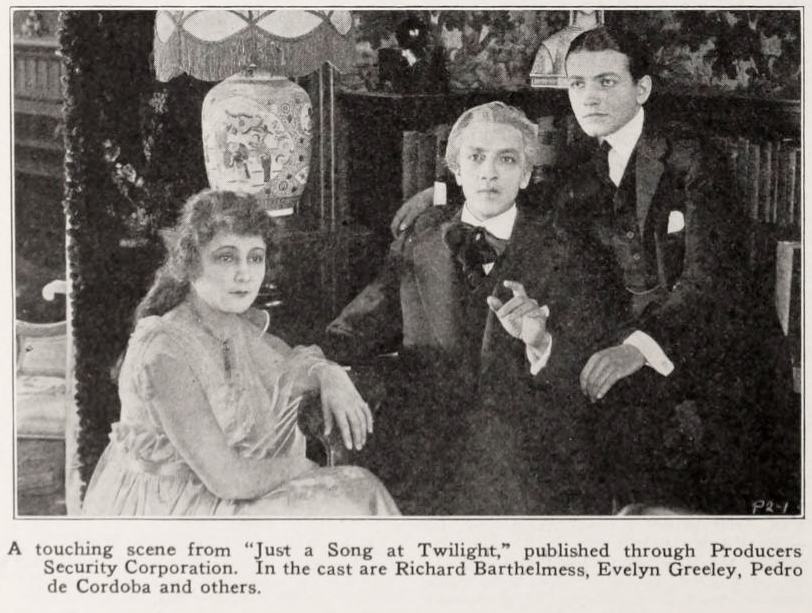
The narrative of "Just a Song at Twilight" unfurls with a delicate yet potent exploration of generational echoes and the relentless grip of past transgressions. We are initially introduced to Lucy Winter, a young woman ensnared by the gilded cage of her father's social ambitions, resigned to a prearranged marriage. Her world, however, is irrevocably altered by the arrival of George Turner, a mysterious gardener whose humble origins belie a deeper, more aristocratic lineage. George, driven by a filial quest to uncover the truth behind his long-presumed-dead father, carries an antique necklace—a family heirloom of striking, almost talismanic, beauty. This very artifact becomes the fulcrum upon which the present collides with a buried past.
Upon discovering the burgeoning affection between Lucy and George, and more critically, recognizing the distinctive necklace George bestows upon Lucy as a token of his devotion, Lucy's father, Stephen Winter, is plunged into a tormented reverie. This dream sequence, a harrowing journey through 18 years of his own life, reveals a chilling tapestry of ambition, betrayal, and profound moral decay. We witness Stephen Winter's ascent from a mere gardener at the opulent Turner mansion to a ruthless banking magnate. His early years are marked by a complex rivalry with Carlysle, the mansion's scion, both men vying for the affections of the ethereal Lucy Lee. Winter ultimately triumphs, eloping with Lucy, but their life together is a protracted struggle against penury. The antique necklace, initially a wedding gift from Carlysle to Lucy, becomes a pawn in their financial desperation, mortgaged back to Carlysle by Lucy, who conceals the truth from her husband.
Stephen Winter, a man of calculating cunning, feigns camaraderie with Carlysle even as he meticulously orchestrates his rival's downfall. Carlysle, meanwhile, consumed by unrequited love and the ravages of morphine addiction, spirals into despair. Winter's machinations culminate in the foreclosure of the Turner estate, Carlysle's wrongful conviction for murder, and Winter's own ascent to the pinnacle of financial power. The tragic coda of this dream-history sees Lucy Lee, heartbroken by Winter's true, despicable nature and finally acknowledging her profound love for Carlysle, succumbing to an untimely death.
Awakening from this purgatorial vision, Stephen Winter is haunted by the spectral call of "Lucy." It is at this precise moment that George Turner arrives, bearing letters that unequivocally expose Stephen Winter as the architect of his father's ruination. A confrontation looms, yet, in a moment of unexpected grace, George's vengeful fury is tempered by a profound pity for the now-vulnerable old man. Winter, stripped bare by his conscience, confesses his transgressions and pledges to secure Carlysle's exoneration. The film then moves towards a redemptive denouement, as George reunites with his father, Carlysle, at the Winter mansion, and Stephen Winter, seeking a measure of atonement, makes peace with his long-suffering victim. The cycle of vengeance is broken, paving the way for the burgeoning love between young Lucy and George, a love unburdened by the shadows of the past, symbolized by their shared promise, "I will." The narrative thus weaves a compelling tapestry of human failing and the enduring hope for reconciliation.
Synopsis
Lucy Winter, raised in the lap of luxury, has reluctantly accepted the suitor of her father's choice. George Turner, whose aunt has recently died, leaving him a necklace of peculiar antique beauty, has decided to search for his father, whom he has always believed dead. Passing a beautiful old Southern mansion that somehow seems strangely familiar, he sees a "Gardener Wanted" sign, applies for the position, and is accepted by the girl Lucy, with whom he falls in love, to the chagrin of her banker father, who orders him to leave after recognizing the necklace which the boy has given Lucy in lieu of an engagement ring. During a troubled sleep Father Time leads Winter's conscience to review his past. This extends over 18 years, during which Winter is installed as gardener at the Turner mansion and becomes the pal of his master, Carlysle. They love the same girl, Lucy Lee, who elopes with Winter. Their married life is one continued struggle. Previously Turner has given the antique necklace to Lucy as a wedding gift. This she later places in Carlysle's hands as security for one of the loans he made to her in their struggle against poverty. She led her husband to believe the money came from her mother, but he knew the truth, and accepted Carlysle's friendship, planning his ruin at the same time. Through the loss of Lucy's love, Turner passes many restless nights, eventually resorting to morphine, which finally masters him. Winter rises to the position of bank cashier, forecloses a mortgage on the Turner mansion, ousts Carlysle as bank president, and becomes president himself. Turner has been wrongly convicted of murder and sent to prison for life. Lucy, realizing the despicable character of Winter, and really in love with Carlysle, dies of a broken heart. Father Time leads Winter's conscience back into his body, and he wakes, calling "Lucy. Lucy!" George Turner arrives at the house and reads a number of letters, including one from his father, accusing Stephen Winter of being the cause of his troubles. He determines on revenge and hastens to the Winter mansion. Pity takes the place of anger at sight of Winter, and the old man tells George how it happened, giving his promise that he will secure his father's pardon. Soon George is able to bring his father from prison to the Winter Mansion. Winter tries to make amends to Carlysle, and the two leave the room arm-in-arm, and the young people give each other the previous promise, "I will."
Review Excerpt
"
Stepping into the world of "Just a Song at Twilight" is akin to unearthing a forgotten treasure, a cinematic relic from an era when storytelling relied on the eloquent gestures and poignant gazes of its performers. This 1918 silent drama, penned by the insightful Henry Albert Phillips, transcends mere melodrama, delving instead into the intricate tapestry of human ambition, the corrosive nature of betrayal, and the profound, redemptive power of forgiveness. It’s a narrative that, d..."