DbcultAccessing Vault...
Cult Review
Senior Film Conservator
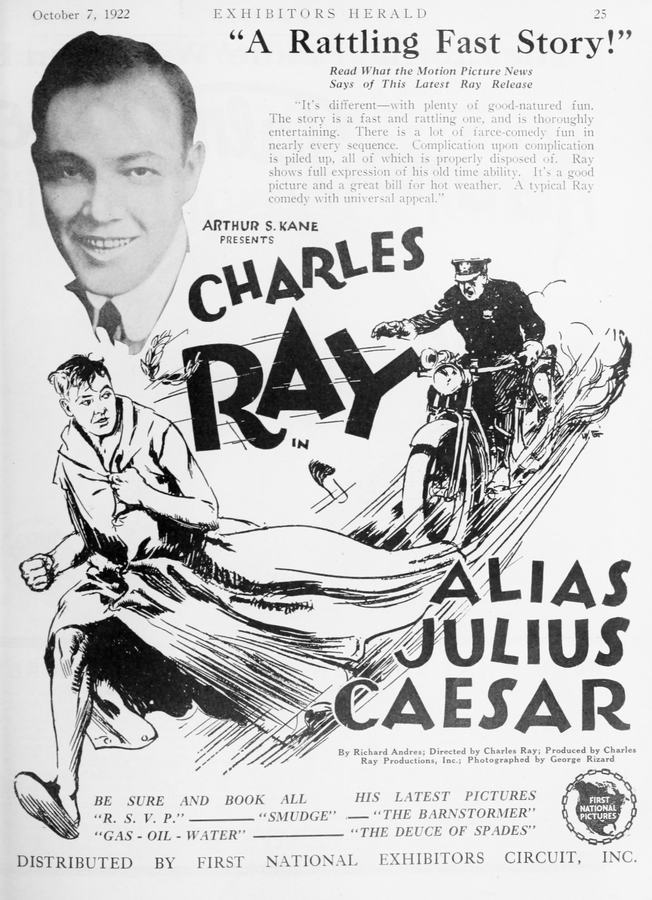
In the flicker of 1922 nitrate, Alias Julius Caesar arrives like a champagne saber—effervescent, dangerous, and aimed squarely at the gilded derrieres of the Jazz-Age elite. Director Edward Withers, armed with a scenario co-sculpted by Richard Andres, flips the Horatio Alger myth onto its starched collar: instead of bootstraps, we get a sand-wedge; instead of virtue rewarded, we see guilt repurposed as social currency.
Act I is a Rococo overture of manicured lawns and whalebone corsets. Charles Ray’s Billy Barnes traverses the fairway like Narcissus on a polo pony, convinced that money is a moral solvent. One pratfall later—an errant ball scalping a judge’s peruke—his world contracts from ballroom chandeliers to jailhouse tallow. The tonal whiplash is intentional; the film wants you to feel the seams of your own comfort rip.
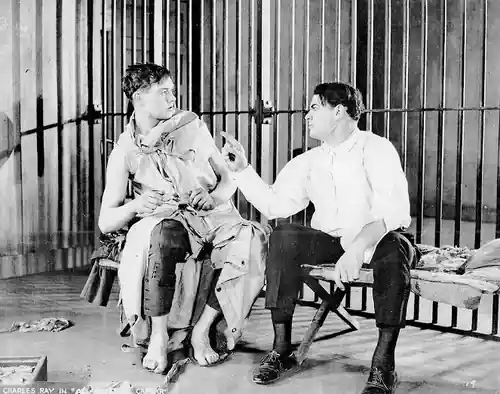
Inside the clink, the palette desaturates to chiaroscuro. Wallace Beery’s jewel thief, Slouchy O’Day (a moniker that smells of gin and sawdust), slinks into Billy’s cell with the predatory grace of a panther that’s read Balzac. Their meet-cute is a silent ballet: a cigarette passed lip-to-lip through barred moonlight, a wordless contract that crime and privilege are simply rival theater troupes trading masks.
Charles Ray, once the poster boy for corn-fed naïveté, weaponizes his own typecasting. Watch his pupils when the warden slams the gate: the iris dilates not with fear but with a dawning realization that identity is a tailor’s dummy—stuff it with cash or contraband, the silhouette remains. Opposite him, Beery is a molten slab of menace, all eyebrows and nicotine, turning exposition into intimations of hunger. Their duet culminates in a jailbreak staged like liturgical drama—shadows of lattice bars cruciform on wet stone.
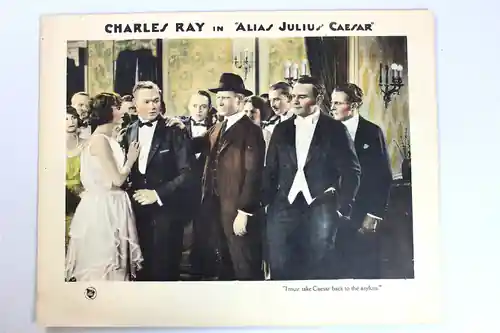
Barbara Bedford’s ingénue appears sparingly, but her close-ups are seismic. In one insert, she removes a glove at the trial; the camera lingers on the wrist tendon as though it were Hamlet’s Yorick skull—an intimation that femininity here is performance, skin merely the curtain.
Cinematographer Fred Miller shoots the country club in honeyed over-exposure— whites so bright they verge on the ultraviolet—then plunges us into penitential cobalt. The shift is more than symbolic; it’s ontological. When Billy finally re-emerges, wearing the jewel thief’s gift (a blood-red stickpin), the frame blooms into a bruised amber, suggesting that morality is not a spectrum but a wound still deciding what color to scab.
Intertitles, often the Achilles heel of silent storytelling, here crackle with epigrammatic venom. Example: "Wealth is a passport; guilt is the visa that never expires." The font mimics engraved banknotes, a sly typographic joke that keeps on giving.
Modern viewers conditioned to Dolby thunder may squint at the quiet, but that hush is fertile. Every cough from the orchestra pit, every clatter of the projector behind you becomes diegetic—your own personal Foley. The film weaponizes absence; when the final title card fades, the vacuum feels punitive, as if the screen itself were sentencing you to imagine the next reel.
Stacked against its 1922 contemporaries, Alias Julius Caesar makes The Blazing Trail look like a Boy Scout manual and renders Love Is Love almost pastoral. Where Sky High mythologizes the frontier, this film vandalizes the drawing room. Yet it shares DNA with The Adopted Son in its belief that family is a negotiable hallucination.
Only two 35mm prints survive: one at MoMA (shrunken, vinegar-syndrome freckles) and a dupe at EYE Filmmuseum. A 4K scan floated online briefly in 2021, scrubbed of most scratches but controversially interpolated to 24 fps, smoothing the stutter that gives silent comedy its caffeinated frisson. Purists should hunt the MoMA 16fps touring print; your retinas will thank you, even if your sacroiliac protests the three-hour runtime with live organ.
Because we still live in an epoch where a single tweet can unseat dynasties, Alias Julius Caesar feels like a prophecy disguised as a prank. It whispers that the line between boardroom and cellblock is drawn in erasable ink, and that redemption may just be another confidence trick—albeit one performed with such brio you’ll applaud even as your wallet walks out the door.
Verdict: A tarnished tiara of a film—worth every lost follicle of the magistrate’s toupee.
IMDb —
1926
Community
Log in to comment.